
Mixing up scope and detail level leads to real problems: miscommunication between shifts, training gaps for new hires, and quality or compliance failures that show up during an audit — or worse, during a customer complaint. ISO 9001 requires documented information that supports process operation and gives confidence that processes are carried out as planned, but it doesn't mandate specific document labels. That means the SOP-versus-work-instruction distinction is something manufacturers have to get right on their own.
Documentation alone doesn't settle it. An SOP describes the process and a work instruction details the task, but neither one enforces what actually happens at the machine. That gap between the documented process and the executed one is where most variation lives, and it only closes when instructions are tied to the machine, the operator and the ERP job context in real time. This article breaks down the definitions, the key differences, where each document type fits, and how connecting those layers closes the gap between what is written and what is done.
Key Takeaways
- SOPs describe an entire process (the "what" and "why"); work instructions detail one task (the "how")
- Compliance and cross-departmental consistency sit with SOPs; hands-on execution sits with work instructions
- One SOP usually anchors several work instructions in the documentation hierarchy
- Choosing the right document — or combining both — cuts errors and speeds up onboarding
- Digital platforms replace static documents with trackable, real-time instruction delivery on the floor
SOP vs Work Instruction: Quick Comparison
Here's the fastest way to tell them apart:
| Dimension | SOP | Work Instruction |
|---|---|---|
| Scope | Entire process or workflow end-to-end | One specific task within that process |
| Detail level | High-level, general guidance | Step-by-step, including tools, settings, and techniques |
| Audience | Managers, supervisors, auditors, cross-functional teams | Frontline operators and technicians |
| Format | Formal document: purpose, scope, responsibilities, procedure | Checklists, diagrams, photos, short videos |
| Approval | Cross-functional review, management sign-off, changes rarely | Supervisor or technical expert sign-off, updated often |
An SOP tells you what to do in a given situation. A work instruction tells you how to physically do it, down to the torque spec or the inspection tolerance.

What is an SOP?
An SOP is a formal, high-level document outlining the steps and responsibilities needed to complete an entire process consistently. Think quality control, safety protocols, or employee onboarding — not a single machine setup.
SOPs matter because they support regulatory frameworks like ISO 9001, OSHA, and AS9100 for aerospace, and they reduce variability across shifts and locations.
OSHA's lockout/tagout standard is a clear example: employers must establish a written energy-control procedure covering purpose, shutdown steps, and verification methods, and it must be inspected at least annually. That's SOP-level governance.
Core benefits:
- Improved accountability across teams and shifts
- Easier, faster audits with a documented trail
- Preserved institutional knowledge when experienced employees retire or leave
Common SOP formats include:
- Checklists
- Hierarchical (numbered step) SOPs
- Flowchart SOPs
- Hybrid formats combining text and visuals

Use Cases of SOPs
SOPs carry the most weight in regulated manufacturing. Aerospace and defense quality systems rely on them heavily. AS9100D builds directly on ISO 9001:2015 with added aviation, space, and defense requirements. Automotive suppliers face similar governance under IATF 16949.
In these environments, the SOP defines process ownership, change control, and escalation paths. The work instruction below it handles the actual machine operation.
What is a Work Instruction?
A work instruction is a detailed, task-specific guide describing exactly how to perform one step within a broader process. ASQ's glossary uses the related term "job instruction," which explicitly covers setup, inspection, rework, and operator work.
In manufacturing, work instructions standardize:
- Machine setup and part loading
- Inspection steps and acceptance criteria
- Safety procedures at the individual workstation
The operational payoff is fewer scrap parts, faster ramp-up for new operators, and consistent execution regardless of who's running the machine. A one-page work instruction can be more detailed than a ten-page SOP when it specifies the exact tool, sequence, measurement, and tolerance.
Common variations:
- Text-based instructions
- Visual/diagram-based guides
- Video-based walkthroughs
- Digital interactive work instructions
Use Cases of Work Instructions
Work instructions dominate wherever task-level precision matters: CNC setup sheets, assembly line steps, first-article inspection procedures. Precision CNC machining and medical device assembly both depend on them heavily, since a single missed step can scrap a part or fail an inspection.
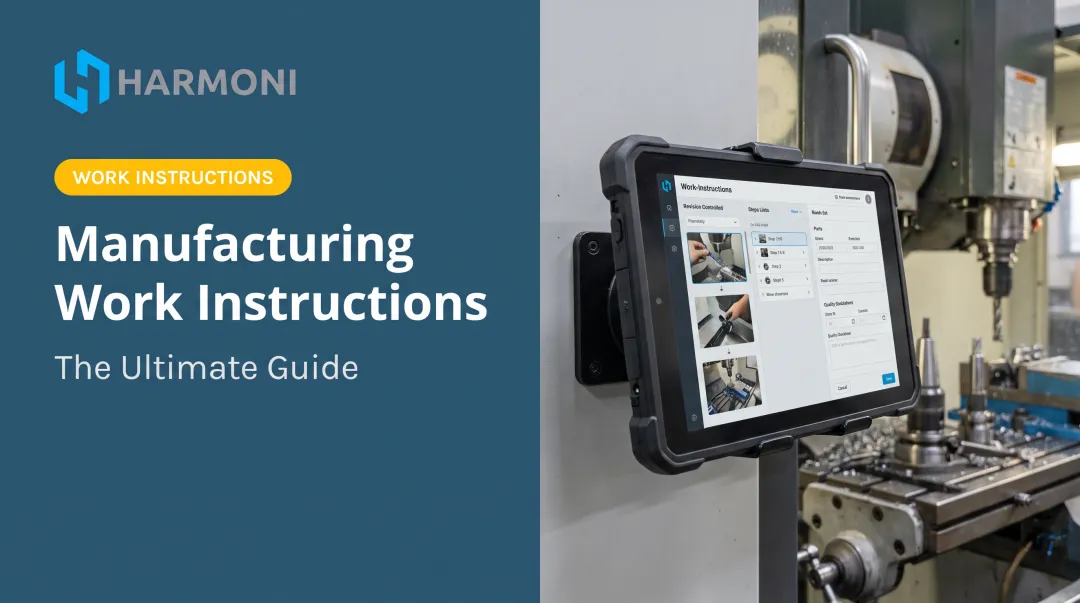
That level of precision is hard to sustain on paper alone. Harmoni's work instruction editor builds step-by-step guides with annotated images and video for machine operators.
It then pulls the correct instructions, setup sheets, and engineering drawings from the RFID-detected job and part revision. Operators stop hunting for the right paper on a clipboard. The correct version shows up at the machine automatically.

Choosing the Right Document (and Making Both Work Together)
Weigh these factors when deciding which document type fits:
- Process complexity — broad, multi-department processes need an SOP
- Regulatory requirements — AS9100, ISO 13485, or IATF audits often expect both layers
- Task specificity — anything happening at a single workstation needs a work instruction
- Change frequency — equipment and tooling changes call for easily updated work instructions, not a full SOP rewrite
Situational rule of thumb: use SOPs for company-wide policy and compliance needs. Use work instructions when training an operator on a specific machine or task.
On real shop floors, these two documents have to stay aligned. A mismatch, such as an SOP that still references an outdated inspection method while the work instruction reflects the current one, causes confusion and inconsistent execution across shifts.
Harmoni's change management system closes that gap. It delivers only approved, up-to-date work instructions, machine programs, and checklists to each workcenter, cutting off a common source of scrap and rework.

The Shift Toward Digital Execution
Static SOPs and work instructions sitting in a binder or shared drive don't track compliance. Manufacturers are moving toward connected systems that deliver the right instruction to the right operator in real time and log whether it was actually followed. LNS Research's 2025 benchmark of 300+ manufacturers confirmed significant adoption of connected-frontline applications that go beyond digitizing paper. These systems deliver dynamic, role-specific instructions that adapt to the operator and the job.
Harmoni's factory orchestration platform combines machine data, ERP workflows, and RFID-detected operator activity. Mid-to-large manufacturers in CNC machining, aerospace, defense, and precision manufacturing can confirm SOPs and work instructions are followed at each workcenter rather than left in a filing system.
Digital work instructions in Harmoni also map directly to ISO 9001, AS9100, and CMMC documentation requirements, so compliance evidence is generated automatically instead of assembled before an audit.
Want to see how orchestrating instructions and machine data in real time tightens execution consistency on your floor? Book a demo and see it against your own equipment.
Conclusion
SOPs and work instructions aren't competing documents. They're complementary layers: one sets the framework, the other guides the hands. The right choice depends on whether your team needs process-level context or task-level precision, and in most shops, you need both, properly linked.
Get this right and the payoff shows up in real numbers:
- Fewer errors
- Faster onboarding
- Stronger audit readiness
- Better labor visibility
WessDel, a Harmoni customer, gained 17 productive hours per employee through improved workflow execution. Operators had the correct instruction in front of them every time, without hunting for it.
When SOPs and work instructions are properly implemented and digitized, consistency stops depending on tribal knowledge and starts showing up on the floor every shift.
Frequently Asked Questions
What are standard operating procedures and work instructions?
SOPs are formal documents describing an entire process from start to finish, including responsibilities and controls. Work instructions are detailed, task-level guides showing exactly how to perform one step within that process.
What is the difference between an SOP and a work instruction?
SOPs cover a broad scope at a high level and are aimed at managers and auditors. Work instructions cover a single task with granular, step-by-step detail aimed at operators performing the work.
What is the difference between procedures and work instructions?
A procedure describes a broader, multi-step process and the responsibilities behind it. A work instruction zeroes in on one specific task within that process, detailing exact steps and settings.
What are the three types of SOP?
The three common SOP formats are checklist SOPs, hierarchical (numbered-step) SOPs, and flowchart SOPs. Many organizations also use hybrid formats combining these styles.
What is the difference between an SOP and a job aid?
A job aid, like a work instruction, is a quick task-level reference used at the point of work. An SOP is a formal, broader process document covering scope, responsibilities, and controls.
What are the key differences between standard work and SOPs?
Standard work, a lean manufacturing concept, defines optimized task sequences tied to takt time and cycle time at a specific workstation. SOPs are broader policy and process documents that don't focus on cycle-time optimization.