
This scenario plays out regularly in manufacturing because quality gets checked too late — after production, not during it. Shop floor quality control exists to close that gap.
This guide covers what shop floor quality control is, the types and phases involved, the key components of an effective system, common challenges, and how technology is changing the way manufacturers manage quality at the point of production.
Key Takeaways
- Shop floor QC monitors and manages quality directly during production — not after.
- Poor quality costs manufacturers a median of $28.50 per $1,000 in revenue, per APQC data.
- Effective QC spans four types: incoming inspection, in-process monitoring, final inspection, and error-proofing.
- Real-time data lets you catch a quality trend before it becomes a scrapped batch.
- Platforms like Harmoni tie quality data, machine performance, and ERP workflows into one connected system — so nothing falls through the cracks.
What Is Shop Floor Quality Control?
Shop floor quality control is the systematic process of monitoring, measuring, and managing product quality directly on the manufacturing floor. It encompasses inspections of incoming raw materials, checks at critical production stages, and final verification before shipment.
Shop floor QC differs from quality assurance in a practical way: QC is operational and real-time, detecting defects as they form. QA is a broader, process-level discipline focused on preventing defects through system design. Shop floor QC focuses specifically on the manufacturing moment — what's happening at the machine, right now.
Why It Matters Financially
The business stakes are concrete. APQC's Open Standards benchmarking data — drawn from 1,097 cross-industry respondents — puts the median cost of poor quality at $28.50 per $1,000 of revenue. For a $50 million manufacturer, that's $1.4 million per year in avoidable losses.
ASQ's cost of quality framework distinguishes between internal failure costs (scrap and rework caught before delivery) and external failure costs (warranty claims, returns, and customer complaints after delivery). External failures are consistently more expensive — in money, time, and customer trust.
Business Outcomes Beyond Defect Reduction
Effective shop floor quality control drives results well beyond the quality department:
- Customer satisfaction — fewer escapes mean fewer complaints and stronger retention
- Regulatory compliance — documented inspection records support ISO 9001, AS9100, IATF 16949, and ISO 13485 audits
- Reduced production costs — catching defects earlier costs far less than rework or scrap after the fact
- Accurate job costing — knowing where quality failures occur helps manufacturers cost jobs correctly and protect margins

Types of Shop Floor Quality Control
Incoming Material Inspection
Quality control starts at the receiving dock. Before raw materials or purchased components enter production, they're verified against specifications — using checklists, measurement tools, and material testing.
Catching non-conformances here is the least expensive option. A rejected casting at receiving costs minutes to sort. That same casting, machined to near-completion before the flaw surfaces, costs hours of labor and machine time.
In-Process Quality Control
In-process QC embeds checks at critical stages throughout the production line. The most structured approach uses statistical process control (SPC) — control charts and process capability analysis that detect variation trends before they produce defects.
ASQ defines SPC as the application of statistical techniques to control a process or production method. Control charts display process performance over time with upper and lower control limits, distinguishing common-cause variation (expected) from special-cause variation (a signal to act).
In-process QC includes both operator self-checks — where the person running the job takes measurements and logs results — and automated sensor monitoring tied directly to machine outputs.
Final Product Inspection
Finished goods are evaluated against full specification requirements before packaging and shipment. Two approaches are common depending on volume and precision requirements:
- High-volume production: Acceptance sampling plans such as ANSI/ASQ Z1.4 (attributes) or ANSI/ASQ Z1.9 (variables)
- Precision machining and aerospace: Dimensional and functional testing of individual parts
Final inspection is a necessary checkpoint, but it's the most expensive place to find a defect. A problem discovered here means production already happened — the goal is to catch trends much earlier.
Error-Proofing (Poka-Yoke)
ASQ defines poka-yoke as devices or methods that make an error impossible or immediately evident. Prevention, not detection — that's the core distinction.
Common poka-yoke implementations include:
- Physical fixtures that only accept correctly oriented parts
- Automated alerts when process parameters fall outside acceptable ranges
- Digital workflow controls that prevent operators from advancing a job without completing required quality steps — a capability that factory orchestration platforms like Harmoni enforce directly at the machine side
Phases of Shop Floor Quality Control
Shop floor quality control runs in three distinct phases:
Phase 1 — Planning and Setup
Before production begins, quality standards are defined, control plans are created, inspection frequencies are set, and roles are assigned. This phase determines what "good" looks like — and how deviations will be identified and escalated. Without this planning, in-process monitoring has no baseline to work from.
Phase 2 — Active Monitoring and Data Collection
This is where quality control happens in real time. Measurements are taken, inspections are performed, and data is recorded at the workcenter.
The shift from paper-based documentation to digitized measurement entry expands what's possible: SPC charts populate automatically, trends become visible immediately, and supervisors can monitor quality conditions without waiting for end-of-shift reports.
Phase 3 — Corrective Action and Continuous Improvement
Quality data gets analyzed to identify root causes of non-conformances. Corrective actions are implemented (containment, rework, or process changes), and findings feed a continuous improvement loop through defect trend analysis, updated SOPs, and periodic audits. Shops that execute this phase consistently move from reacting to quality failures to catching process drift before it produces scrap.

Key Components of an Effective Shop Floor Quality Control System
SOPs and Control Plans
Every quality control activity needs documented, standardized procedures — inspection criteria, frequencies, tools, acceptable tolerances, and escalation paths. SOPs also serve as audit evidence for customers and regulatory bodies. Without them, inspection outcomes depend entirely on individual judgment.
Employee Training and Accountability
Operators must be trained not just in how to inspect, but in what to do when something looks wrong. Stop-Call-Wait behavior is the practical expression of quality ownership at the machine level:
- Stop production when something looks wrong
- Call for support before proceeding
- Wait for disposition before resuming
Quality sustained over time comes from operators who understand their role in it, not from a quality department checking work after the fact.
Quality Control Tools and Techniques
Core analytical tools used on the shop floor:
- Control charts (SPC) — monitor process stability and flag special-cause variation
- Fishbone/Ishikawa diagrams — organize potential causes of a problem into categories for root cause analysis
- Pareto charts — rank defect types by frequency or cost to prioritize improvement efforts
- 5 Whys — repeated questioning that moves through symptoms toward the actual root cause
Traceability and Documentation
Complete part genealogy, covering which materials, machines, operators, and process settings were used, is essential for non-conformance investigations, containment decisions, and regulatory compliance.
Specific requirements vary by industry: defense manufacturers must meet DFARS counterfeit part tracking requirements under 252.246-7007, while medical device manufacturers must comply with FDA's 21 CFR Part 820 and UDI requirements effective February 2026.
Non-Conforming Material Management
When defective or suspect parts are identified, shops need a documented process covering:
- Segregating non-conforming material from conforming stock
- Visually marking it to prevent accidental use
- Dispositioning it: rework, scrap, or use-as-is with authorization
Without this process, non-conforming parts can advance in production or reach customers. The workflow needs to be documented, role-assigned, and connected to the broader quality system.

Common Challenges in Shop Floor Quality Control
Human Error and Shift-to-Shift Inconsistency
Inspection results vary when operators interpret criteria differently, apply different levels of scrutiny, or work from memory rather than documented standards. A 2015 Sandia National Laboratories study of 82 qualified inspectors evaluating precision nuclear-weapons components found an 85% defect hit rate with a 35% false-alarm rate — and item-specific detection rates ranging from 1% to 93%.
That spread isn't an outlier. Even trained, qualified inspectors produce variable results when the process depends on individual judgment.
Clear SOPs, visual work instructions, and embedded quality checks in standardized work reduce this variability by reducing reliance on individual judgment.
Reactive Quality Management
The most widespread quality problem in manufacturing isn't a specific defect — it's the timing. Defects found after production is complete mean entire batches require sorting, rework, or scrapping. The goal is to identify problems while they're happening, not after the damage is done.
Real-time in-process quality control — SPC trends, digitized measurement entry, and out-of-tolerance alerts — is what makes the shift from reactive to proactive possible.
Integrating Quality Data with Production Systems
Quality data collected on paper or in isolated systems can't easily connect with ERP or MES platforms. When that connection is missing, production managers don't get the full picture:
- Job costing becomes inaccurate without complete production data
- Corrective actions slow down because problems aren't surfaced in time
- Compliance reporting requires manual effort to reconstruct what happened
Integration gaps also mean quality problems are visible only in the quality department — not on the production dashboards where supervisors are making decisions in real time.
How Technology Improves Shop Floor Quality Control
Digital quality systems move inspection from paper-based, after-the-fact recording to real-time, operator-level data capture. Instead of reviewing a completed log at end of shift, supervisors can see quality trends develop as production runs — and intervene before a trend becomes a scrap event.
What Modern Platforms Enable
- Bluetooth-enabled measurement tools that populate inspection records automatically at the workcenter, eliminating manual transcription
- Unified quality dashboards combining machine data, operator activity, and ERP workflows, accessible from any device
- Out-of-tolerance alerts that reach supervisors before a trend generates scrap
- Engineering revision control that keeps operators on the correct, current revision of drawings and work instructions at all times

Factory Orchestration Platforms
Factory orchestration platforms like Harmoni sit between ERP systems, shop floor operations, machines, and operators to coordinate quality requirements in real time, not record what happened after the fact.
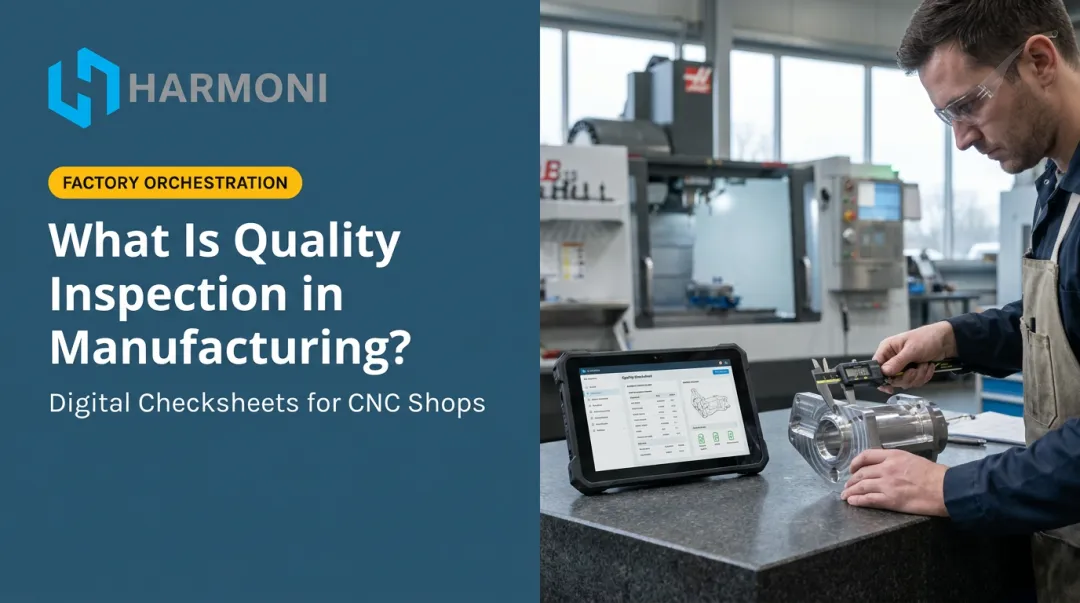
Harmoni's platform surfaces digital quality checksheets directly at the workcenter. When operators complete inspection entries, that data is captured in real time and tied to the specific job, part, and CNC program in progress via long-range RFID — linking the operator, machine, and revision without manual input. Supervisors receive exception alerts when quality conditions change and can contact the work cell directly without walking the floor.
For defense and ITAR-regulated manufacturers, Harmoni's Government Cloud deployment adds machine-level multi-factor authentication, including facial recognition and RFID credential verification. The result is an auditable, timestamped record of who accessed which program, on which machine, and when.
This directly supports the documentation requirements of AS9100, DFARS counterfeit part controls, and CUI-handling environments.
The traceability benefit compounds across the operation: when every quality checkpoint is logged automatically and tied to operator identity, machine state, and job data, audit preparation becomes a reporting task rather than a reconstruction effort.
Frequently Asked Questions
How do you improve shop floor quality control?
Embed quality checks into standardized work so inspection happens during production, not after. Train operators to own quality at the point of production and act on deviations immediately. Use real-time data to catch trends early, and implement corrective action processes that address root causes rather than just containing symptoms.
What are the phases of shop floor quality control?
There are three main phases:
- Quality planning and setup — defining standards and control plans before production begins
- Active monitoring and data collection — in-process inspections, measurement entry, and SPC
- Corrective action and continuous improvement — root cause analysis, process updates, and audit-driven refinement
What are the types of shop floor quality control?
The four main types are:
- Incoming material inspection — verifying materials and components before they enter production
- In-process quality control — operator self-checks and SPC during active machining or assembly
- Final product inspection — sampling plans or full dimensional verification before shipment
- Error-proofing (poka-yoke) — design or process changes that prevent defects from occurring at all
What is a shop floor control system?
A shop floor control system is software or a platform that monitors, tracks, and manages production activities — including quality checkpoints, job status, machine performance, and operator activity — in real time, ensuring operations meet quality and schedule requirements at once.
What is the difference between quality control and quality assurance on the shop floor?
Quality control involves hands-on inspection and testing to detect defects in products being made. Quality assurance focuses on the processes and systems designed to prevent defects from occurring. Both are necessary — QC catches what escapes, QA reduces how much escapes in the first place.
How does real-time data improve shop floor quality control?
Real-time data lets supervisors and operators see quality trends as they develop — not hours later. That visibility enables immediate corrective action before defective parts accumulate, reducing scrap, rework costs, and the risk of shipping non-conforming product to customers.