
Introduction
Most manufacturers know their machines are generating data. The problem is they're finding out what that data says hours too late — through an end-of-shift report, a batch of scrapped parts, or an unplanned stop that has already cost a full production run.
That gap between when a machine performance issue begins and when someone detects it is where downtime accumulates and schedules unravel. According to Siemens' 2024 True Cost of Downtime report, one hour of downtime at a large automotive plant costs $2.3 million. Even at smaller scale, the math is painful.
Real-time machine performance monitoring closes that gap. Instead of learning what happened after the shift ends, you see what's happening while you can still change it.
This guide covers what real-time machine performance actually means, which metrics drive the most value, how it applies across CNC, aerospace, defense, and automotive environments — and what it takes to act on that data before the damage is done.
Key Takeaways
- Real-time machine performance means capturing and analyzing machine data as production occurs, not after the shift ends
- The highest-value metrics are OEE, machine utilization, cycle time vs. standard, MTTR, and spindle uptime for CNC environments
- Real-time monitoring shifts teams from reactive problem-solving to proactive intervention
- Applications span CNC machining, aerospace, defense, and automotive — each with distinct visibility and compliance demands
- Data creates value only when it reaches operators and connects to ERP workflows, not when it sits on an unmonitored dashboard
What Is Real-Time Machine Performance?
Real-time machine performance refers to the continuous capture, transmission, and analysis of data from production equipment — machine status, cycle times, output rates, error codes, and environmental signals — with low enough latency that decisions can be made while conditions can still be changed.
The distinction from historical reporting matters. End-of-shift summaries and manual logs tell you what already happened. Real-time monitoring tells you what is happening now, enabling intervention rather than retrospective analysis.
Three Ways Machine Data Gets Collected
No single data collection method captures the full picture:
- Direct CNC/controller integration — pulls native machine signals such as spindle load, feed rate, and alarm codes directly from the controller (Fanuc FOCAS, Haas NGC, Mazatrol, Siemens Sinumerik, Heidenhain, and others)
- External sensor retrofits — adds connectivity to legacy equipment that cannot connect natively, without requiring machine replacement
- Operator-entered data — captures contextual information like job setup reason codes, quality observations, and downtime classifications that machine signals alone cannot explain

Each layer fills a gap the others miss. Machine data alone tells you that a machine underperformed. Operator context tells you why — whether it was waiting for material, running a difficult setup, or dealing with a quality hold.
How Real-Time Machine Data Flows
The data journey has four steps: a machine or sensor generates a signal → an edge device or controller transmits it → the monitoring platform applies logic → dashboards display the result and trigger alerts if thresholds are breached. The entire sequence completes in seconds.
Integration with ERP systems is what transforms raw signals into operational context. Without knowing which work order is running, who the operator is, and what the target cycle time is, machine data lacks the context needed to act on it. Platforms like Harmoni address this by connecting machine data, operator activity, and ERP workflows into a single view — so the signal and its business context arrive together.
Key Metrics to Track for Real-Time Machine Performance
OEE: The Foundational Composite Metric
Overall Equipment Effectiveness (OEE), as defined by the Lean Enterprise Institute, is the product of three rates:
- Availability — planned production time not lost to breakdowns or unplanned stops
- Performance — actual output rate versus theoretical maximum speed
- Quality — conforming parts as a share of total parts produced
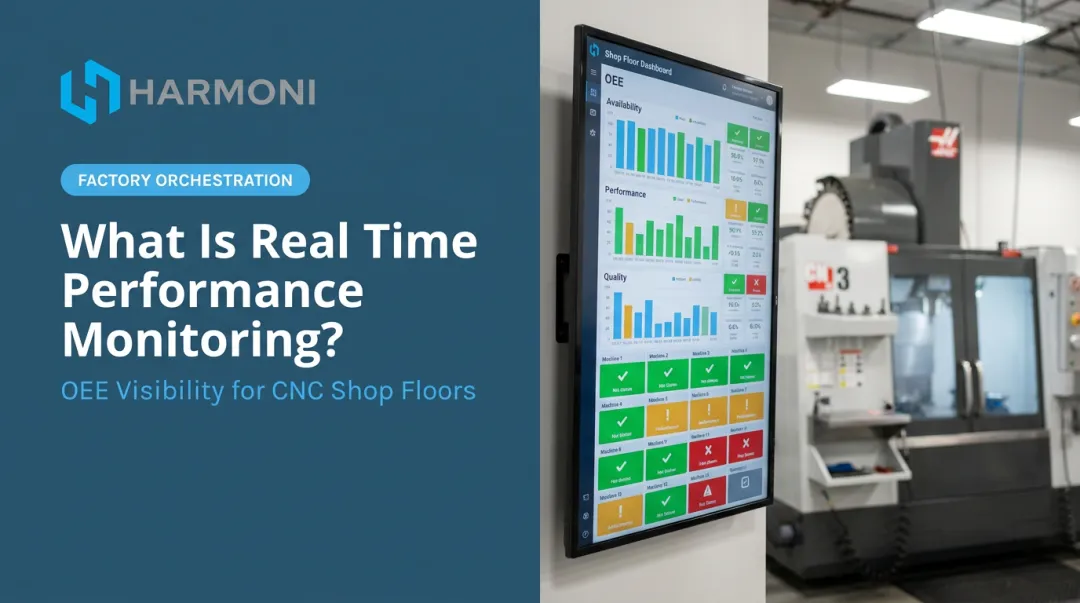
Tracking OEE in real time — rather than calculating it nightly — lets teams see which of the three components is degrading mid-shift. A performance rate dropping through the afternoon often signals tooling wear or a feed/speed issue that can be corrected before the shift's output is compromised.

Machine Utilization and Availability
Machine utilization measures the percentage of scheduled time a machine is actively cutting versus sitting idle. Real-time tracking surfaces micro-stoppages under five minutes — the kind manual logs consistently miss. A four-minute stoppage looks trivial in isolation. Accumulated across a shift and across multiple machines, those micro-stops represent meaningful lost capacity.
Availability measures the share of planned production time not lost to breakdowns. Monitoring it continuously lets maintenance teams spot declining trends before a full failure occurs, acting on a warning signal rather than responding to a crisis.
Cycle Time vs. Standard
Comparing each part's actual cycle time against the engineered standard in real time identifies when a process is drifting. Common causes include:
- Tooling wear
- Incorrect feeds and speeds
- Material variation
Each shows up as a cycle time deviation before it drives scrap or schedule slippage. The earlier the deviation is caught, the less it costs to correct.
Harmoni uses ERP-sourced cycle time estimates as the performance baseline — meaning a 100% performance score indicates the job ran exactly as quoted. That business-grounded benchmark makes mid-shift process changes immediately measurable.
MTTR, MTTF, and Response Speed
- MTTR (Mean Time to Repair) — average time to restore a machine after failure; real-time alerts with failure codes and machine state at time of stop cut diagnostic time
- MTTF (Mean Time to Failure) — average operating time before failure; trend monitoring of vibration, temperature, and spindle load flags impending failures early
Both metrics improve with faster, more specific information — not bigger maintenance crews.
Spindle Uptime and CNC-Specific Signals
For CNC machining environments, spindle uptime is the precision equivalent of availability. A spindle that is powered on but not cutting represents capacity being wasted. Monitoring spindle-on time, feed-hold frequency, and alarm code patterns gives shop managers a granular view of true productive machine time versus time lost to setup, inspection, or waiting.
Harmoni collects spindle time natively from Fanuc (0i, 30i, 31i, 32i via FOCAS), Haas NGC, Mazak, Siemens Sinumerik, Heidenhain, DMG MORI, Makino, and Fadal — automatically pairing it with operator labor records for job costing and performance analysis.

Benefits of Real-Time Machine Performance Monitoring
Reduction in unplanned downtime. Real-time alerts on abnormal machine conditions — elevated temperature, unusual load patterns, repeated feed holds — allow maintenance intervention before a failure forces an unplanned stop. With automotive downtime costing up to $2.3 million per hour, the financial case for early intervention is clear even when the stop only affects a supplier-level operation.
Improved throughput and schedule adherence. Real-time cycle time and utilization visibility lets production supervisors identify bottlenecks as they form. They can reallocate labor or adjust sequencing in the moment — before a slowdown at one machine cascades into a missed delivery commitment.
Scrap and quality loss prevention. Process drift — tooling wear, material variation, thermal effects on tight tolerances — often begins as a subtle cycle time deviation or load increase long before a part goes out of spec. Research on CNC turning of hardened bearing steel confirms that progressive flank wear measurably increases cutting force, power consumption, and vibration.
Catching these signals early and triggering process correction before nonconforming parts are produced is especially critical in aerospace, defense, and medical manufacturing — where scrap costs are high and traceability demands are strict.
Accurate job costing and accountability. Real-time machine data linked to specific work orders and operators produces a factual record of actual machine time consumed per job. This replaces estimated or memory-based job costing with data reflecting what actually happened — surfacing which jobs consistently run over standard and closing the gap between quoted and actual costs.
Foundation for continuous improvement. Real-time data shortens the gap between a process change and proof it worked. CI teams at facilities using Harmoni have implemented changes and measured the effect on OEE, cycle time, or utilization within the same shift — no waiting for a weekly summary to confirm results.
One customer reduced scrap by 22% in two months; another gained 17 productive hours per employee per month, largely by eliminating the manual data entry that was obscuring where time was actually going.
Industry Applications of Real-Time Machine Performance
CNC Machining and Precision Manufacturing
CNC and precision machining environments deal with a specific challenge: operators often run two, three, or four machines simultaneously. Without real-time visibility, checking on each machine requires physical inspection — which means problems go undetected until the operator's next pass.
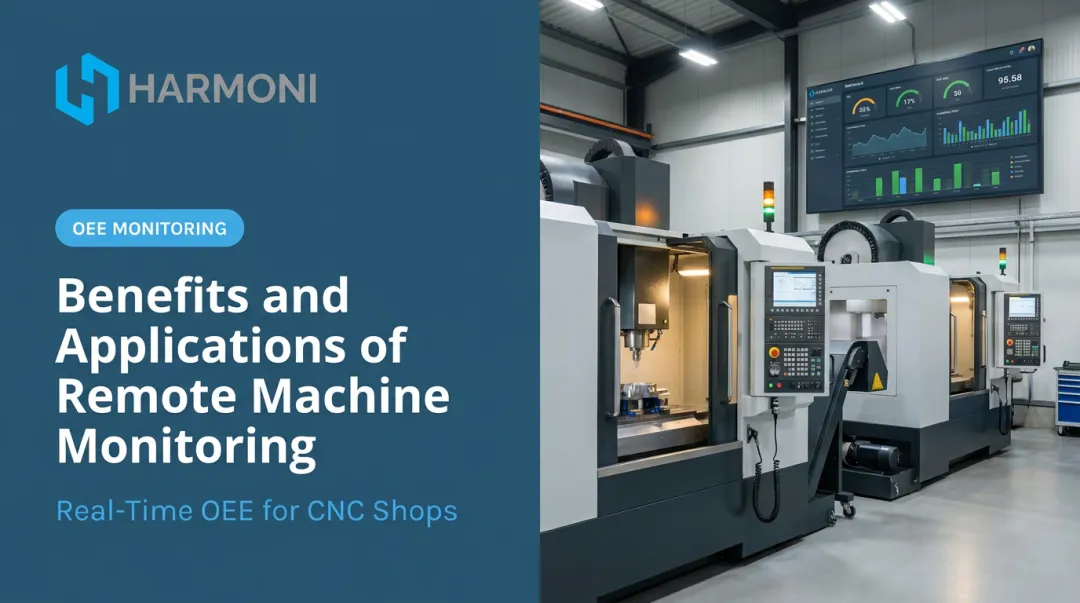
Real-time alerts change that dynamic. When a machine enters a feed hold, completes a cycle unexpectedly early, or triggers an alarm, the operator receives a signal pointing them to the specific machine that needs attention. Harmoni's Visual Factory andon indicators and workcenter displays surface this information at the machine level, so operators don't have to guess where to look next.
The capacity gains can be substantial. In one documented case from Modern Machine Shop, real-time machine monitoring boosted five-axis utilization by 46% for a DMG MORI five-axis machine — purely by making idle time visible and actionable.
Aerospace, Defense, and Automotive
Aerospace and defense manufacturers use real-time machine performance data for two distinct purposes: regulatory traceability and nonconformance prevention.
Traceability requirements in these sectors demand documentation of which machine ran which part under what conditions. Real-time platforms that capture machine state, cycle data, and operator activity create that record automatically — rather than relying on paper travelers that may be incomplete or completed after the fact.
The consequences of quality failures in these environments are severe:
- NASA OIG linked welding quality issues on the Space Launch System Exploration Upper Stage to a seven-month delay and $200 million in cost overruns
- The F-35 program requested more than $283 million in 2025 to correct defects tied to manufacturing nonconformances

For defense contractors handling Controlled Unclassified Information (CUI), Harmoni offers a dedicated Government Cloud deployment at portal.us.harmoni.io, built for facilities with ITAR and CMMC alignment requirements.
Automotive manufacturers apply real-time monitoring to maintain takt time discipline across high-volume lines. A single machine running slow starves downstream assembly and disrupts delivery commitments to OEM customers. Real-time cycle time monitoring makes takt deviations visible the moment they begin, not when the line supervisor notices the assembly queue has dried up.
How to Implement and Act on Real-Time Machine Performance Data
Start with Connectivity and Integration
Implementation begins by identifying which machines can connect natively through their controllers and which require sensor-based retrofits. The goal is complete shop floor visibility without machine replacement. Harmoni connects across mixed environments — Fanuc, Haas, Mazak, Siemens, Heidenhain, DMG MORI, Makino, and Fadal — and layers machine data with ERP and operator context from deployment day one. Built-in drivers eliminate the infrastructure complexity that typically extends enterprise software rollouts to months; Harmoni deploys in weeks.
Define the Metrics and Alerts That Drive Action
More data is not automatically more useful. Effective implementation requires deciding upfront which metrics are the leading indicators of the problems most costly to your operation:
- A CNC shop focused on capacity should prioritize spindle utilization
- A shop with tight tolerances should prioritize cycle time variance
- An aerospace supplier should prioritize availability and quality rate
Configure alerts and dashboards around those priorities. Operators and supervisors should receive actionable signals — not raw data noise that leads to alert fatigue and ignored dashboards.
Connect Machine Data to Operator Workflows and ERP Context
Most manufacturers don't have a data problem — they have an action problem. Alerts that reach the wrong person too late, or arrive stripped of job context, don't change outcomes.
Harmoni routes information to close that gap:
- Exception alerts go to managers, who can contact the work cell immediately
- Workcenter displays surface alerts directly at the machine level
- RFID identification links the detected operator to the machine and active job
- ERP-connected alerts carry full job context — work order number, target cycle time, operator on record — so the person responding has what they need to act

Frequently Asked Questions
What does real-time machine performance mean?
Real-time machine performance refers to the continuous monitoring and analysis of production equipment data — cycle times, utilization rates, machine status, and error signals — as it is generated during production. It enables manufacturers to detect and respond to issues while they are still occurring, rather than after the shift ends.
What is real-time performance monitoring?
Real-time performance monitoring is the practice of collecting and analyzing operational data from machines and processes with minimal latency, so dashboards, alerts, and reports reflect current conditions. In manufacturing, it replaces end-of-shift reports with live visibility into OEE, utilization, cycle time, and machine health.
What is real-time model scoring?
In manufacturing analytics, real-time model scoring applies a predictive model (such as a machine failure prediction algorithm) to incoming sensor data as it arrives, producing a scored output — a failure probability or anomaly severity score — in seconds rather than through batch processing. This enables predictive maintenance and proactive intervention before a machine stops.
What metrics matter most for tracking machine performance in real time?
OEE (availability × performance × quality), machine utilization rate, actual vs. standard cycle time, and MTTR are the highest-value metrics for most operations. In CNC environments, add spindle uptime, which directly reflects the productive capacity being captured or lost on the floor.
How does real-time machine performance monitoring reduce downtime?
It reduces downtime in two ways. First, it catches anomalies (abnormal load, temperature spikes, repeated alarms) before they escalate into failures, enabling predictive intervention. Second, when failures do occur, it accelerates repair by giving maintenance teams the machine's exact state and alarm history at the moment of the stop, cutting diagnostic time and MTTR.
What is the difference between machine monitoring and factory orchestration?
Machine monitoring captures and displays equipment performance data. Factory orchestration connects that data to operators, work orders, ERP systems, and automated workflows so the insight actually drives action. The difference is execution: monitoring surfaces what is happening; orchestration ensures someone responds to it with the right context. That distinction is what Harmoni was built around.