
Introduction
Walk any CNC machine shop and you'll see two technologies competing for the same job: tracking work orders, parts, and operators. Barcode labels and RFID tags both identify things without guesswork, but the way they do it — and what that means for your labor costs and job costing — couldn't be more different.
This isn't just a technical debate. In a 2024 Zebra survey of 1,200 manufacturing leaders, 66% planned to implement RFID within five years. Yet only 16% of manufacturers currently have real-time visibility into their own production floor.
That gap is what this article addresses: which technology actually closes it, and when does the simpler option still win?
Key Takeaways
- Barcodes need line-of-sight scans of printed lines; RFID reads tags in bulk via radio waves—no aiming required
- RFID wins on automation and real-time data; barcodes win on cost and simplicity
- Choose barcodes for low-volume or metal/liquid-heavy work; choose RFID for high-mix CNC, aerospace, and automotive floors
- Most mature shops run both and assign each where it fits
What is Barcode Technology?
A barcode is a printed pattern of straight lines (1D) or a grid of squares and dots (2D, like QR codes or DataMatrix) that a light-based scanner reads by bouncing light off the symbol. The scanner decodes that pattern into a part number, job ID, or serial number almost instantly.
On a manufacturing floor, barcodes typically travel on:
- Work order travelers that move with a job from station to station
- Part labels scanned at receiving, inspection, or shipping
- Bin and location labels for basic inventory control
The appeal is simplicity. A barcode printer and a handheld scanner cost a fraction of an RFID setup, and operators can be trained to use one in minutes. For shops running a handful of jobs at a steady pace, that's often all they need.
1D vs. 2D barcodes: 1D barcodes hold a small amount of data , usually just an ID number, and get longer as you pack in more characters. 2D symbols like QR codes and DataMatrix squeeze far more data (serial numbers, lot codes, dates) into a much smaller footprint, which is why they've become the default for traceability-heavy parts.
Use Cases of Barcode in Manufacturing
Barcode still earns its place on shop floors where volume is high but variation is low, or where budget is the deciding factor. Think single-part-number production runs, receiving docks, or shipping stations where one scan at one checkpoint is enough.
It also holds up in environments where RFID struggles : heavy metal fixtures, coolant-soaked parts, or painted surfaces that can detune a tag's antenna.
The catch is speed and reliability. Every barcode scan requires an operator to stop, aim, and pull the trigger. On a high-mix floor with dozens of job changeovers a day, that adds up fast, and missed or skipped scans create gaps in your work-in-process data.
One documented example from a machine shop environment found calibration and tracking time dropped from 5 minutes to 5 seconds per part after switching from manual barcode-based capture to on-metal RFID. That gap shows what manual scanning costs in a fast-paced environment.

What is RFID Technology?
RFID (Radio Frequency Identification) uses a small chip and antenna embedded in a tag, paired with a reader that emits a radio signal. When a tag enters the reader's field, it responds with its encoded ID — no line of sight, no aiming, no trigger pull required.
That difference reshapes shop-floor workflows:
- Tags are read automatically as they pass through a zone, not scanned one by one
- A single reader can capture dozens of tags at once
- Operators keep working instead of stopping to log each transaction
- Reads work without line of sight, so tags can sit inside bins, on travelers, or on badges
Passive tags have no battery and draw power from the reader's field. They're cheaper and last indefinitely. Active tags carry their own battery and can broadcast over longer distances, but cost more.
Read range also varies by frequency. Low-frequency tags work under a foot away. Passive UHF tags, the type most common in industrial settings, can be read well beyond 10 meters under the right conditions.
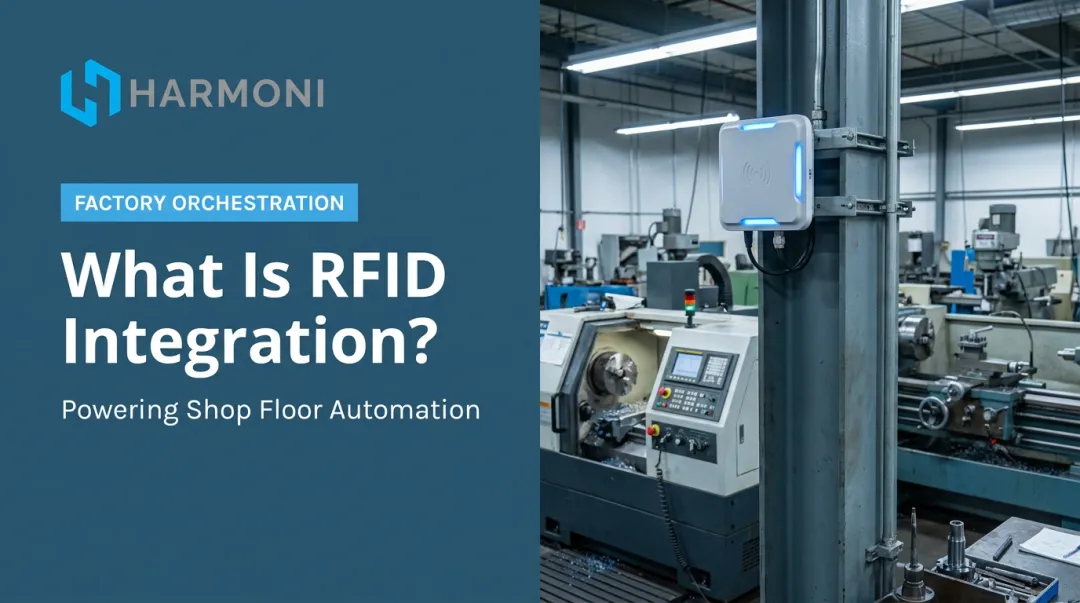
That range is what Harmoni's factory orchestration platform is built around. Instead of badging in at a shared kiosk or scanning a barcode before every job, operators are identified automatically as they approach a CNC workcenter. Long-range RFID detects the employee and job paperwork together, then triggers clock-in, program loading, and work instruction delivery in one motion.
Use Cases of RFID in Manufacturing
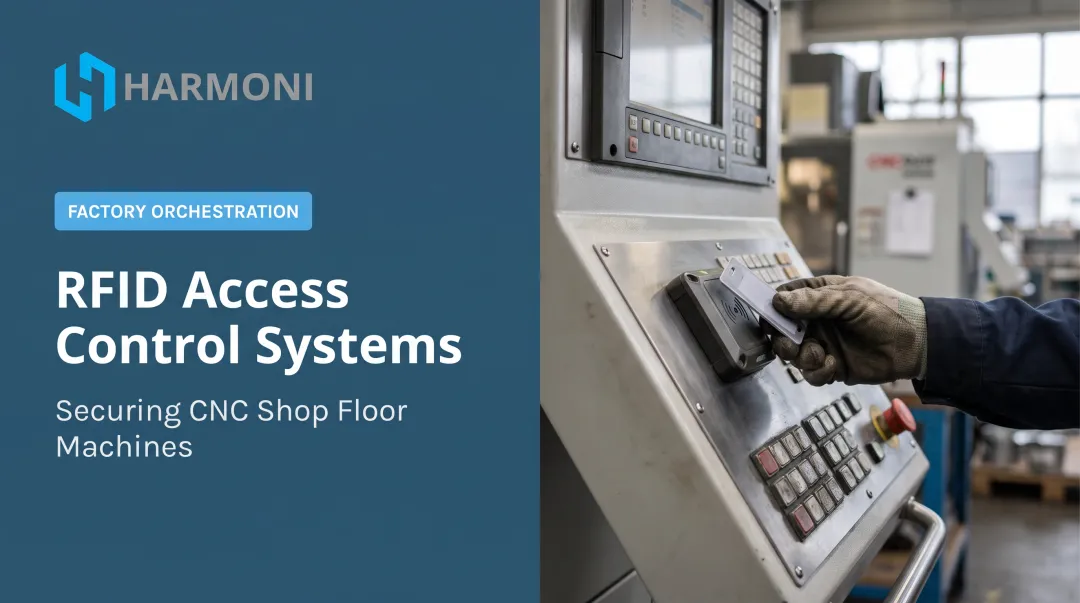
The clearest manufacturing use case is pairing people, jobs, and machines automatically. At a Harmoni-equipped workcenter, an operator walks up to the machine. The system reads the badge tag and job-traveler tag at the same time, then loads the correct CNC program, offsets, and revision-controlled work instructions. No manual entry, and far less risk of pulling the wrong program.
This matters most in industries where traceability and real-time visibility aren't optional:
- Aerospace and defense, where part revisions and labor records feed compliance requirements
- Automotive component manufacturing, where high volumes meet tight tolerances
- Precision and high-mix job shops, where changeovers happen constantly
The same hands-free model pays off beyond the CNC floor. Aubert & Duval, an aerospace parts manufacturer, tagged more than 6,000 items with battery-less UHF RFID and equipped forklifts with mounted readers. The result was a 75% reduction in forklift handling time, equal to three full-time employees' worth of labor, without a single manual scan.

RFID vs Barcode: What's Better for Manufacturing?
There's no universal winner here. The right answer depends on five factors:
- Cost tolerance: how much upfront investment can you absorb before seeing ROI?
- Data needs: do you need a simple ID, or serial/lot/revision-level detail?
- Environmental conditions: how much metal, coolant, or dust surrounds your process?
- Throughput volume: are you tracking one item at a time or dozens simultaneously?
- ERP/MES integration: how much manual re-entry are you willing to tolerate?
Quick Comparison Table
| Factor | Barcode | RFID |
|---|---|---|
| Cost | Low upfront; labels and scanners are cheap | Higher upfront investment, but automates labor over time |
| Line of sight & range | Required; one item scanned at a time | Not required; multiple tags read at a distance |
| Speed & automation | Sequential, manual action per scan | Bulk, hands-free reads reduce manual steps |
| Durability & environment | Labels wear and are affected by dirt or damage | More durable; metal and liquid can interfere without shielded tags |
Choose barcode if you're prioritizing low cost, fast setup, or working in a process heavy on metal and liquid exposure where RFID tags need extra engineering.
Choose RFID if you need real-time visibility, automated labor tracking, and fewer manual touchpoints across a high-mix production floor.
Real-World Example: RFID in Action on the Shop Floor
WessDel, a San Jose-based aerospace and defense machine shop working with titanium and beryllium alloy components, ran into a problem plenty of job shops will recognize: operators were losing serious time to manual ERP transactions.
Time studies found operators spent an average of 11 minutes per ERP transaction — clocking in, clocking out, switching jobs — often multiple times per shift at shared terminals. That travel and data entry time wasn't just lost productivity; it created gaps between what was happening on the floor and what the ERP system actually recorded.
The trigger to change was simple: WessDel needed real-time visibility into what operators and machines were actually doing, not an end-of-shift reconciliation.
After implementing Harmoni's RFID-enabled orchestration platform, WessDel reported:
- 17 productive hours gained per employee, per month
- 5X return on ongoing costs
- 10% reduction in delinquent jobs
- Full installation completed in under one week

Bob Dorricott, President & Owner of WessDel, put it plainly: "I was impressed by how easy the Harmoni system was to install. They had no issues communicating with machines, new and old, and it was seamlessly working with Epicor out of the box."
The takeaway is situational, not universal: RFID-based orchestration pays off most when a shop needs to coordinate people, machines, and jobs simultaneously — not just track inventory. If that sounds like your floor, see how Harmoni's platform automates operator and job detection using long-range RFID.
Conclusion
Barcode and RFID solve different jobs. Barcode wins when budget and simplicity matter most, or when your environment fights radio signals. RFID wins when you need automation, real-time labor visibility, and fewer manual steps on a high-mix floor.
Choose the option that cuts errors, tightens labor accountability, and keeps production consistent for your shop, at your volume, and within your budget. For many CNC and precision manufacturers, that decision comes down to how much manual scanning and delayed visibility still cost the floor each day.
Frequently Asked Questions
What is an RFID barcode?
"RFID barcode" is a common but inaccurate term. RFID and barcode are separate technologies with different mechanics. Some hybrid tags do combine a printed barcode with an embedded RFID chip for redundancy, but they aren't the same system.
Can my phone scan RFID chips?
Most smartphones can read NFC tags, a short-range RFID variant used for close-range taps. They cannot read the UHF RFID tags common in industrial settings without a dedicated reader.
Are RFID chips legal?
Yes. RFID is legal and widely used across retail, healthcare, and manufacturing. Regulations govern specific frequency bands and data privacy, but the technology itself is not restricted.
Can RFID and barcode be used together in the same operation?
Yes, and many manufacturers do exactly this. RFID handles high-value or high-turnover tracking, while barcode serves as a backup or for lower-priority items.
Which is cheaper to implement, RFID or barcode?
Barcode has a much lower upfront cost. RFID typically costs more to implement but often delivers stronger long-term ROI through labor savings in high-volume environments.
Does RFID work reliably around metal and CNC machinery?
Standard RFID tags can face interference near metal and coolant. Shielded or on-metal tags are engineered specifically to handle machine shop conditions reliably.