What's missing isn't data. It's connection.
That's where industrial control systems come in. ICS is the operational backbone that keeps machines, processes, and production in sync — and understanding how it's structured is foundational to improving anything that happens on your shop floor.
This article covers what ICS is, how it's built, the four types used in manufacturing, and how modern manufacturers are extending ICS capabilities to close the gap between machine data and real operational intelligence.
Key Takeaways
- ICS is the umbrella term for hardware and software that monitors and controls machines and processes in manufacturing environments
- The four main types are SCADA, DCS, PLC-based systems, and IACS/PAC systems — each suited to different scales and process types
- Every ICS operates on five core elements: sensors, controllers, actuators, feedback loops, and HMIs
- ICS enables real-time monitoring, tighter process control, and the data infrastructure manufacturers need to scale
- Factory orchestration platforms like Harmoni extend ICS by connecting machine data, operator activity, and ERP workflows into unified execution
What Is an Industrial Control System in Manufacturing?
Every time a CNC machine adjusts feed rate mid-cycle, a conveyor stops because a sensor tripped, or an alarm fires before a part goes out of spec — that's an industrial control system doing its job.
NIST defines ICS as a collective category covering different control systems and associated instrumentation used to operate or automate industrial processes. In practical terms: it's the hardware and software that senses what's happening in a production environment, makes decisions based on that data, and triggers physical responses — in real time.
From Isolated Machines to Networked Infrastructure
Early ICS setups were closed-loop and isolated. Each machine operated independently — a temperature controller on one line had no awareness of what was happening two stations down.
Modern ICS looks nothing like that. Today's systems are networked, internet-connected, and increasingly capable of integrating with AI and cloud infrastructure. NIST was already describing ICS as "networked digital control systems" back in 2002 — and the pace of change since then has only accelerated.
Scale ranges from a single PLC controlling one CNC machine to a plant-wide SCADA system overseeing hundreds of simultaneous processes. The core function stays the same across all of them: sense → decide → act → feedback.
Why ICS Matters Most in Precision and Discrete Manufacturing
That networked control capability matters far more in some environments than others. In aerospace, automotive, and CNC machining, tolerances are tight and traceability isn't optional. ICS enforces the process discipline that keeps production within spec — and generates the documentation trail that customers, auditors, and standards like AS9100 require.
The shift from reactive to proactive control is accelerating. Deloitte's 2025 survey of 600 US manufacturing executives found that 46% were already using IIoT solutions, with smart manufacturing initiatives linked to up to 20% higher production output among respondents. ICS is the physical-control foundation that makes those results possible.
The 4 Types of Industrial Control Systems in Manufacturing
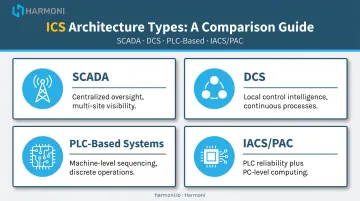
"ICS" is an umbrella term. Under it sit four distinct types, each designed for different operational scales, process requirements, and data environments. Many facilities run more than one simultaneously.
SCADA (Supervisory Control and Data Acquisition)
SCADA operates at the top of the control hierarchy. It collects data from sensors and equipment across an entire facility (or across multiple sites) and presents it to operators through centralized dashboards, providing the supervisory layer above all other control systems.
Critically, SCADA doesn't directly control individual devices. It supervises and sends commands to lower-level systems like PLCs and RTUs. This makes it ideal for:
- Multi-line factories requiring consolidated visibility
- Geographically distributed operations
- Alarm management and historical data logging
- Remote monitoring and supervisory intervention
A real-world example: Veoneer's automotive facility in Goleta, California deployed an Ignition SCADA and MES architecture for automotive production — completing the build in under three months.
DCS (Distributed Control Systems)
Where SCADA centralizes oversight, DCS distributes control intelligence. Controllers are placed near the process equipment itself, making local decisions without waiting for a central system to respond.
This architecture makes DCS the preferred choice for continuous process manufacturing: chemicals, food and beverage, pharmaceuticals, and utilities. Because control decisions happen locally, DCS is more resilient to communication failures and delivers faster, more precise process control for complex, interdependent production lines.
DCS is less characteristic of discrete CNC environments, where machine-level sequencing matters more than continuous process regulation.
PLC-Based Control Systems
PLCs — Programmable Logic Controllers — are rugged, purpose-built computers that execute specific logic programs to automate discrete operations. They control motors, valves, robotic arms, CNC machines, and conveyor systems with millisecond-level response times.
PLCs are the workhorses of discrete manufacturing. The global PLC market reached $17.2 billion in 2024 and is forecast to grow to $23.1 billion by 2030, driven by adoption across virtually every production sector. In aerospace, for example, NWI Aerostructures retrofitted gantry machines with Siemens SINUMERIK ONE CNC combined with a Siemens S7-1500 PLC for precision structural-component machining.
IACS and PAC Systems
IACS (Industrial Automation and Control Systems) is IEC's broader category encompassing all automation used to coordinate complex industrial processes. PACs (Programmable Automation Controllers) sit within that category as a hybrid technology: they combine PLC reliability with PC-level computing power and multi-protocol communication capability.
PACs now serve environments that need to bridge traditional machine control with modern data analytics, IIoT connectivity, and ERP integration. For mid-to-large manufacturers pursuing digital transformation, PACs represent a practical middle path between legacy PLC infrastructure and fully modernized control architecture.
The 5 Core Elements of an Industrial Control System
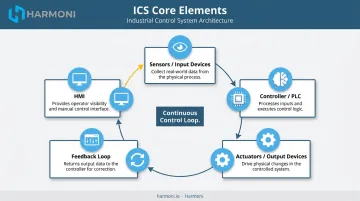
Regardless of which ICS type a facility uses, every system operates on the same fundamental architecture. These five elements form a continuous control loop — and understanding them helps manufacturers identify gaps in their current setup.
Sensors and Input Devices
Sensors are the system's eyes and ears. They measure physical variables — temperature, pressure, flow rate, position, vibration, and spindle speed — and convert those readings into electronic signals that feed the controller. A miscalibrated sensor doesn't just produce bad data; it corrupts every downstream decision the controller makes.
Controllers
The controller (typically a PLC or PAC) is the decision-making brain. It receives sensor inputs, compares them against programmed setpoints or logic rules, and determines what action to take. This cycle runs continuously — often hundreds of times per second — to maintain process stability.
Actuators and Output Devices
Actuators physically execute the controller's commands. Common output devices include:
- Motors and drives — adjust speed and torque on demand
- Valves — regulate flow in fluid and pneumatic systems
- Conveyors and robotic arms — move parts through production stages
- Hydraulic systems — apply controlled force for forming or clamping
- Safety shutoffs — halt machinery when process limits are exceeded
Feedback Loops
After an actuator acts, sensors immediately measure the result and report back to the controller. This closed-loop feedback creates a continuous correction cycle that sustains process accuracy in real time. Without it, a system can only react — not adjust. That distinction matters in aerospace tolerances and CNC machining, where drift of even a few thousandths of an inch means scrap.
Human-Machine Interface (HMI)
HMIs are the operator's window into the system. Touchscreens, dashboards, and SCADA displays translate raw machine data into visual information that operators can act on. A functional HMI shows real-time status, surfaces alarms, and allows manual overrides — giving operators the information they need to intervene before a small deviation becomes a defect.
Benefits of Industrial Control Systems for Manufacturers
ICS investment pays off across several dimensions that matter directly to shop floor performance:
Reduced errors and more consistent quality. Automated control loops remove the variability introduced by manual adjustments, maintaining tighter tolerances across shifts, operators, and production runs. Consistency gains are especially pronounced in high-mix, low-volume environments where each job carries unique parameters.
Faster problem detection. ICS systems catch deviations as they happen, not hours later during an end-of-shift review. That window matters: catching a process drift early is the difference between a minor correction and a scrapped batch or a line shutdown.
Lower unplanned downtime. Continuous monitoring of machine health signals (vibration, temperature, cycle time drift) enables predictive rather than reactive maintenance. Deloitte reports that predictive maintenance can increase productivity by 25%, reduce breakdowns by 70%, and lower maintenance costs by 25%. Siemens' 2024 study of 181 manufacturers put downtime at a large automotive plant at $2.3 million per hour — catching problems early isn't optional at that scale.
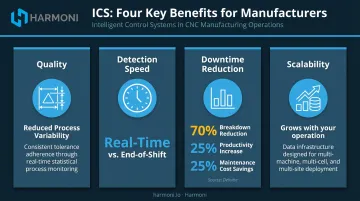
Data infrastructure for growth. A well-architected ICS creates the foundation manufacturers need to scale production, integrate new equipment, and connect to higher-level systems, without rebuilding from scratch every time the operation changes.
From ICS to Factory Orchestration: Closing the Shop Floor Visibility Gap
Here's the limitation that most ICS implementations run into: traditional ICS excels at controlling machines and logging process data, but it has no awareness of what's happening with operators.
Who's working on which job? How long is setup taking? Was the right fixture used? Was a step skipped? Machine data alone can't answer those questions. Without that context, even the best ICS telemetry leaves manufacturers with an incomplete picture.
What the Orchestration Layer Adds
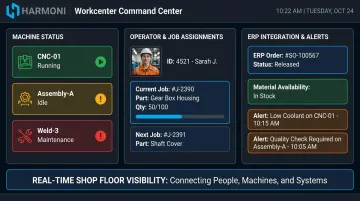
Factory orchestration platforms sit above the ICS layer, connecting machine data with operator activity, ERP job orders, and engineering requirements in real time. This is distinct from the machine control that PLCs and SCADA handle. It's the manufacturing operations layer that adds human context, job accountability, and workflow coordination.
Harmoni's platform does exactly this. It connects CNC machine data from controllers across brands — Fanuc, Haas, Mazak, Siemens, Heidenhain, and others — with RFID-based operator detection and ERP integration (Epicor, Infor, JobBoss, ABAS, ODOO). The result is a unified command center at each workcenter that coordinates people, machines, jobs, and systems simultaneously.
The results are measurable. WessDel, a beryllium alloy manufacturer, documented 17 productive hours gained per employee per month and a 5x return on ongoing platform costs after deploying Harmoni — driven largely by eliminating manual ERP transactions that had previously taken 11 minutes each. Machine Specialties, Inc. (MSI), a high-precision aerospace and defense manufacturer, nearly eliminated part count errors on complex parts and replaced paper travelers entirely with digital work instructions and automated labor tracking.
The Right Frame for Mid-to-Large Manufacturers
For CNC machining shops, aerospace manufacturers, and precision manufacturers, the relationship is layered:
- ICS provides the machine-level data foundation: real-time process control, sensor feedback, and equipment telemetry
- Factory orchestration turns that data into execution discipline: operator identity, job assignments, engineering revisions, and ERP workflows all connected to the machine signal
Together, they close the visibility gap that leaves most manufacturers reacting to problems after they've already cost time and money.
Frequently Asked Questions
What are the 4 types of control systems in manufacturing?
The four types are SCADA (supervisory monitoring across a facility or multiple sites), DCS (distributed control for continuous process manufacturing), PLC-based systems (machine-level sequencing for discrete operations), and IACS/PAC systems (broader automation frameworks that combine PLC reliability with higher-level computing). Most mid-size shops run at least two of these in parallel — PLCs at the machine level with SCADA supervising above.
What are the 5 elements of a control system in manufacturing?
The five elements are sensors (input), controller (decision-making), actuators (output), feedback loop (continuous correction), and HMI (operator interface). Together they form a closed sense-decide-act-monitor cycle that runs continuously to maintain process stability.
What are examples of control systems in manufacturing?
Common examples include PLCs controlling CNC machine tool paths and spindle speeds, SCADA systems monitoring throughput across automotive assembly lines, and DCS managing continuous chemical or food production processes. Aerospace applications often combine PLC and CNC controls — such as Siemens SINUMERIK with S7-1500 — for structural component machining with full process traceability.
How does an ICS differ from a SCADA system?
SCADA is one type of ICS — the supervisory layer that collects data and sends commands to lower-level controllers. ICS is the broader category that encompasses all control technologies, including PLCs, DCS, and PACs that operate at the machine and process level.
What is the role of PLCs in industrial control systems?
PLCs are the most widely deployed controllers in discrete manufacturing, executing ladder logic to automate machine operations with high speed and reliability. They handle everything from conveyor sequences to CNC axis movements — forming the execution layer that SCADA systems supervise from above.