Introduction
Quality failures caught late cost more than the ones caught early. Manufacturing veterans have long used the 1:10:100 rule as a shorthand: a dollar spent on prevention beats ten spent on correction, which beats a hundred spent on failure after the fact.
It's a heuristic, not a lab-tested law, but the direction holds up in ASQ's cost-of-quality framework, which separates prevention, appraisal, and failure costs.
The problem? Manual inspection wasn't built for today's shop floor. High-mix, high-throughput production means more part numbers, tighter tolerances, and less time per unit to catch mistakes. Missed defects, scrap, rework, and inconsistent results across shifts follow naturally.
This guide covers what automated quality control actually is, the four recognized types of quality control, and how automation stacks up against manual inspection. It then breaks down the real benefits worth caring about and where quality control fits into a broader real-time production strategy.
Key Takeaways
- Sensors, machine vision, and AI enable automated inspection beyond manual checks
- Automation boosts consistency and speed, though most shops keep human oversight
- Real-time AQC data drives traceability, root-cause analysis, and predictive maintenance
- Leading manufacturers coordinate people and machines upstream to prevent defects
What Is Automated Quality Control?
Automated quality control (AQC) uses sensors, machine vision, AI/ML algorithms, and robotics to inspect, measure, and verify product quality with minimal human intervention. Instead of an operator eyeballing a part under a light, a camera or sensor array does the looking, and software makes the call.
Every AQC system runs on three core components:
- Data capture: cameras, sensors, or scanners collect raw information about a part or process
- Analysis: AI/ML models or rule-based logic interpret that data against a spec
- Action: the system flags, sorts, alerts, or halts production based on what it finds
AQC isn't limited to the end of the line. It shows up at incoming material checks, in-process monitoring during machining, and final inspection before shipment. NIST's own research into automated manufacturing quality control notes that automation has been applied through CMMs, robot-integrated workstations, and software error correction since at least the 1980s. That history shows steady evolution, not a sudden shift.
What's changed recently is connectivity. Modern AQC increasingly plugs into MES and ERP systems, so inspection stops being an isolated checkpoint and becomes part of a continuous data stream feeding the rest of the shop. Factory orchestration platforms like Harmoni sit at that connection point, turning digital quality checksheets and SPC data into part of the same real-time stream that feeds ERP and MES systems.
The 4 Types of Quality Control
Quality professionals commonly reference four categories, each drawn from separate ASQ and NIST definitions:
| Type | What It Means | Manufacturing Example | Automation Fit |
|---|---|---|---|
| Process control | Monitoring a process and signaling when corrective action is needed | Real-time feedback during additive manufacturing builds | Strong: sensors excel here |
| Acceptance sampling | Inspecting a sample from a lot to decide accept/reject | Random sampling on a batch of stamped brackets | Moderate |
| Statistical process control (SPC) | Statistical techniques applied to control a process | Control charts tracking a lithography process | Strong: automation generates the data SPC needs |
| Total Quality Management (TQM) | Organization-wide, customer-focused continuous improvement | Cross-functional improvement across engineering, purchasing, and quality | Weak: this is a management philosophy, not a technology |
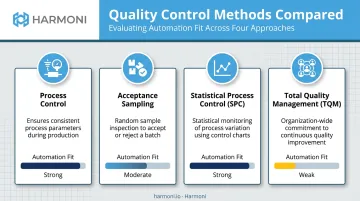
Automation strengthens process control and SPC most directly because both depend on continuous, high-frequency data. TQM sits above the technology layer entirely.
Common Examples of Automated Quality Control Technologies
Four technology categories cover most real-world AQC deployments:
- Machine vision/optical inspection catches surface defects, dimensional errors, and assembly mistakes. Automated optical inspection (AOI) is standard in electronics manufacturing for exactly this reason
- Robot-mounted 3D scanning and optical CMMs handle high-precision dimensional inspection of complex parts, common in automotive and aerospace metrology
- In-line sensor monitoring tracks temperature, vibration, and torque during machining, flagging out-of-spec conditions the moment they occur. This is a textbook example of an automation control system at work
- AI-driven predictive quality analytics flag jobs at risk of failing spec based on historical machine and operator patterns, distinct from predictive maintenance, which forecasts equipment failure rather than part nonconformance
Automated vs. Manual Quality Control: Key Differences
For most shops, automated and manual inspection each fit different situations. The right approach depends on production volume, defect complexity, and budget constraints.
| Factor | Automated Inspection | Manual Inspection |
|---|---|---|
| Speed & throughput | Inspects at production-line speed with no bottleneck | Limited by how many parts a human can check per minute |
| Consistency | Applies identical criteria to every unit, every time | Subject to fatigue and subjective judgment on ambiguous defects |
| Cost structure | Higher upfront investment in cameras, sensors, and integration | Lower barrier to entry but recurring labor costs indefinitely |
| Scalability | Scales cleanly with volume; needs reconfiguration for new parts | Adapts quickly to new parts but requires adding headcount to scale |
Detection reliability also varies by defect type and by which inspector performs the check, according to a peer-reviewed study on visual inspection reliability for precision-manufactured parts. That variability is one reason many shops shift repetitive checks to automated systems.
The practical answer for most manufacturers is a hybrid model: automated screening handles high-volume, repetitive checks, while skilled staff step in for complex or ambiguous cases that still need human judgment.
Key Benefits of Automated Quality Control in Manufacturing
The value of AQC goes well beyond "catches more defects." Here's where it actually moves the needle:
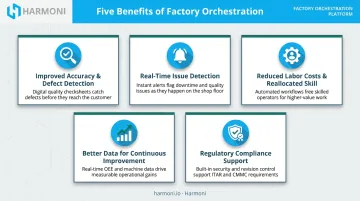
- Improved accuracy and defect detection — machine vision and AI apply consistent criteria to every part, cutting the false negatives and positives common in manual checks
- Real-time issue detection — catching defects as they occur stops scrap from compounding and enables immediate corrective action
- Reduced labor costs, reallocated skill — automating repetitive inspection frees quality engineers for root-cause analysis and process improvement
- Better data for continuous improvement — automated systems generate structured, timestamped quality data that feeds traceability efforts and root-cause investigations
- Regulatory compliance support — consistent, documented inspection helps manufacturers in regulated sectors like aerospace (AS9100) and medical devices (ISO 13485) demonstrate repeatable quality processes
NIST's research on AI adoption in U.S. manufacturing identifies quality inspection and predictive maintenance among the leading use cases for manufacturing AI. Quality inspection has moved from experimental technology to standard, expected practice across manufacturing.
None of these benefits are automatic. A poorly calibrated camera or an under-trained model can produce worse results than a careful human, especially early on. Proper implementation drives these gains more than the technology itself.
Beyond Inspection: Extending Quality Control With Real-Time Shop Floor Orchestration
Here's a fact inspection alone can't fix: many defects don't start at the part, they start upstream. Wrong tooling. A missed setup step. An operator running an outdated program revision. Inspection catches the bad part after the damage is done, but it doesn't prevent the mistake that caused it.
This is the gap Harmoni's factory orchestration approach targets. Rather than sitting only at the inspection station, Harmoni operates as a layer between ERP, MES, machines, and operators. It combines machine data with operator activity and engineering requirements to catch execution errors as they happen.
A few capabilities make this possible:
- RFID-based automatic detection of operators and jobs at each workcenter, eliminating manual clock-ins and reducing job-tracking errors
- Machine-side command centers where operators log labor, record completed and scrapped quantities, and confirm the correct job without leaving the machine
- Real-time dashboards that unify CNC spindle data, ERP records, and operator activity into one view, so managers see problems as they emerge instead of in next week's report
One documented example: WessDel, Inc. used Harmoni's RFID-enabled monitoring to bridge a data gap between shop floor activity and ERP records that had previously relied on manual time tracking. The result was 17 productive hours gained per employee per month and a 5X return on ongoing costs.
Results like that come from prevention, not detection alone. Preventing the root causes, wrong tooling, missed steps, setup errors, stops defects before they ever reach the inspection station. This orchestration layer typically deploys in weeks rather than months, since it retrofits onto existing machines instead of requiring hardware replacement.
Challenges & How to Choose the Right Automated QC System
Automation isn't a plug-and-play decision. A few recurring obstacles show up across implementations:
- High upfront investment in cameras, sensors, lighting, fixturing, and integration work
- Integration complexity with legacy production systems, especially older ERP setups or mixed-vintage machine fleets
- Ongoing calibration and tuning as part mixes, lighting conditions, and model drift require periodic adjustment
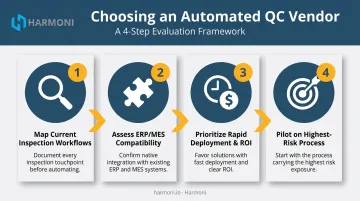
Before selecting a vendor, walk through this checklist:
- Map current inspection workflows and identify where scrap, rework, or missed defects actually happen, not where you assume they happen
- Assess compatibility with your existing ERP/MES and machine controls before signing anything
- Prioritize vendors offering rapid deployment with a clear, defensible ROI timeline rather than vague promises
- Pilot on your highest-scrap or highest-risk process first. Prove the concept on the process losing you the most money before scaling shop-wide
Manufacturers running Epicor, JobBoss, Infor, or ABAS alongside Mazak, Haas, Fanuc, or Siemens controls should confirm native integration before signing a contract. Platforms like Harmoni already support these exact ERP and machine combinations, which can shave weeks off deployment compared to a custom build.
Frequently Asked Questions
What is automated quality control?
Automated quality control (AQC) uses sensors, machine vision, and AI to inspect and verify product quality automatically during manufacturing. It reduces reliance on manual checks while catching defects at production speed.
What are the 4 types of quality control?
The four standard types are process control, acceptance sampling, statistical process control (SPC), and total quality management (TQM). Automation most directly strengthens process control and SPC, since both depend on continuous data.
What is an example of an automation control system?
An in-line machine vision system that scans parts for surface defects and automatically rejects out-of-spec units is one example. A sensor system that halts a CNC machine when torque or vibration drifts out of tolerance is another.
Does automated quality control eliminate the need for human inspectors?
No. Most manufacturers use hybrid models: automation handles high-volume repetitive checks, while skilled staff manage complex judgment calls, ambiguous defects, and oversight.
How much does it cost to implement automated quality control?
Costs typically range from around $5,000 for a single vision sensor to $250,000 or more for a full metrology cell, depending on scale and technology. ROI typically comes from reduced scrap, labor, and rework rather than the upfront price tag alone.
Can small and mid-sized manufacturers benefit from automated quality control?
Yes. Scalable options, from vision-guided sensors to lightweight orchestration platforms, let smaller shops start with one process and expand automation as volume and budget allow.