
Introduction
A CNC machine drifts out of tolerance at 9:15 a.m. Nobody catches it until the afternoon shift report lands on a supervisor's desk. By then, dozens of parts are scrap and an operator has been running a bad job for hours.
This scenario plays out in shops every day. The gap between when a problem happens and when someone notices it is where real money disappears.
That gap is exactly what real-time monitoring closes. Top-performing "real-time businesses" saw 62% higher revenue growth and 97% higher profit margins than their slower-moving peers, according to MIT CISR's 2024 study of 259 global companies.
This guide covers what real-time monitoring means, how the technology works, and why it matters on the manufacturing floor, where every minute of delayed visibility costs real dollars.
Key Takeaways
- Real-time monitoring captures and analyzes data as events occur, not hours or days later
- It replaces guesswork with immediate visibility into machines, labor, and jobs
- Manufacturers use it to catch scrap, downtime, and mis-scheduled work before it eats into margins
- Success depends on clear goals, integrated tools, and defined alert response procedures
What Is Real-Time Monitoring?
Real-time monitoring is the continuous, low-to-zero latency collection, transmission, and analysis of data as it's generated. It's built to catch anomalies, errors, or performance issues the moment they happen, not after the fact.
The "real-time" part is the whole point. The shorter the gap between an event and its visibility, the faster a team can respond, and the less damage accumulates in cost, scrap, or downtime.
A five-minute detection window versus a five-hour one can mean the difference between one bad part and five hundred.
Real-time monitoring also functions as a foundational building block of broader observability and operational visibility strategies, whether you're running IT infrastructure or a production line. You can't build meaningful analytics or predictive maintenance on top of data that arrives too late to matter.
Real-Time vs. Batch/Periodic Monitoring
Batch or periodic monitoring reviews data at set intervals: end-of-shift summaries and weekly quality audits. Real-time monitoring skips the waiting and surfaces issues continuously.
Consider a job running with the wrong program loaded, or a machine sitting idle for three hours because nobody flagged it. Under a batch model, that mistake surfaces in tomorrow's shift report. Under real-time monitoring, it's flagged within seconds or minutes, while there's still time to fix it.
The cost difference is substantial. A 2023 ABB survey of 3,215 plant-maintenance decision-makers found:
| Metric | Finding |
|---|---|
| Median cost of unplanned downtime | $125,000 per hour |
| Outage frequency | More than two-thirds of respondents reported outages at least once a month |
Batch reporting doesn't cause downtime, but it delays the response that could have shortened it.

How Real-Time Monitoring Works
Use cases vary wildly across industries, but most real-time monitoring systems run on the same underlying pipeline: collect, transmit, process/analyze, and alert/visualize.
Data Collection & Transmission
Data sources differ by industry, but on a shop floor they typically include:
- Machine controllers and sensors capturing cycle times and status
- RFID or badge systems tracking operator location and job assignment
- ERP/MES transactions recording work orders and quantities
- Application logs and operator inputs at the workstation
Automated collection, whether through agents, PLC feeds, or RFID scans, cuts out manual data entry and the errors that come with it. A human typing job numbers into a spreadsheet at the end of a shift is a slower, less reliable version of the same data a sensor captures instantly.
Processing, Analysis & Alerting
Raw data gets normalized and filtered, then compared against thresholds or patterns, whether rules-based or AI-driven, to spot anomalies. A cycle time that suddenly doubles, or a machine that's gone quiet for 45 minutes, should trigger a response.
Triggered alerts need to reach the right person fast. Depending on the system, that might mean:
- Dashboard updates visible to floor supervisors
- Direct notifications sent to a manager's device
- Status changes on the work-cell screen where operators can see them immediately
Real-time monitoring only works if someone acts on what it reveals. An alert that sits unseen for two hours might as well not have fired at all.
Visualization & Continuous Improvement
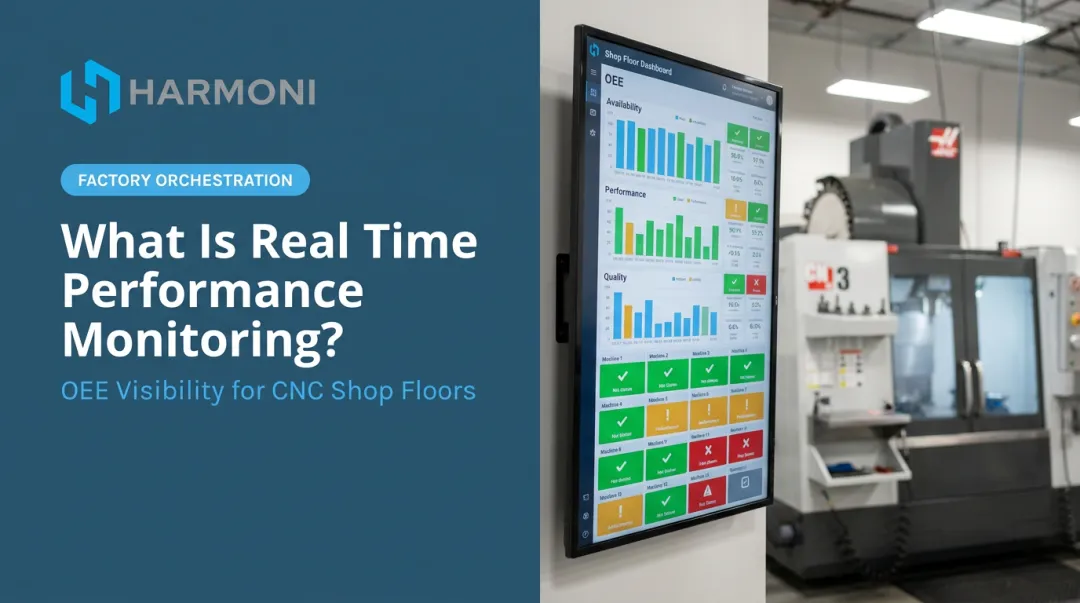
Dashboards translate raw data into charts and status boards teams can read at a glance. That's how a supervisor checks the health of an entire shop floor in under a minute instead of walking every aisle.
Monitoring systems aren't "set and forget." Thresholds, metrics, and alert rules need periodic review as operations change, new equipment comes online, or job mixes shift. What counted as a meaningful deviation last year might be noise today.
Why Real-Time Monitoring Matters for Manufacturers
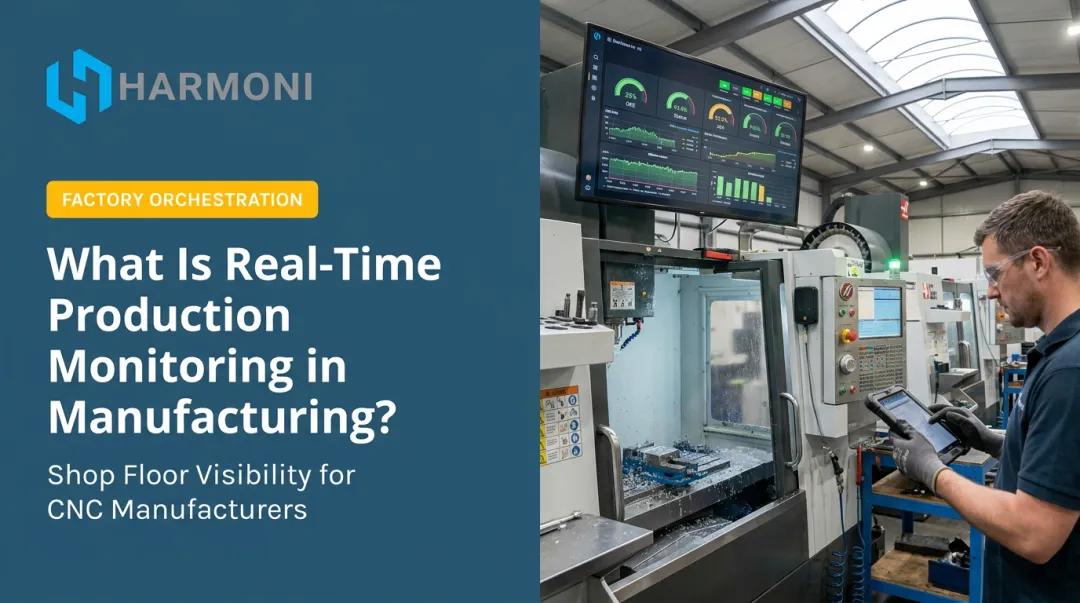
On the shop floor, real-time monitoring identifies scrap, machine downtime, and mis-scheduled jobs while they're happening, not after the production run is already finished. That timing difference is everything.
Real-time monitoring also delivers benefits that are easy to underestimate:
- Improves labor visibility by showing which operators are working which jobs at which workcenters, keeping accountability and execution consistent shift to shift.
- Delivers accurate job costing by capturing labor and machine time as it happens, rather than reconstructing costs from memory and paper logs at week's end.
- Reduces wasted operator time by coordinating people, machines, and ERP/MES systems, eliminating manual steps like clocking in at a terminal or hunting for program files.

Add up these operational gains, and the financial stakes become clear. NIST estimates $119.1 billion in annual preventable maintenance-related losses across US discrete manufacturing, including $18.1 billion from downtime and $100.2 billion in lost sales tied to delays and defects. Real-time visibility doesn't eliminate every dollar of that, but it shortens the window where those losses accumulate unnoticed.
How Harmoni Brings Real-Time Monitoring to the Shop Floor
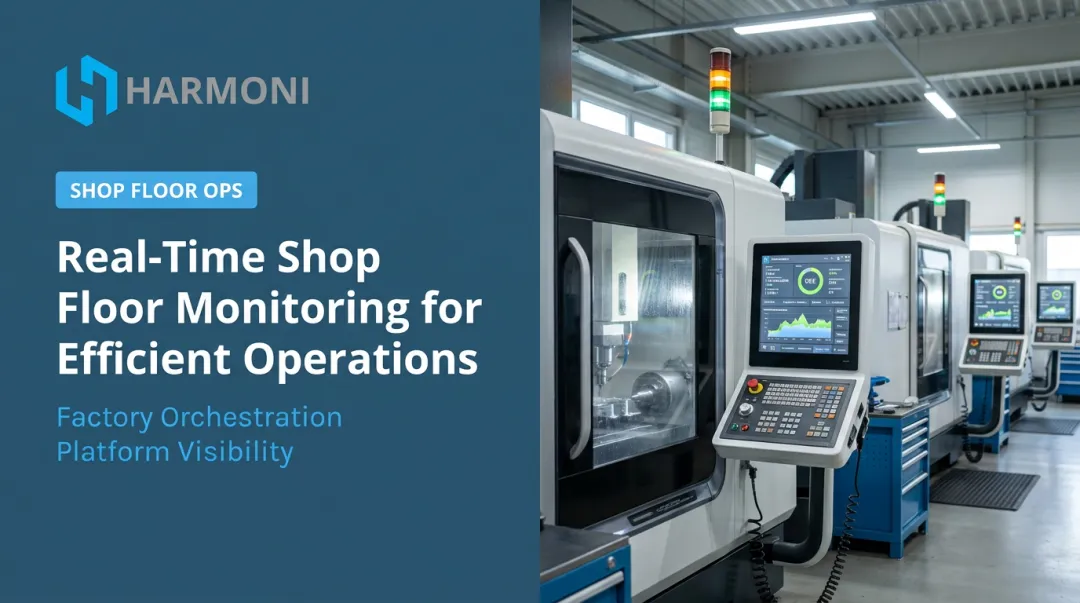
Harmoni's factory orchestration platform unifies machine data, operator activity, and ERP workflows into a single real-time dashboard. That's visibility traditional MES or ERP systems, running on their own, typically don't provide.
A key piece of this is Harmoni's RFID technology. It automatically detects nearby employees and jobs at each workcenter, delivering real-time labor and job tracking without manual clock-ins or paperwork. Operators show up, the system knows who's working what, and supervisors don't have to reconstruct the day from memory.
Types of Data and Real-World Use Cases
Real-time monitoring pulls from several data categories, and the mix depends on the industry:
- Machine/system metrics — uptime, cycle times, error rates
- Quality metrics — first-pass yield, defect counts, inspection results
- Transactional/ERP data — work orders, quantities completed, schedule status
- Operator or user activity — job assignments, login events, task duration
In manufacturing, these categories translate into specific shop floor practices:
- Live machine status and cycle times displayed on a dashboard
- First-pass yield tracked per job rather than per week
- Real-time progress measured against ERP-scheduled due dates
Manufacturing isn't the only place this matters. IT teams rely on the same underlying concept for network and infrastructure monitoring.
Splunk's 2024 observability study found leading organizations were 2.3x more likely than beginners to measure incident resolution in minutes or hours instead of days. Faster visibility leads to faster fixes, regardless of industry.
Best Practices for Implementing Real-Time Monitoring
Real-time monitoring only delivers value if it's set up with intention. A few practices separate systems that drive results from ones that just generate noise:
- Define clear goals and key metrics upfront. Decide what matters, whether that's machine uptime, labor utilization, or first-pass yield, before collecting data. Tracking everything without a target buries teams in noise.
- Choose tools that integrate with existing systems. A monitoring platform that doesn't talk to your ERP, MES, or machine controllers becomes a disconnected silo nobody checks consistently. Harmoni, for example, connects natively to ERPs like Epicor and CNC controls like Haas, keeping data unified instead of siloed.
- Establish alert thresholds and response procedures. Someone needs to own each alert type and know how fast to act. Data only becomes action when the response is as fast as the detection.

Skipping any of these steps tends to produce the same outcome: a dashboard full of numbers that nobody trusts or acts on.
Frequently Asked Questions
What is a real-time monitor?
A real-time monitor is a tool or system that continuously captures and displays data as it's generated. It gives instant visibility into performance, status, or errors instead of waiting for a scheduled report.
How is real-time monitoring different from real-time analytics?
Monitoring focuses on continuous observation and alerting when something deviates from expected behavior. Real-time analytics adds a deeper layer, analyzing that same live data for patterns, trends, or predictive insight.
What industries rely on real-time monitoring?
IT operations, manufacturing, healthcare, logistics, and retail all depend on it. In manufacturing specifically, it's used heavily for machine status and labor visibility on the shop floor.
What's an example of real-time monitoring on a factory floor?
A machine sensor flags unexpected downtime the moment it happens instead of at shift's end. Similarly, RFID-based systems track which operator is running which job at a workcenter as it occurs.
Is real-time monitoring the same as proactive monitoring?
Not quite. Real-time refers to how fast data becomes visible, while proactive monitoring uses that data, often with AI, to predict and prevent issues before they occur.
How quickly can a manufacturer implement real-time monitoring?
Modern platforms like Harmoni are designed to deploy in weeks rather than months. That means measurable operational improvements arrive quickly, without a drawn-out IT project.