That gap between planning and execution is the visibility problem. Real-time production visibility means capturing accurate, timely data from machines, operators, and systems — then surfacing it in a way that lets managers identify and respond to problems while they're still happening, not after the shift ends.
This guide covers the exact steps to improve production visibility, what you need in place beforehand, the variables that most affect data quality, and the most common implementation mistakes to avoid.
Key Takeaways
- Connect machines, operators, and systems into one unified data layer — not more dashboards stacked on top of disconnected tools
- The biggest barriers are siloed systems, manual data collection, and the gap between ERP plans and shop floor reality
- Define KPIs and baselines before building dashboards, or you'll have no way to measure improvement
- Data governance matters as much as technology: if teams define metrics differently, the data won't tell a consistent story
- The right solution deploys in weeks and delivers measurable results — not a multi-year rollout
How to Improve Real-Time Production Visibility: A Step-by-Step Guide
Step 1: Connect Machines and Capture Shop Floor Data
Start with a connectivity audit across every machine and workstation. You need to know three things about each asset:
- What is already sending usable data
- What requires additional hardware or software to connect
- What is entirely invisible — manual stations, legacy equipment, offline processes
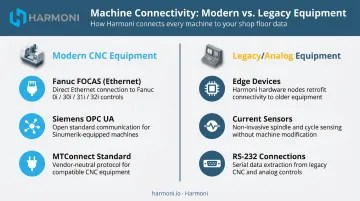
Match connection methods to equipment types — that's where most shops get tripped up. Modern CNC machines from Fanuc, Haas, Mazak, Siemens, and Heidenhain typically support accessible data protocols. Fanuc controllers, for example, expose machine data via the FOCAS protocol over standard Ethernet. Siemens Sinumerik controls support OPC UA natively. Where MTConnect is available, it provides a standardized, non-proprietary data format that works across many brands.
Older or analog equipment is a different story. Legacy machines often require edge devices, current sensors, or RS-232 connections to capture any activity at all. AMT has documented that legacy manufacturing technology requires an adapter to transform information into a form an MTConnect Agent can receive — and that's before you've done anything with the data.
Automated data capture eliminates the bias, rounding, and omissions that come with manual collection — but only when configured correctly. Validate that each data source is accurate before rolling out to additional machines. Poor source data will undermine every downstream dashboard and report you build on top of it.
Step 2: Break Down Data Silos by Integrating Systems
Map every system on the floor — ERP, MES, CMMS, quality tools — and document where data handoffs break down. The most common failure point is the gap between what the ERP plans and what the shop floor actually executes. That gap is where visibility failures live.
The goal is a single source of truth for production actuals: job status, operator assignments, machine states, and cycle times visible together in one place. Any stakeholder looking at the data should see the same picture.
Getting there requires connecting data streams so machine output, operator activity, and ERP job data share a common context layer. Harmoni sits between ERP systems, MES software, and CNC machines to do exactly that — unifying planned data with what's actually happening on the floor.
Harmoni's architecture captures data across three streams simultaneously:
- Live cycle times, utilization, and machine states pulled directly from connected CNC controls
- RFID-driven job and labor tracking at the machine, automatically paired with machine activity
- Planned job targets, work orders, and costing estimates from ERPs like Epicor, Infor, or JobBoss
Where most monitoring tools stop at one data stream, this approach creates operational context: not just that a machine is running, but which work order, which operator, and how actual performance compares to the quote.
Step 3: Define KPIs and Establish Baselines
Before building any dashboards, identify the metrics that actually matter to your operation. Common starting points:
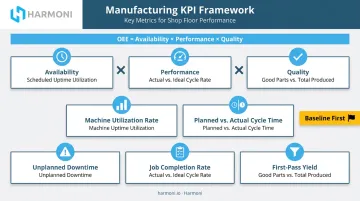
- OEE (Overall Equipment Effectiveness — Availability × Performance × Quality)
- Machine utilization rate
- Planned vs. actual cycle time
- Unplanned downtime frequency and duration
- Job completion rate vs. schedule
- First-pass yield
Tracking too many metrics simultaneously creates noise and reduces focus. Pick the ones tied directly to business outcomes — job costing accuracy, on-time delivery, scrap reduction, labor efficiency — so leadership can see operational ROI, not just technical dashboards.
Benchmark before you change anything. Modern Machine Shop's Top Shops data reported median spindle utilization of 75% and median OEE of 73% among top CNC performers — and most shops find their own baselines fall below both numbers. Without documenting current-state performance first, there's no way to prove improvement later.
That's why definitions matter from day one. ISO 22400-2:2014 defines 41 standardized KPIs for manufacturing operations management, including OEE. Using those established definitions prevents the metric drift that erodes trust in dashboards over time.
Step 4: Build Role-Specific Dashboards and Configure Automated Alerts
A one-size dashboard serves no one. Design visibility views that match each role's decision scope:
| Role | Scope | Key Data |
|---|---|---|
| Operator | Machine / job level | Job progress, cycle time vs. target, quality flags |
| Supervisor | Cell / shift level | Machine states, downtime events, jobs behind schedule |
| Executive | Plant-wide | OEE trends, utilization, on-time delivery rate |
Configure automated alerts that trigger when critical thresholds are crossed — cycle time overruns, unplanned downtime events, jobs falling behind schedule, quality flags. The goal is intervention while a problem is still in progress, not discovery in tomorrow morning's report.
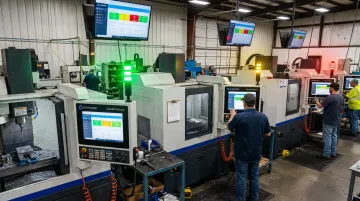
Harmoni's Visual Factory system reinforces this directly on the shop floor. A patent-pending, high-intensity indicator light at each machine terminal communicates real-time OEE conditions: green for running within expected parameters, yellow for slipping performance, red for an immediate issue.
Those lights are benchmarked against your actual ERP production plan, so supervisors can see at a glance which work cells are on track and which need attention — without opening a dashboard.
Finally, establish a regular review cadence. Visibility only drives improvement when teams act on what the data shows. Document how insights move from dashboard to corrective action to process change.
When Real-Time Visibility Matters Most
The value of real-time data scales directly with the complexity and variability of your production environment. Not every shop has the same urgency — but certain conditions make it especially critical.
High-mix, low-volume environments — CNC machining shops, aerospace, defense, precision manufacturing — see the highest ROI from real-time visibility. Frequent job changeovers, varying cycle times, and tight tolerances mean problems compound quickly when not caught early. The BLS reports over 265,000 workers employed across machine shops in the U.S. alone, and the operational complexity they manage daily makes delayed data genuinely costly.
Schedule changes and change orders rank among the riskiest moments in production. Without a live view of job status and machine states, a seemingly simple adjustment can cascade before anyone realizes what happened:
- Missed deadlines from jobs that quietly fell behind
- Misallocated labor sent to the wrong workcenter
- Scrapped parts already in process under the old schedule
Knowing which jobs are running, on which machines, and how far along they are makes rescheduling decisions far less risky — and far less expensive when things change last minute.
What You Need Before Getting Started
Preparation directly determines implementation success. Jumping to dashboards before data infrastructure and organizational alignment are in place is the single most common reason visibility projects fail.
Technology and Connectivity Readiness
Assess the age, protocol support, and data accessibility of every machine before selecting tools. Connectivity gaps identified early are far cheaper to address than mid-implementation surprises.
Key questions to answer:
- Which machines support MTConnect, OPC UA, or proprietary protocols natively?
- Which require hardware additions (sensors, edge devices, RS-232 connections)?
- Are there purely manual stations that need a different approach entirely?
Harmoni connects to existing equipment without machine replacement. Each terminal includes built-in RS-232, Ethernet, USB, and analog inputs — covering modern CNC controls and legacy analog machines alike.
Operator and Process Readiness
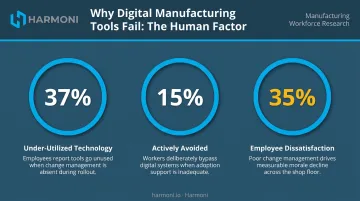
Even well-connected systems fail when employees experience them as surveillance rather than support. A 2022 MDPI study of 184 UK manufacturing employees found that 37% of adopted digital manufacturing technology was under-utilized and 15% was avoided entirely. Another 35% of workers reported dissatisfaction after implementation. Those outcomes trace directly to poor change management.
Invest in communication and training before go-live:
- Explain how the data will be used and who can see it
- Show operators how the system benefits them directly — clearer job instructions, fewer interruptions, less paperwork
- Make operator-facing tools genuinely useful, not just monitoring mechanisms
Harmoni's machine-side operator command center is designed around this principle. Operators use RFID to log in, which automatically loads the correct CNC program, surfaces digital work instructions, and initiates quality checksheets — removing administrative friction rather than adding monitoring burden.
Data Governance Fundamentals
Agree on metric definitions before implementation. What counts as "downtime"? How is setup time categorized? How is scrap recorded? These definitions must be consistent across all shifts and work centers.
Inconsistent definitions create data conflicts that erode stakeholder trust over time. Once that trust is lost, managers revert to gut-feel decisions and anecdotal reporting.
Key Factors That Determine the Quality of Your Production Visibility
Visibility quality depends on several controllable variables.
Data Latency
The difference between data refreshed every few seconds versus data batched end-of-shift is operational, not technical. Real-time alerts let supervisors intervene while a problem is still fixable. Delayed data means problems surface in post-shift reports — after the opportunity to act has passed.
Dashboards built on stale data create false confidence. Managers believe they're seeing the present when they're actually seeing hours ago.
Integration Depth
Visibility that shows only whether a machine is running or idle is incomplete. True visibility requires layered data — machine state, job assignment, operator activity, and ERP work order status in one view.
Shallow integration produces metrics you can't trace back to decisions. You can see that utilization dropped; you can't determine why or assign accountability.
Operator Engagement
Operators are the closest source of truth on the floor. When they actively log downtime reasons, quality flags, and job updates, the system gains context that sensors alone can't provide. Machine data confirms that production stopped; operator input explains whether the cause was tooling, material, a setup problem, or a process issue.
Without that context, downtime data is a number without a corrective path.
Governance and Metric Standardization
When different shifts or supervisors define the same metric differently, the data can't be reliably compared or trended. ISO 22400-2:2014 addresses this directly — it establishes 41 standardized KPIs for manufacturing operations management, including OEE, with consistent definitions across the organization.
Without shared definitions, visibility investment produces competing numbers instead of shared accountability.
Common Mistakes That Undermine Real-Time Production Visibility
Adding More Software Without Integration Planning
Deploying a new visibility tool on top of disconnected ERP, MES, and machine systems creates an additional silo. The result is more dashboards, more logins, and still no single source of truth.
McKinsey found that two-thirds of industrial companies were stuck in digital-manufacturing "pilot purgatory", unable to scale pilots into production-wide value. Disconnected point solutions are a primary reason.
Skipping Baseline Measurement and KPI Definition
Without documented current-state performance, there's no way to prove improvement. Teams end up with dashboards they can't interpret, and leadership loses confidence in the initiative.
Treating Visibility as an IT Project
The most successful implementations are driven by operations leadership who understand the shop floor. Technology teams alone cannot define what data matters, what thresholds should trigger alerts, or what a "good shift" looks like. IT builds the infrastructure; operations must drive the outcome.
Ignoring the Operator and Human Layer
Focusing exclusively on machine data while neglecting operator interaction leaves significant gaps in production tracking. The shop floor isn't fully automated — any complete visibility strategy must account for human activity alongside machine output.
Conclusion
Improving real-time production visibility isn't a single tool purchase. It requires connecting the right data sources, integrating systems that previously operated in silos, defining meaningful KPIs, and delivering role-appropriate dashboards that drive action.
Most visibility failures trace back to the same root causes: poor preparation, siloed implementation, undefined metrics, and neglect of the operator layer. Getting these fundamentals right matters more than which specific technology is chosen.
Manufacturers who achieve true real-time visibility — where machines, operators, and systems are coordinated in a unified view — gain the ability to identify and respond to problems while they're still happening. The result is fewer unplanned stoppages, faster recovery when issues do occur, and a shop floor that runs on current data rather than yesterday's reports. Harmoni's factory orchestration platform is built around exactly this model — if you're ready to see what it looks like in practice, request a free demo at harmoni.io/demo.
Frequently Asked Questions
What does operational visibility mean?
Operational visibility is the ability to monitor, measure, and understand what's happening across a business's people, machines, and systems in real time. It enables decisions based on current data rather than delayed reports or manual summaries.
What is the difference between production visibility and manufacturing visibility?
Production visibility focuses on the shop floor — job status, machine states, operator activity, and cycle times. Manufacturing visibility is broader, encompassing inventory, supply chain, order fulfillment, and financial performance across the entire operation.
How do ERP systems contribute to real-time production visibility?
ERP systems provide the planned data — work orders, job schedules, material requirements — but aren't designed to capture live shop floor events. Real-time visibility requires connecting ERP data with machine-level and operator-level data through an integration layer or factory orchestration platform like Harmoni.
What KPIs should manufacturers track to measure production visibility?
Strong starting metrics include:
- OEE
- Machine utilization rate
- Planned vs. actual cycle time
- Unplanned downtime frequency and duration
- Job completion rate
- First-pass yield
The right KPIs depend on your operation and should tie directly to business outcomes.
How long does it take to implement a real-time production visibility solution?
Modern factory orchestration platforms can deploy in weeks when connectivity infrastructure is in place. KPI definition, operator training, and dashboard configuration typically take longer than the technology installation itself.
What is the biggest barrier to achieving real-time production visibility?
Siloed systems and inconsistent data governance. Most manufacturers have the data they need, but it lives in disconnected ERP, MES, and machine systems with no integration layer to connect them into a single real-time view.