Introduction
Running a machine shop means managing constant variables: high-mix job queues, custom orders, schedule disruptions, and razor-thin margins — often tracked across spreadsheets, whiteboards, and an ERP system that only shows you what happened yesterday.
Choosing the wrong software doesn't just create administrative friction. It creates blind spots. Job costs drift from estimates without anyone noticing. Delivery windows slip because scheduling doesn't reflect what's actually happening on the floor. Operators work from outdated instructions because the right data never reached the right workstation.
This guide covers what machine shop management software actually is, which features separate functional tools from genuinely useful ones, and what criteria to prioritize when evaluating your options.
Key Takeaways
- Machine shop management software coordinates quoting, scheduling, job tracking, and shop floor execution in one connected system
- Real-time shop floor visibility, accurate job costing, and ERP integration are the highest-impact features to evaluate
- Generic ERP alone rarely bridges the gap between planned production and actual floor execution
- Deployment speed and operator adoption matter as much as feature depth
- The best fit depends on your production mix, machine environment, and existing systems
What Is Machine Shop Management Software?
Machine shop management software is a category of industrial software designed to help job shops and precision manufacturers plan, track, execute, and analyze production — from initial quote through final delivery.
The term covers a spectrum of tools:
- Purpose-built ERP systems for job shops (quoting, purchasing, scheduling, financials)
- Manufacturing Execution Systems (MES) focused on shop floor control and work-in-process visibility
- Factory orchestration platforms that coordinate across ERP, MES, machines, and operators in real time
According to ISA-95, MES sits at Level 3 — between business planning systems (ERP) and shop floor control (machines and sensors). In practice: ERP captures what's planned, MES tracks what's executing, and orchestration layers bridge the gap between those two realities in real time.
Core Components
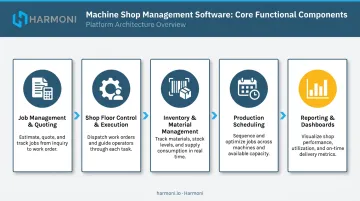
Most platforms cover five functional areas:
- Job management and quoting — Builds accurate quotes from real labor, material, and overhead data, then converts them into trackable work orders without re-entering information. Modern Machine Shop's 2025 Top Shops analysis found top-performing shops returned quotes in one day and achieved a 19% higher quote-to-book ratio — a direct connection between quoting speed and revenue.
- Shop floor control and execution — Manages operator assignments, routing steps, real-time job status, and WIP location. Most generic ERP tools fall short here; they record transactions but don't direct execution in real time.
- Inventory and material management — Ties real-time material availability to specific jobs, supports barcode-based picking, and prevents the same stock from being allocated to two jobs simultaneously.
- Production scheduling and capacity planning — Accounts for machine availability, labor capacity, lead times, and last-minute change orders. Static schedules that ignore floor reality consistently fail in high-mix environments.
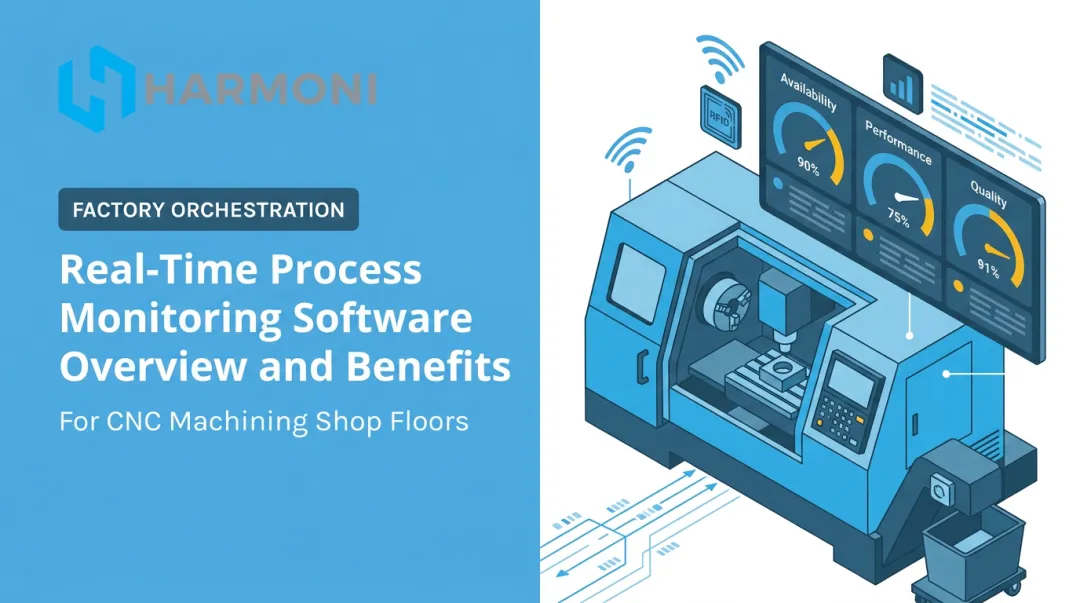
- Reporting and dashboards — Unifies machine data, operator activity, and ERP metrics to surface where throughput is slipping, which jobs are running over budget, and which operations are creating bottlenecks.
Operational Benefits
Shops that integrate these components effectively see measurable results across the production cycle:
- Reduced scrap and rework through in-process visibility
- More accurate job costing that protects margins
- Faster quoting that improves win rates
- Shorter response time when production problems surface
- Improved on-time delivery rates
A concrete example: Coastal Machine and Supply saw a 46% increase in five-axis machine utilization after implementing machine monitoring, according to Modern Machine Shop's Top Shops reporting. That kind of gain becomes reachable once real-time visibility is in place.
What to Consider When Choosing Machine Shop Management Software
Machine shop environments vary significantly by job complexity, volume, machine mix, and workforce size. The right software is never one-size-fits-all. The factors below help move beyond feature checklists and connect software capabilities to measurable production outcomes.
Real-Time Shop Floor Visibility
This is the single most critical factor. Shops that can only see job status after the fact are permanently reactive — delays, scrap, and cost overruns become visible only after the damage is done.
True real-time visibility means:
- Live machine status (running, idle, faulted, in setup)
- Operator activity tied to specific jobs
- WIP location across workcenters
- Alerts triggered when operations fall behind cycle time targets
ERP data rarely reflects what's actually happening on the floor — and that gap is where delays and cost overruns compound. Software that closes it changes whether your team is preventing problems or recovering from them.
Job Costing Accuracy and Quoting Depth
Quoting from estimates without capturing actuals creates a margin visibility gap. Shops win jobs without knowing whether they're profitable — or leave margin on the table because historical cost data isn't tracked.
The KPIs this directly affects:
- Estimated vs. actual cost variance per job
- Gross margin by job type or customer
- Quote-to-win conversion when pricing is both competitive and sustainable
Software that captures actual labor hours, machine time, and material consumption at the job level — and feeds that data back to ERP — is what closes this gap. Estimates improve over time when actuals are consistently tracked.
Integration With Existing ERP, MES, and Machine Systems
Most shops already have some combination of ERP, CNC machines, and floor tracking tools. The right software integrates deeply rather than replacing everything. Full platform replacements carry high cost, long timelines, and disruption risk most shops can't absorb.
What integration depth means in practice:
- Bidirectional data flow with ERP systems (job status, labor actuals, scheduling data)
- Native connectivity to CNC controllers — Fanuc, Haas, Mazak, Siemens, DMG MORI, and others
- Open architecture that doesn't lock your shop into a single vendor ecosystem
MTConnect, the open interoperability standard from AMT, is now deployed on more than 250,000 devices across 50+ countries — making standards-based machine connectivity a realistic baseline requirement rather than a premium feature.
Production Scheduling and Responsiveness to Change
Static scheduling tools fail in job shops. Priorities shift daily based on material delays, machine downtime, rush orders, and engineering changes. Scheduling must be dynamic and reflect floor reality, not just planned sequences from last week.
Operational metrics this influences:
- Machine utilization rate
- On-time delivery percentage
- Average job cycle time
Evaluate whether a scheduling tool can re-sequence work when conditions change — and whether that re-sequencing happens in minutes or requires a dedicated scheduler to rebuild the plan manually.
Operator Usability and Shop Floor Adoption
The most feature-rich software fails if operators won't use it. Adoption problems on the shop floor aren't training problems — they're design problems.
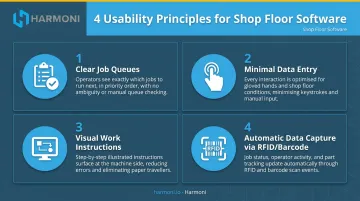
Good usability at the workcenter level looks like:
- Clear job queues with no ambiguity about what to run next
- Minimal manual data entry
- Visual work instructions accessible without navigating complex menus
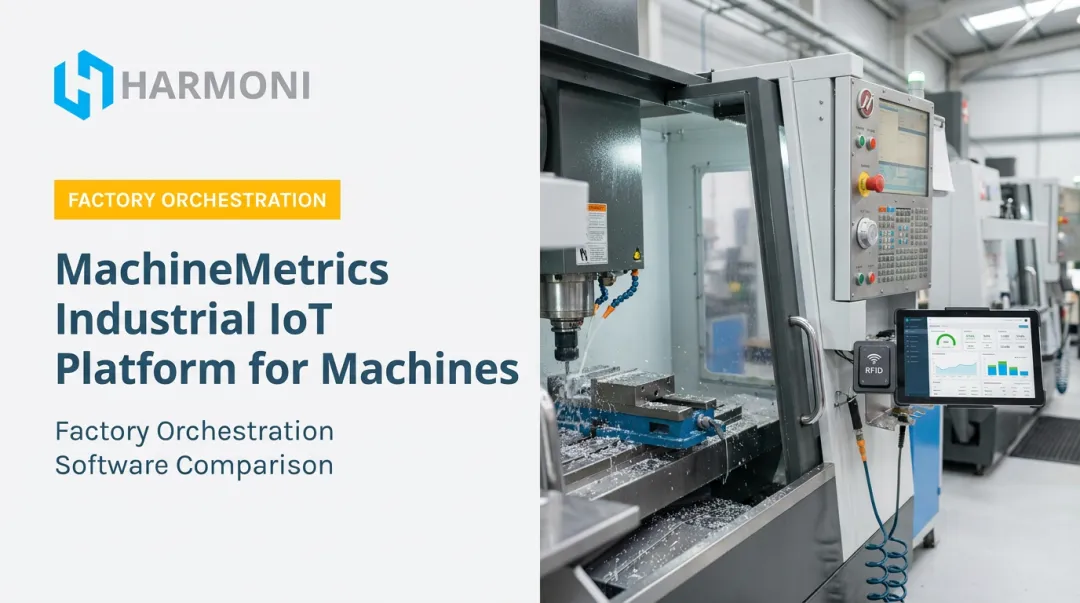
- Automatic data capture (RFID, barcode) that reduces steps rather than adding them
If an operator has to walk to a shared terminal, log in, find the right job, and manually enter time — that's not a workflow, it's a bottleneck.
Deployment Speed and Scalability
Long implementations — 6 to 18 months — create real risk. The business keeps changing while software sits in deployment, and teams lose confidence before they ever see value.
Scalability matters beyond growth in volume: adding new machine types, integrating new ERP modules, or expanding to additional workcenters shouldn't require custom development each time.
Before committing, push vendors on specifics:
- Exact deployment timeline with defined milestones
- References from shops with a comparable machine mix and ERP environment
- What's included in implementation vs. billed separately
Vague promises about "fast deployment" without concrete dates are a red flag.
How Harmoni Can Help
Most machine shop management software leaves a gap between what ERP systems record and what actually happens on the shop floor. Harmoni, a factory orchestration platform headquartered in Akron, Ohio, is designed specifically to close that gap.
Harmoni operates as an orchestration layer alongside ERP and MES — making those systems work better in real manufacturing environments without replacing them. It integrates with the systems shops already use, including Epicor, Infor, Infor Visual, JobBoss, JobBoss2, ABAS, and ODOO on the ERP side, and Fanuc, Haas, Mazak, Siemens, Heidenhain, DMG MORI, Makino, and Fadal on the machine side. MTConnect is natively supported where available.
Key differentiators:
- Long-range RFID automatically detects nearby employees and jobs, eliminating manual clock-ins and job selection entirely. At WessDel, this reduced time-tracking transactions from 11 minutes each to seconds, recovering 17 productive hours per employee per month
- Machine-side command centers surface job instructions, process requirements, and real-time status at each workcenter — operators get the right information without leaving the machine
- Unified dashboards bring machine data, ERP data, and operator activity together for production managers and leadership in a single view
- Digital work instructions and quality checksheets deliver job-specific guidance automatically based on RFID-identified jobs — the correct revision, every time
- In-process controls catch problems while production is running, not after parts are scrapped
- Deploys in weeks, not months, with no machine replacement required — Harmoni retrofits to existing equipment regardless of age or manufacturer
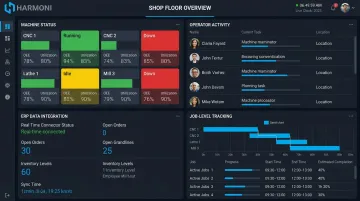
Those capabilities translate directly to measurable results on the shop floor.
Machine Specialties, Inc. (MSI), a high-precision aerospace and defense manufacturer, deployed Harmoni across their entire shop floor in early 2024 with Epicor integration. The results included automated labor tracking that replaced paper travelers, near-elimination of part count errors on high-risk components, and a shift from tracking spindle time to earned hours, giving their finance team a more accurate view of job profitability.
For a look at how Harmoni fits your specific environment, you can request a free demo at harmoni.io/demo.
Conclusion
Choosing machine shop management software is a decision that shapes how every job flows through your shop — from the first quote to final delivery. The right system connects people, machines, and data in real time, giving you operational control rather than a historical record.
The platform that fits your shop aligns with your production environment, your existing systems, your workforce, and where your business is heading — not just what's most widely marketed. Popularity doesn't equal fit.
Software selection is also an ongoing commitment, not a one-time event. The initial deployment is a foundation. As your shop scales, takes on new work types, or brings on new equipment, your platform should grow with it — and your team should regularly evaluate whether it still matches operational reality.
If you're still mapping out your requirements, Harmoni's factory orchestration platform connects machines, operators, and ERP data into one unified system and deploys in weeks without replacing existing equipment. Request a free demo at harmoni.io/demo to see how it fits your shop.
Frequently Asked Questions
What is the difference between machine shop management software and ERP?
ERP covers business-wide functions like quoting, purchasing, inventory, and financials. Machine shop management software — whether MES or an orchestration layer — focuses on execution: what's happening on the floor in real time. Effective setups use both together, with the execution layer feeding actual production data back into ERP records.
What features should I prioritize when evaluating machine shop software?
Start with real-time shop floor visibility, job costing tied to actuals, dynamic scheduling, integration with your existing ERP and CNC machines, and operator-friendly interfaces. These five areas have the most direct impact on margins, delivery performance, and day-to-day production control.
Can machine shop management software integrate with existing CNC machines and ERP systems?
Yes — leading solutions offer native integrations with common CNC controllers (Fanuc, Haas, Mazak, Siemens) and ERP platforms (JobBoss, Epicor, Infor). What matters most is integration depth: bidirectional data flow delivers far more value than one-way data export.
How long does it take to implement machine shop management software?
Traditional ERP deployments can run 6 to 18 months. Purpose-built or orchestration-layer solutions designed for manufacturing environments can deploy in weeks. Ask vendors for a specific timeline and measurable milestones before committing.
How does machine shop software improve job costing accuracy?
Software improves job costing by capturing actual labor hours, machine time, and production quantities at the job level in real time — replacing estimates with verified actuals. Shops can then compare projected vs. real costs and adjust pricing, routing, or staffing accordingly.
Is machine shop management software suitable for small shops or only large manufacturers?
Machine shop software works for shops of all sizes, though the right fit depends on complexity. Smaller shops often benefit from job-focused ERP tools with basic floor tracking. Mid-to-large manufacturers running high-mix environments typically need deeper integration between ERP, shop floor control, and machine monitoring to maintain visibility at scale.