
Introduction
In a CNC shop or aerospace machining environment, ten operators running the same job can produce ten different outcomes. The work varies. Quality suffers. And when you dig into the root cause, it almost never traces back to a skill gap — it traces back to the absence of a clear, consistent standard for how the work gets done. Writing that standard is only half of it. A document defines how the job should run; it cannot confirm the current revision reached the machine or that the operator worked to it, and closing that gap means tying the instruction to the machine and the ERP job at the moment of execution.
Writing standard work instructions sounds straightforward. In practice, most fall short. They're too vague to act on, scoped too broadly to be useful at a single workstation, or accurate at the time of writing but never updated when the process changes. Some never make it off the shared drive.
This guide covers what effective standard work instructions actually require. That includes where they sit in your documentation structure, how to write them step by step, what every complete instruction must include, and the failure patterns that make good documentation useless on the shop floor.
Key Takeaways
- Standard work instructions define the best-known method for a specific task — they answer how exactly to execute one step, not what the output should be
- Write instructions at the workstation with operator input — not handed down from engineering after the fact
- Every instruction needs: a clear title, objective, roles, materials, numbered steps with action verbs, visuals, and quality checkpoints
- Instructions most often fail due to poor accessibility, missing operator involvement, and no update cycle — not poor writing
- Digital delivery at the point of work is essential for consistent instruction use across shifts and operators
What Are Standard Work Instructions (and Why They Matter in Manufacturing)
Standard work instructions are step-by-step documents that specify the most efficient, safest, and most consistent method for performing a specific task. They answer the question: how exactly do I do this, right now, at this step?
That's a narrower question than most documentation answers.
Where Standard Work Instructions Fit
It helps to understand the documentation hierarchy before writing a single word:
| Level | Document Type | Scope |
|---|---|---|
| Broadest | Standard Work System | The overall operating model for production |
| Process | SOP / Procedure | How a process runs across roles or departments |
| Task | Standard Work Instruction | How one operator executes one specific task |
An SOP describes a broader process — incoming inspection, first-article approval, material handling. A standard work instruction zooms into a single operator's actions at a single step. The distinction matters because combining the two produces documents that are too wide to be actionable at the machine.
Getting that hierarchy right is the foundation. Once you know where standard work instructions sit, the business case for writing them well becomes concrete.
Why It Matters in Manufacturing
In CNC machining, aerospace, and precision manufacturing, execution variation is expensive. Scrap, rework, failed first-article inspections, and missed cycle time targets all trace back to the same root cause: operators doing the same task differently because no agreed-upon method exists.
ASQ classifies scrap and rework as internal failure costs — direct consequences of process variation that could have been prevented. NIST research on machining environments confirms that on-machine conformance controls reduce rework, concessions, and scrap.
The mechanism is straightforward: when every operator follows the same verified method, variation shrinks — and so do defect rates, first-article failures, and rework hours. Standard work instructions are how that verified method gets documented, distributed, and enforced at the machine level.
How to Write Effective Standard Work Instructions: Step-by-Step
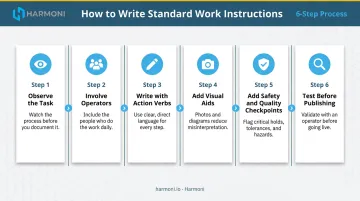
Step 1: Observe the Task at the Workstation
Effective instructions are written where the work happens — not in an office, not from memory.
Before writing anything, physically observe the task being performed by the most skilled operator available. Document:
- The exact sequence of actions in the order they occur
- Every tool, fixture, consumable, and piece of PPE used
- Cycle time from start to completion
- Quality checks the operator performs (including informal ones)
- Any decision points, safety hazards, or conditional branches
The goal at this stage is description, not prescription. You're capturing what the best execution actually looks like before you standardize it.
Step 2: Involve the Operators Who Do the Work
Operators carry knowledge that doesn't exist anywhere in writing — the tolerance they've learned to watch on a particular part family, the fixture quirk that causes problems if you skip a step, the reason a certain torque sequence matters. That knowledge is what makes instructions accurate.
The Lean Enterprise Institute's analysis of Toyota's approach to standardized work makes this explicit: standardized work is a goal teams work toward, not a tool imposed on people. Instructions written without operator input reflect what engineers think happens, not what actually happens. The difference shows up immediately in whether instructions get followed.
Step 3: Write Steps Using Action Verbs, One Action Per Step
This is where most instructions break down. Each numbered step should:
- Start with an action verb (torque, inspect, load, verify, position, press, zero)
- Contain exactly one action
- Run no longer than two sentences
- Include the expected outcome or acceptance criterion where relevant
Example of a poorly written step:
Ensure the fixture is properly seated and the part is clamped correctly before proceeding to the next operation.
Rewritten as two clear steps:
3. Position the part against the datum stops until it seats fully. 4. Clamp the part — verify zero movement when you apply lateral pressure by hand.
Compound steps hide errors. When an operator skips one action, nothing in the instruction flags it.
Step 4: Add Visual Aids Where They Reduce Ambiguity
For manufacturing tasks, visuals aren't decoration — they resolve interpretation gaps that text alone cannot close.
Controlled studies in assembly and repair environments support this concretely. A 2018 LEGO assembly study found that digital text-plus-picture instructions produced significantly lower mental demand and frustration than text-only instructions. A 2023 turbine blade repair study found that digital instructions with contextual visual assistance completed repairs 21.2% faster than paper-based documents, with 26% lower perceived workload.
Useful visuals for manufacturing instructions include:
- Annotated photos of correct part orientation
- Pass/fail comparison images for visual inspections
- Torque specifications overlaid on assembly diagrams
- Arrows indicating exact tool placement or measurement points
Add visuals at any step where a text description alone could be interpreted two or more ways.
Step 5: Add Safety Warnings and Quality Checkpoints in Context
After the core steps are written, layer in:
- Safety warnings at the specific step where the hazard exists — not as a generic header at the top
- Quality checkpoints with actual acceptance criteria (dimensions to verify, torque values, surface condition standards)
- Regulatory checkpoints where required — for example, AS9100D traceability requirements at inspection hold points
Explain the consequence of each check, not just the action itself. When operators understand that skipping a checkpoint means a scrapped part, a failed inspection, or an out-of-tolerance condition, the instruction teaches — it doesn't just direct.
Step 6: Test the Instruction Before Publishing
Give the draft to someone unfamiliar with the task. Watch them execute it without coaching. Every point of hesitation, every question they ask, every mistake they make is a gap in the instruction.
Before release, confirm the document includes:
- Version number and effective date
- Named author and named approver (a different person)
- Sign-off from the appropriate subject matter reviewer
Don't skip the test. Instructions that look complete on paper regularly fail the moment an untrained operator tries to follow them.
Key Components Every Standard Work Instruction Must Include
Regardless of industry or task complexity, a complete standard work instruction contains the same predictable elements. Missing any one of them is a common reason instructions fail audits or don't get used.
Title and Objective
The title should be specific enough to distinguish this instruction from related ones — "CNC Lathe Setup — Part Family A Changeover" rather than "Machine Setup." The objective is one sentence: what this instruction covers and what goes wrong without it.
Procedure Steps, Checkpoints, and Control
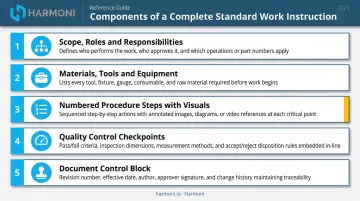
The following five components make up the operational and compliance core of every instruction:
- Scope, roles, and responsibilities — Define who executes the task, who verifies it, and who approves the instruction. In multi-operator environments, gaps in role clarity create both duplication and omission.
- Materials, tools, and equipment — List every item needed before the operator starts: tools, fixtures, consumables, PPE. They should be able to gather everything without consulting a separate document.
- Numbered procedure steps with visuals — One action per step, starting with a verb. Include visual aids at any step requiring visual confirmation and cycle time targets if the operation runs to takt.
- Quality control checkpoints — Identify where checks occur in the sequence, what to measure or verify, and what constitutes a failure condition.
- Document control block — Revision number, effective date, author, and approver. This block is non-negotiable for ISO 9001, AS9100D, or IATF 16949 compliance environments, where controlled documented information must support identification, availability, and change authorization.
Key Factors That Determine If Instructions Get Used
The most technically complete standard work instruction is worthless if operators can't find it, don't trust it, or can't access it at the moment they need it.
Accessibility at the Point of Work
Instructions must exist where the task occurs — not filed in a shared drive, not in a binder in the supervisor's office. In modern manufacturing environments, that means digital delivery at the machine.
Harmoni's factory orchestration platform addresses this directly. Using RFID-based job identification, the platform automatically surfaces the correct work instruction at the workcenter when a job is loaded — operators receive the right instruction for the right part and revision without searching for it.
At Machine Specialties, Inc. (MSI), an aerospace, defense, and medical parts manufacturer, this meant operators had job data, work instructions, and quality checksheets available at every machine — eliminating paper travelers and reducing communication gaps between operators and engineering.
A Controlled Update and Review Cycle
Instructions become outdated whenever a process changes — new tooling, revised tolerances, an ECO, a quality escape. When that happens consistently, operators stop trusting any documentation, which is more damaging than having none at all.
Establish:
- Assign a named owner to each instruction
- Define review triggers: process changes, tooling updates, quality escapes
- Schedule regular reviews for instructions that haven't been updated recently
- Give operators a direct way to flag discrepancies at the machine
Harmoni supports this through operator-initiated alerts, which allow shop floor workers to flag quality or process issues directly from their workcenter interface without leaving the machine.
Operator Training and Visible Reinforcement
A controlled revision cycle keeps instructions accurate — but accuracy alone doesn't drive adoption. Publishing an instruction is not training.
Supervisors must conduct structured reviews with operators when instructions are new or updated. Posting the instruction at the workstation and referencing it during audits and daily standups reinforces that it's the expected method, not optional guidance.
Common Mistakes When Writing Standard Work Instructions
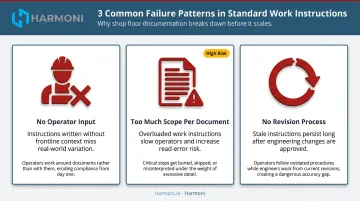
Three patterns account for most standard work instruction failures:
Authored without operator input. Engineers and managers writing instructions alone miss critical steps, use inaccurate cycle times, and fail to reflect actual working conditions. The result: instructions that get filed, not followed.
Too much scope in a single document. When one instruction covers multiple tasks, job types, or machine configurations, it becomes hard to follow and impossible to update cleanly. Each instruction should cover one task, one operator role, one configuration — nothing more.
No revision process after release. Releasing an instruction and never revisiting it after process changes drives quality escapes and audit findings. Without version control and a named review owner, instructions drift from reality within months.
Frequently Asked Questions
What is a standard work instruction?
A standard work instruction is a step-by-step document specifying how a specific task should be performed by an operator — covering the exact sequence of actions, tools required, and quality checks at each step. It's more granular than an SOP, which covers a broader process across multiple roles.
What is an example of standard work?
A CNC machine changeover procedure is a clear example — it defines the exact steps an operator takes to swap tooling, zero axes, load a part program, and verify the first-piece inspection, with cycle time targets, visual references, and sign-off requirements.
What are the three types of SOPs?
The three SOP formats are step-by-step (linear numbered instructions for simple tasks), hierarchical (steps and sub-steps for complex procedures), and flowchart-based (decision-tree format for conditional tasks). Standard work instructions fall into the step-by-step category, applied at the individual task level.
How is a standard work instruction different from a standard operating procedure?
An SOP describes how a broader process runs across multiple roles or departments. A standard work instruction zooms into a single task performed by a single operator — it's the lowest-level, most granular layer of standard work documentation.
How often should standard work instructions be updated?
Review instructions immediately after any process change, engineering change order, tooling update, or quality escape — and on a regular scheduled cadence at minimum. Assign each document to a named owner so updates don't slip through unnoticed.