Introduction
Unplanned downtime is expensive, and most manufacturers underestimate how much it actually costs them. According to Siemens' 2024 True Cost of Downtime report, a single idle production line at a large automotive plant costs $2.3 million per hour. Even for mid-size CNC shops, the math on avoidable downtime adds up fast.
The root cause is rarely the equipment. Most shops simply lack real-time visibility into what's happening on the floor when it's happening. Machine performance monitoring software closes that gap. In 2025, these platforms have matured from basic dashboards into operational infrastructure that connects machines, operators, and ERP systems into a single live view of production.
This guide covers five of the top machine performance monitoring platforms for 2025 — Harmoni, MachineMetrics, Datanomix, Scytec DataXchange, and SensrTrx — evaluated on real-time visibility, machine connectivity, ERP integration depth, operator usability, and deployment speed. By the end, you'll have a clear picture of which platform fits your shop's size, workflow, and integration requirements.
Key Takeaways
- Machine performance monitoring software captures real-time OEE, cycle times, machine status, and downtime events to improve throughput and reduce waste
- ERP and MES integration depth separates useful platforms from expensive dashboards
- Native protocol support (MTConnect, OPC UA, DNC) determines whether a platform can connect to your existing machine mix
- Top platforms coordinate operators, machines, and production workflows — not just report on them
- Top picks for 2025 include Harmoni (factory orchestration), MachineMetrics, Datanomix, Scytec DataXchange, and SensrTrx — each suited to different shop sizes and integration needs
What Is Machine Performance Monitoring Software?
Machine performance monitoring software is an IIoT-enabled platform that captures real-time data from CNC machines and production equipment — including machine status, cycle counts, spindle utilization, downtime events, and OEE components. It connects to equipment using protocols like MTConnect (now deployed across 250,000+ devices in 50+ countries), OPC UA, and direct PLC or controller integrations.
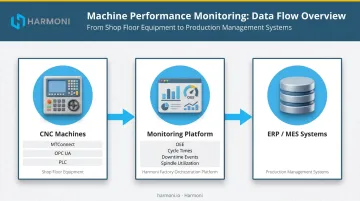
What It Replaces
Without monitoring software, shops rely on manual data collection: operators writing down cycle counts, supervisors estimating downtime causes after the fact, and production managers reviewing reports hours after problems occur. This creates a lag between when a problem starts and when anyone with authority to fix it finds out.
The core operational value of monitoring software is closing that gap — showing machine status, downtime patterns, and cycle time deviations as they happen rather than during the next shift meeting.
What to Expect in 2025
Closing that gap is now table stakes. What separates the leading platforms in 2025 is how well they fit into the broader operation:
- Does the platform integrate with our ERP, or does it create a separate data silo?
- Can it connect to every machine brand on our floor without custom development?
- Does it help operators do their jobs, or does it add another screen to manage?
The five platforms below answer these questions in different ways, each suited to a distinct type of shop and operational need.
Best Machine Performance Monitoring Software for 2025
These tools were evaluated on real-time visibility, machine connectivity breadth, ERP/MES integration, operator usability, and deployment speed.
Harmoni
Harmoni is a factory orchestration platform purpose-built for mid-to-large manufacturers. Where most monitoring tools collect data passively, Harmoni actively coordinates machines, operators, and ERP workflows in real time — a distinction that matters on high-mix, high-complexity shop floors. It connects to major CNC brands (Fanuc, Haas, Mazak, Siemens, Heidenhain, DMG MORI, Makino, Fadal) and integrates natively with ERPs including Epicor, Infor, ABAS, ODOO, and ECI JobBoss/JobBoss2.
What sets it apart: Harmoni's factory orchestration layer goes beyond dashboards. Long-range RFID automatically detects which employee is at which machine and which job is active — no manual scanning required. A command center at each workcenter then guides operators through the correct task sequence, surfaces the right work instructions and CNC programs, and enforces process controls for regulated environments (CMMC, ITAR, AS9100).
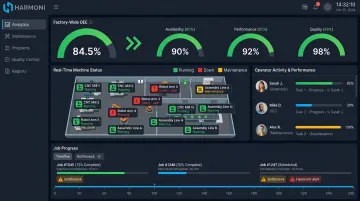
Real-time dashboards give managers simultaneous visibility into machine status, labor activity, and job progress across the entire floor.
For aerospace and defense manufacturers, Harmoni's Government Cloud deployment and machine-level multi-factor authentication (RFID badge + facial recognition) provide audit-ready data capture aligned to DFARS and CMMC requirements.
A documented customer deployment at WessDel (San Jose, CA) recovered 17 productive hours per employee per month and delivered a 5x ROI through improved data accuracy and elimination of manual ERP transactions. The platform deploys in weeks without requiring machine replacement, and has been featured in Modern Machine Shop and Crain's Cleveland Business.
| Category | Details |
|---|---|
| Key Features | Real-time OEE dashboards, RFID-based operator detection, automated task sequencing, process control enforcement, ERP-integrated job costing, digital work instructions, digital quality checksheets, Visual Factory andon lights, MFA at the machine level |
| Machine Integrations | Fanuc, Haas, Mazak, Siemens, Heidenhain, DMG MORI, Makino, Fadal; MTConnect-native where supported |
| ERP Integrations | Epicor, Infor, Infor Visual, ABAS, ODOO, ECI JobBoss, JobBoss2 |
| Pricing | Contact Harmoni directly — sales@harmoni.io · (888) 341-4097 · harmoni.io |
MachineMetrics
MachineMetrics is a cloud-based industrial analytics platform widely adopted by CNC and discrete manufacturers. It supports MTConnect, OPC UA, and PLC adapters across a broad range of machine types, and its analytics layer is one of the more mature in this category — the company raised a $20M Series B in 2021 and serves hundreds of customers globally.
Where it excels: MachineMetrics differentiates through depth of analytical reporting. It surfaces machine utilization trends, identifies repeat downtime causes, and provides predictive maintenance signals derived from sensor data. Shops that want rigorous OEE analysis and shift-level performance reporting alongside real-time alerting will find it a strong fit.
| Category | Details |
|---|---|
| Key Features | Real-time OEE, downtime reason coding, predictive maintenance alerts, shift-level analytics, automated cycle-time capture |
| Machine & ERP Integrations | MTConnect, OPC UA, PLC adapters; REST API for ERP/MES connectivity |
| Pricing | Per-machine SaaS subscription — pricing declines at volume; contact for specifics |
Datanomix
Datanomix is a machine monitoring platform focused specifically on automated cycle extraction and production analytics. It uses edge devices and MTConnect to capture cycle data directly from CNC controls — no operator input required. The company raised $12M in growth capital in 2023.
The differentiator: Datanomix automatically compares actual cycle times against programmed times, flags deviations, and builds historical performance baselines — making it particularly useful for shops where quoting accuracy and scheduling precision are primary concerns. Modern Machine Shop has documented its G-Code Cloud capabilities for supporting paperless CNC workflows.
| Category | Details |
|---|---|
| Key Features | Automated cycle-time extraction, production analytics dashboards, downtime coding, shift reporting, historical benchmarking |
| Machine & ERP Integrations | Edge devices, MTConnect; REST API for downstream integration |
| Pricing | Per-machine SaaS subscription; contact for pricing |
Scytec DataXchange
Scytec DataXchange is a retrofit-friendly monitoring platform designed for shops running mixed or legacy machine fleets. Founded in 2001, Scytec has built its product around broad hardware compatibility — including DNC connectivity and PLC adapters that bring older CNC machines online without requiring modern controllers.
Best suited for: DataXchange is the practical choice when a shop's fleet spans multiple decades of equipment. Its Status Relay Controller hardware connects legacy machines that lack any network interface. API connections to ERP, maintenance, and third-party data systems are documented and available. Note: Minitab announced an acquisition of Scytec in January 2026 — confirm current support commitments and roadmap before signing a multi-year contract.
| Category | Details |
|---|---|
| Key Features | Runtime capture, utilization tracking, downtime alerts, historical reporting, legacy machine connectivity via DNC and PLC adapters |
| Machine & ERP Integrations | DNC, MTConnect, PLC adapters; API connectors to ERP and maintenance systems |
| Pricing | Per-site or per-machine licensing; volume discounts start at 10 machines; contact for current figures |
SensrTrx (now Mingo Smart Factory, acquired by Nulogy)
SensrTrx — now operating as Mingo Smart Factory following a rebranding, and acquired by Nulogy in October 2024 — combines OEE monitoring with work-order tracking and operator input collection. It functions as a lightweight MES with monitoring built in.
Why shops choose it: Mingo connects machine data to production scheduling context. Managers can see not just whether a machine is running, but whether it is running the right job at the right pace relative to the production plan. Product direction under Nulogy's ownership is still evolving — request a current roadmap before making a long-term commitment.
| Category | Details |
|---|---|
| Key Features | OEE tracking, work-order management, operator data entry, production scheduling visibility, real-time dashboards |
| Machine & ERP Integrations | OPC UA, MTConnect (via gateway); REST API and ERP connectors available |
| Pricing | Per-site or per-module pricing; contact for pricing |
How to Choose the Right Machine Performance Monitoring Platform
The most common buyer mistake is selecting a tool based on dashboard aesthetics — then discovering post-purchase that it can't connect to half the machines on the floor, or that ERP integration requires a separate middleware project.
Five Criteria That Actually Matter
Controller compatibility: Does the platform connect to your specific controller brands and firmware versions without heavy customization? A protocol logo on a vendor's website doesn't guarantee native support for every model — ask for a compatibility matrix before signing anything.
ERP integration depth: Can the platform push job start/stop events, completed quantities, scrap counts, and updated cycle times back to your ERP in near real time? Passive monitoring that skips ERP write-back creates a second data silo rather than eliminating the first one.
Operator usability: Does the platform reduce operator burden, or add to it? The best tools surface the right information at the right moment without layering a new system on top of an existing workflow.
Deployment speed: Can the platform go live in weeks, or does it require months of configuration? Shops with urgent throughput problems need data quickly — pre-built connectors compress timelines significantly.
Observability scope: Does the platform show machine data alone, or does it combine machine status, operator activity, and production workflow in a single view? Broader scope means faster end-to-end diagnosis when something goes wrong.
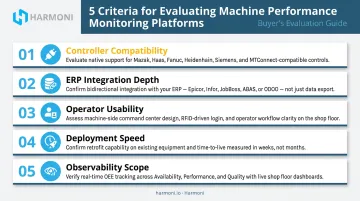
These five criteria apply across most shop environments. Regulated industries need to go a step further.
For Regulated Environments
Shops operating in aerospace, defense, or precision manufacturing should add two more questions:
- Does the platform support audit-ready data capture with traceable logs of who ran which job on which machine?
- Does it enforce process controls — revision-controlled work instructions, MFA at the machine, Government Cloud deployment — rather than just monitoring passively?
Most platforms on this list don't address these requirements. Among the options reviewed, Harmoni's process control and compliance architecture is built specifically around these environments — covering Government Cloud deployment, machine-level MFA, and revision-controlled work instructions in a single platform.
Conclusion
The best machine performance monitoring software in 2025 is the one that fits your machine mix, integrates cleanly with your ERP, and gives your team real-time visibility into production problems while they're still happening — not after the shift ends.
From there, narrow your list by machine compatibility and ERP fit, then weigh operator usability against deployment timeline. The platforms reviewed here each serve a distinct use case — the right choice comes down to your floor configuration, compliance requirements, and how much of the production workflow you want actively managed in one system.
Harmoni combines real-time machine visibility with operator coordination, process control, and full ERP integration in a single factory orchestration platform. Reach out at sales@harmoni.io, call (888) 341-4097, or book a free demo at harmoni.io/demo.
Frequently Asked Questions
What is machine performance monitoring software?
Machine performance monitoring software collects real-time data from production equipment — machine status, OEE components, cycle times, and downtime events — using protocols like MTConnect and OPC UA. That data feeds dashboards and downstream ERP or MES systems to improve throughput and scheduling accuracy.
What metrics should machine performance monitoring software track?
The core set includes OEE and its three components (availability, performance, quality), actual versus standard cycle time, downtime events with reason codes, part counts (good versus scrap), and MTTR/MTBF for reliability analysis. Platforms that also capture operator activity and job-level data provide far more diagnostic value.
How does machine monitoring software integrate with ERP systems?
Most platforms use REST APIs or pre-built connectors to push job start/stop events, completed quantities, scrap counts, and updated cycle times to the ERP in near real time — mapping CNC job IDs to ERP work orders so that production counts and job costs stay accurate without manual entry.
What is the difference between machine monitoring and factory orchestration?
Machine monitoring collects and reports on machine data passively. Factory orchestration goes further — actively coordinating operators, machines, production instructions, and ERP workflows in real time to guide execution, prevent errors, and automate non-productive steps before problems compound.
How long does it take to implement machine performance monitoring software?
Most vendors recommend a 3-to-10 machine pilot taking 4–8 weeks to reach stable data capture and baseline reporting. Platforms with pre-built machine connectors and ERP integrations can shorten that timeline considerably. Harmoni, for example, deploys in weeks without requiring machine replacement.
How much does machine performance monitoring software cost?
Most platforms charge a per-machine or per-site SaaS subscription; some add a one-time activation fee or charges for legacy connectivity hardware. Contact vendors directly for current pricing, as volume discounts typically apply at scale.