Introduction
Most manufacturers have a scheduling problem they don't fully see. The ERP system generates a plan, supervisors walk the floor expecting execution, and somewhere between those two moments — things go sideways. A machine goes down. An operator waits for instructions nobody delivered. A job that should have shipped Thursday gets discovered on Friday morning during a review meeting.
According to Siemens' 2024 downtime study, large automotive plants lose an estimated $2.3 million per hour to unplanned downtime — a figure that has doubled since 2019 even as downtime duration has decreased. The financial cost of execution failures keeps rising while the window to catch them keeps shrinking.
Real-time production planning and scheduling closes that window. It connects live machine data, operator activity, and ERP workflows into a single picture of what is actually happening on the floor, not what was assumed when the plan was built.
This article covers why static scheduling consistently fails, what real-time strategies look like in practice, how to measure their effectiveness, and what technology makes it all possible.
Key Takeaways
- Static ERP schedules break down at first contact with the shop floor — real-time planning replaces assumptions with live data.
- Five core strategies form a complete real-time scheduling system: finite capacity scheduling, dynamic re-sequencing, operator-level coordination, bottleneck identification, and actuals feedback.
- A factory orchestration layer bridges the persistent gap between ERP plans and shop floor execution.
- OEE, schedule adherence, on-time delivery, and job costing accuracy only tell the truth when actuals are captured automatically — not entered by hand.
Why Traditional Production Scheduling Breaks Down on the Shop Floor
Static scheduling has a fundamental flaw: it is built on assumptions. All machines available. No operator absences. Materials arriving exactly when needed. Those assumptions are reasonable at planning time and wrong almost immediately after production starts.
The result is what practitioners call the plan-execution gap: the distance between what the ERP says should happen and what actually occurs at the machine level. This gap rarely stays small.
A single unplanned event cascades. The machine that goes down at 7 a.m. pushes a job due at noon, which blocks a downstream work center with three jobs queued, which leaves an operator standing idle waiting for instructions that never come.
By the time a supervisor discovers the damage, it's shift-end — and the only tool for assessing it is a report that records what already happened.
The Most Common Failure Modes
Traditional planning fails in predictable ways:
- Whiteboards and spreadsheets capture the schedule as it was, not as it is — updating them requires someone to physically walk the floor, which rarely happens on time
- No systematic re-sequencing mechanism exists when a machine goes down; a supervisor rebuilds the schedule manually, under pressure, and often imperfectly
- Operators self-select their next task when plan changes go uncommunicated — sometimes that works out, often it doesn't
- Job costing data is wrong by definition when time variances aren't captured until shift end
The ISA-95 standard draws a clear boundary here: ERP systems operate at Level 4 (business planning), while manufacturing operations scheduling and execution live at Level 3. Most manufacturers have Level 4 covered. Level 3 is where real-time visibility breaks down — and where unplanned events go unmanaged until it's too late to recover the shift.
What Real-Time Production Planning Actually Means
Real-time production planning is a continuous process of capturing live data and using it to drive immediate, informed adjustments to what happens next. Basic machine monitoring is passive and descriptive — it records events after they occur. Real-time planning is active and prescriptive — it changes decisions based on what is happening right now.
The Three Data Streams That Must Feed the System
No real-time planning system works without all three of these inputs:
- Machine status data — cycle times, downtime events, utilization rates, and OEE by work center
- Operator activity data — who is on which job, how long tasks actually take, idle time, and changeover duration
- ERP workflow data — job priorities, due dates, routing sequences, and planned versus actual quantities
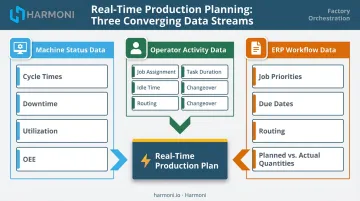
When these streams run separately, each tells a partial story. A machine running at 70% OEE looks like a performance problem until you add operator data and discover the operator has been waiting 40 minutes for setup documentation. Combining all three streams is what makes a diagnosis actionable — and that same integration is why the underlying scheduling model matters as much as the data itself.
Finite vs. Infinite Capacity Scheduling
Most ERP systems default to infinite capacity scheduling — they generate work orders assuming machines and labor are always available. This is useful for rough demand planning. It is useless for daily shop floor execution.
Finite capacity scheduling respects actual constraints: a machine that is in a maintenance cycle cannot be scheduled, an operator who is already at capacity cannot absorb another job. Shifting from infinite to finite scheduling is foundational to real-time planning — without it, the plan being "monitored" is guaranteed to be wrong before the shift starts.
Why Proactive Decision-Making Changes the Outcome
Real-time planning's practical value comes down to timing: acting while recovery is still possible. A bottleneck identified at 10 a.m. can be relieved before noon. The same bottleneck discovered at the next morning's production review is already a missed delivery.
5 Core Strategies for Real-Time Production Planning and Scheduling
Finite Capacity Scheduling Based on Live Machine Status
Effective finite scheduling requires the system to pull live OEE, downtime status, and cycle time data before sequencing jobs to a work center — not after.
If a machine is running 15% slower than standard due to a tooling issue, assigning it a full day's job queue based on standard cycle times guarantees a late shift. If a machine is in a scheduled maintenance window, booking jobs to it generates a plan that cannot execute.
The practical application: before a job is dispatched to a work center, the scheduling system should confirm that the machine is available, performing within acceptable range, and has the capacity to complete the job within its required window.
High-mix CNC environments — where setups vary significantly and machine performance fluctuates — benefit most from this approach. McKinsey's research on industrial equipment manufacturers found that data-driven planning produced 30% efficiency gains in product planning and reduced work-in-process time from three days to four hours.
Dynamic Job Re-Sequencing When Disruptions Occur
Disruptions are not exceptional events on a shop floor — they are routine. Rush orders, machine breakdowns, and material shortages happen on a predictable basis. The difference between a shop that absorbs them and one that is derailed by them is whether re-sequencing is systematic or improvised.
A real-time scheduling system needs a defined re-sequencing protocol:
- Trigger conditions — what events initiate a re-sequencing decision (machine down, priority change, material hold)
- Re-sequencing rules — how jobs are ranked when alternatives must be evaluated (due date urgency, machine capability match, job priority tier)
- Assignment logic — which work center or machine can absorb the displaced job without creating a secondary bottleneck
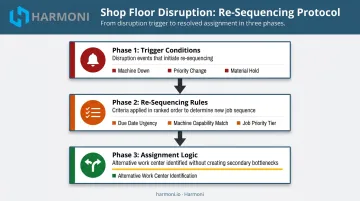
When these rules are defined in advance and applied systematically, re-sequencing takes minutes rather than hours, and the decision quality is consistent rather than dependent on whoever happens to be supervising that shift.
Operator-Level Work Coordination and Accountability
Scheduling does not end at the planning board. A perfectly sequenced schedule fails the moment an operator doesn't know which job to run next, where the setup documentation is, or whether their current job is running on time.
Operators lose significant productive time to non-value-adding activities, including:
- Searching for travelers and setup documentation
- Walking to shared terminals to log time
- Waiting for supervisor approval before starting a new job
- Selecting their next task based on what looks ready rather than what the schedule requires
Centralizing job sequences, work instructions, and real-time status at each work center eliminates most of this waste. When an operator arrives at a machine and the correct program, setup sheet, and job parameters are already displayed — automatically triggered by their identification — the gap between "what the plan says" and "what the operator does" closes to near zero.
Jabil's implementation of digital work instructions, documented in McKinsey's discrete manufacturing research, produced more than 10% higher production yield and a 60% reduction in manual-assembly-related quality issues within four weeks. Operator-level coordination is not a soft improvement — it has direct, measurable impact on yield and quality.
Real-Time Constraint and Bottleneck Identification
At any given moment, one work center is limiting your total throughput. The question is whether you identify it while it's forming or after it has already cost a shift's worth of output.
Real-time constraint monitoring means tracking queue depth, cycle time performance, and idle time by work center on a continuous basis. When one work center begins accumulating jobs while downstream centers run out of work, that signal is visible in time to act on it.
A 2021 peer-reviewed study of dynamic bottleneck management in a complex manufacturing environment reported at least 10% throughput improvement after implementing data-driven bottleneck diagnosis. The mechanism is straightforward: finding the constraint while there is still time to redistribute work within the shift recovers production time that end-of-day analysis cannot.
Across 27 peer-reviewed studies, researchers have identified 14 distinct bottleneck detection methods — reflecting how much recoverable output depends on catching constraints within the shift rather than after it closes.
Closing the Feedback Loop: Feeding Actuals Back into the Schedule
A real-time planning system is only as good as its ability to update the schedule based on what actually happened — not what was planned. Actual cycle times, actual scrap counts, actual operator hours. This feedback loop is what separates a dynamic schedule from a plan that is simply being observed while the floor drifts away from it.
The job costing implication is direct: when actuals are captured automatically and continuously, the variance between planned and actual cost is visible at the job level, in real time. A job running 20% over standard cycle time shows up as a cost problem today — not next week when accounting closes the period.
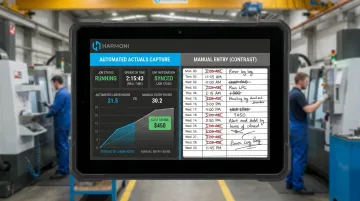
MESA identifies manual entry as a significant source of duplicate entries and errors in manufacturing data. When actuals require manual logging, they are delayed, estimated, and incomplete. When they are captured automatically — through machine connections and RFID-based operator tracking — they are immediate, accurate, and complete.
WessDel, a precision manufacturer of aerospace and defense components in beryllium and titanium alloys, found that operators were spending an average of 11 minutes per ERP transaction when manually logging time at shared terminals. After implementing Harmoni's automated actuals capture, that time dropped to seconds, producing 17 productive hours recovered per employee per month and a 5x return on ongoing platform costs.
Closing the Gap Between ERP Plans and Shop Floor Reality
ERP systems are built for planning and financial control. They generate work orders based on planned times and assumed capacity. What they cannot do is incorporate what is actually happening at the machine level, minute by minute, during an active shift.
As NIST notes, many manufacturers cannot fully leverage their ERP investments because they lack comprehensive production data — meaning top-level goals can appear on track while hidden costs accumulate in unplanned downtime, scrap, and quality losses. The ERP reflects the plan, not the floor.
The Role of a Factory Orchestration Layer
The practical solution is a system that sits between the ERP, the machines, and the operators — translating planned work orders into real-time shop floor coordination. This layer:
- Pulls job priorities, routing sequences, and due dates from the ERP
- Collects live machine status, cycle time, and OEE data from the floor
- Delivers real-time work instructions and job sequences to operators at each work center
- Pushes actuals — labor hours, quantities, scrap events — back into ERP work orders automatically
- Surfaces exceptions (jobs at risk, idle machines, overdue operations) to supervisors without requiring them to walk the floor
This is the role Harmoni was built to fill. As a factory orchestration platform, Harmoni integrates with ERP systems including Epicor, Infor, JobBoss2, ABAS, and ODOO, and connects to CNC machine controls from Mazak, Haas, Fanuc, Heidenhain, Siemens, DMG MORI, Makino, and Fadal.
Long-range RFID automatically identifies which operator is at which machine and which job they are running, removing manual time entry and paper travelers from the equation entirely.
The result is a unified view: machine data, operator activity, and ERP workflow data in one real-time picture. Machine Specialties, Inc. (MSI) — a 300-person precision manufacturer serving aerospace, defense, and medical markets — integrated Harmoni with their Epicor ERP in early 2024 and achieved near-elimination of part count errors, a shift from spindle-time to earned-hours tracking, and real-time management visibility across the entire floor.
How to Measure Real-Time Scheduling Success
Measuring scheduling effectiveness requires metrics that reflect real-time conditions — not monthly averages that smooth over the daily variation where the real problems live.
OEE: The Foundational Metric
OEE (Overall Equipment Effectiveness) measures the percentage of planned production time that is truly productive, combining:
- Availability — actual run time versus planned run time
- Performance — actual output rate versus standard rate
- Quality — good parts versus total parts produced
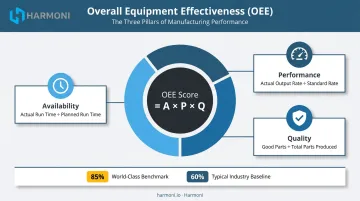
OEE.com cites 85% as a commonly referenced world-class benchmark, with many manufacturers operating near 60%. In a real-time scheduling context, OEE is only useful when it is measured continuously, broken down by work center and shift. A monthly OEE average tells you nothing about whether Tuesday's second shift on Cell 4 was the reason a job missed its delivery window.
OEE gives you the foundation — but a complete picture of scheduling health requires tracking the downstream metrics that connect machine performance to customer outcomes and financial results.
Additional KPIs That Reveal Scheduling Health
| KPI | What It Measures | Why It Matters |
|---|---|---|
| Schedule Adherence Rate | Jobs completed in planned sequence and window | Reveals how often the plan is actually being followed |
| On-Time Delivery Rate | Orders shipped by committed date | Customer-facing outcome of scheduling effectiveness |
| Operator Utilization Rate | Paid labor time on value-adding work vs. waiting/searching | Quantifies the cost of coordination failures |
| Job Cost Variance | Planned vs. actual cost per job | Financial validation that scheduling improvements are translating to profitability |
The critical qualifier for all of these: they are only reliable when actuals are captured automatically. Schedule adherence calculated from manually entered shift-end data reflects what operators remembered and logged — not what actually happened. Without automated data capture, every metric in this table is an approximation at best.
Frequently Asked Questions
What are the 5 steps of production planning?
The standard steps are: forecasting demand, resource and capacity planning, scheduling production operations, executing the plan, and monitoring and adjusting based on actual performance. Real-time data delivers its greatest value in that final step, enabling continuous adjustment based on what is actually happening on the floor rather than what was assumed at shift start.
What's the difference between MPS and MRP?
A Master Production Schedule (MPS) defines what to produce and when at the finished goods level. Material Requirements Planning (MRP) calculates the components and raw materials needed to support the MPS. Both depend on accurate input data, which is why real-time shop floor actuals are essential to keeping them reliable.
What is the difference between production planning and production scheduling?
Production planning determines what to produce, in what quantities, and with which resources over a planning horizon. Production scheduling assigns specific jobs to specific machines and operators within a defined time window. Scheduling is where real-time data has the most immediate operational impact: it is the point at which plans meet the physical constraints of the floor.
What technologies are needed for real-time production planning?
The core technology stack includes four layers:
- Machine connectivity via MTConnect, OPC-UA, or direct CNC control integration
- A factory orchestration or MES platform to collect and contextualize live data
- ERP integration for work order and priority data
- Real-time dashboards that surface actionable information to planners, supervisors, and operators at the work center level
How does real-time scheduling help reduce scrap and production errors?
Real-time scheduling reduces errors by delivering correct work instructions, revision-controlled documentation, and setup parameters to operators for the right job at the right time. Most errors trace back to outdated travelers, verbal job sequences, or operators self-selecting tasks without guidance — problems that digital, automated delivery at each work center eliminates.