Introduction
Most mid-to-large manufacturers have invested heavily in software over the past decade. Yet walk onto a typical shop floor today and you'll still find operators working from paper travelers, job costing data that doesn't match actual labor hours, and production supervisors who can't answer basic questions — like which machine is running which job right now — without physically walking the floor.
The data exists somewhere. The problem is that ERP systems, built for planning and financial record-keeping, don't reflect what's actually happening at the machine level. That gap between planned and actual performance is where production errors, wasted labor, and inaccurate job costs live.
SaaS in manufacturing is changing how companies close that gap — deploying faster than legacy systems and integrating at the machine level in ways traditional on-premise software never could. This article covers what manufacturing SaaS is, the key software categories worth understanding, and why back-office tools alone aren't enough to fix a shop floor problem.
Key Takeaways
- SaaS replaces large upfront capital costs with predictable operating expenses and faster time-to-value
- Core manufacturing SaaS categories include ERP, MES, SCM, QMS, and factory orchestration platforms
- 60% of manufacturing professionals still rely on manual processes for half their work (survey of 300+ manufacturers)
- The biggest gap in most SaaS stacks sits between ERP data and actual shop floor execution
- Evaluate manufacturing SaaS on integration depth, deployment speed, and operational outcomes — not feature count
What Is SaaS in Manufacturing?
Software-as-a-Service (SaaS) is a cloud-hosted, subscription-based delivery model. There's no on-premise hardware to purchase, no IT team managing servers, and updates deploy automatically — no waiting on release cycles.
Compare that to traditional manufacturing software. On-premise ERP and MES implementations require significant upfront capital, in-house IT resources to maintain, and upgrade cycles that often stretch years. By the time a facility finishes implementing version 10, version 12 is already out , and they're already behind.
Why Manufacturing Was Slow to Adopt
Manufacturing lagged behind other industries in SaaS adoption for legitimate reasons:
- Data security concerns — sensitive production data, engineering drawings, and ITAR-controlled information sitting in the cloud raised flags
- Machine connectivity gaps — older CNC equipment wasn't built with internet connectivity in mind
- Regulatory compliance — aerospace, defense, and medical device manufacturers face strict documentation and audit trail requirements
Those barriers have dropped substantially. Cloud infrastructure has matured, industry-specific SaaS platforms have built the compliance frameworks manufacturers need, and modern platforms can connect to machines regardless of their age or manufacturer. As NIST's Industry 4.0 guidance notes, cloud storage now enables faster, safer data management and cross-location collaboration. For manufacturers still weighing the move, that maturation is exactly what the rest of this guide addresses.
Key Benefits of SaaS for Manufacturers
Cost Structure and Deployment Speed
The most immediate advantage is financial structure. SaaS converts capital expenditure into predictable operating expense — no server infrastructure, no multi-year upgrade projects, no dedicated IT team for software maintenance.
A Forrester Total Economic Impact study of the Plex Smart Manufacturing Platform modeled a composite North American automotive supplier with $200M in annual revenue and found 400% ROI, $8.47M NPV, and payback under six months. Key benefit drivers included $6.7M from office staff productivity and $2.2M from automating production tracking and labeling. This is a commissioned single-composite study — results vary — but it illustrates the scale of value possible when SaaS genuinely replaces manual processes.
Deployment speed is the other half of the equation. Modern cloud-native manufacturing platforms can go live in weeks rather than the multi-year timelines traditional on-premise MES implementations often require. What drives that speed:
- Pre-built integrations with common ERP systems and machine controls
- Cloud hosting that eliminates infrastructure setup
- Configuration-first approaches that reduce custom development
- Vendor-managed onboarding rather than self-implementation
Scalability and Continuous Improvement
SaaS scales without re-architecting systems. Adding a second facility, a new production line, or additional users doesn't require purchasing servers or engaging IT for infrastructure changes — you expand the subscription.
Automatic updates are equally valuable. Vendors push feature releases and security patches on their own schedule. Manufacturers stay current without scheduling downtime or managing upgrade projects internally.
Real-Time Data Accessibility
Cloud-based platforms make production data accessible to plant managers, engineers, quality teams, and leadership simultaneously. In practice, information silos are one of the most expensive problems in manufacturing — and one of the most common. When quality doesn't know what production is running, and production doesn't know what engineering just revised, errors compound fast.
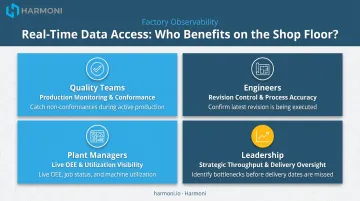
Real-time data access breaks that cycle. Consider what becomes possible when every stakeholder sees the same live picture of the floor:
- Quality teams catch non-conformances while the job is still running — not during final inspection
- Engineers confirm their latest revision is what operators are actually executing
- Plant managers see OEE, job status, and machine utilization without waiting for an end-of-shift report
- Leadership can identify bottlenecks before they become missed delivery dates
Taken together, these benefits shift manufacturing operations from reactive to proactive — and that shift has direct impact on scrap rates, on-time delivery, and labor efficiency.
Essential SaaS Categories Every Manufacturer Should Know
Enterprise Resource Planning (ERP)
ERP systems are the operational backbone: managing orders, inventory, financials, scheduling, and HR. Modern cloud ERP platforms have fully embraced SaaS delivery, with several purpose-built options for manufacturers:
- Epicor Kinetic — cloud, hybrid, and on-premise options for discrete manufacturing
- Infor CloudSuite Industrial Enterprise — AWS-hosted for machinery and metal fabrication
- ABAS — cloud hosting option for mid-sized manufacturers
- JobBOSS2 — multi-tenant SaaS cloud built for job shops
ERP is the system of record. Its limitation: it records what should happen, not always what is happening. A job can run two hours behind without ERP flagging it — and that's exactly the problem the categories below address.
Manufacturing Execution Systems (MES)
Per the ISA-95 standard, MES sits at Level 3 — between plant control systems and ERP's Level 4 business planning layer. It monitors and controls production in real time: work-in-progress tracking, quality checks, machine status, and traceability.
MES bridges planning and execution. For complex, high-mix environments, it's often the difference between knowing a job is late and knowing why it's late. The MES market is valued at $15.95B–$17.6B in 2025, with projections reaching $25–$41B by 2030–2033 depending on the analyst — a growth rate that signals sustained demand across regulated and high-complexity manufacturing sectors.
Supply Chain Management (SCM)
SCM software handles demand forecasting, supplier collaboration, inventory optimization, and order tracking. Supply chain visibility became a board-level priority after global disruption events exposed how fragile single-source procurement strategies were.
Gartner's survey of 1,300+ supply-chain professionals found two striking commitments in the aftermath of that disruption:
- 87% planned to invest in supply chain resilience within two years
- 89% planned to invest in supply chain agility within the same window
Those numbers explain why SCM SaaS adoption has accelerated — and why it's unlikely to slow down.
Quality Management Systems (QMS)
QMS tracks non-conformances, manages corrective actions, maintains audit documentation, and ensures compliance with industry standards. The relevant standards vary by sector:
- Aerospace: AS9100 / IAQG 9100:2016
- Medical devices: ISO 13485
- Automotive: IATF 16949:2016
These aren't optional frameworks. They're requirements for doing business in regulated industries. SaaS QMS platforms make the documentation burden manageable, centralizing records that would otherwise live in spreadsheets and shared drives.
Factory Orchestration Platforms
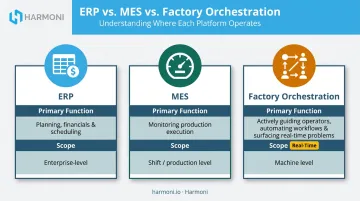
Factory orchestration is an emerging SaaS category that coordinates people, machines, ERP systems, and engineering requirements in real time on the shop floor. It's distinct from ERP (which plans) and MES (which monitors):
| Platform Type | Primary Function | Scope |
|---|---|---|
| ERP | Planning, financials, scheduling | Enterprise-level |
| MES | Monitoring production execution | Shift/production level |
| Factory Orchestration | Actively guiding operators, automating workflows, surfacing problems in real time | Machine-level, real-time |
Harmoni pioneered this category. As described by Modern Machine Shop and Production Machining, Harmoni's platform organizes shop-floor data to automate non-productive labor, strengthen process control, and unify machines, people, and data into one operating layer — sitting between ERP systems, machine controls, and operators without replacing either.
The Shop Floor Gap: Why SaaS Needs to Go Beyond the Back Office
Here's the core problem most manufacturers face: ERP data looks clean. Scheduled hours, planned costs, job statuses — it all appears organized. But on the actual floor, operators are working from printed travelers that were accurate last Tuesday, job costing is based on estimated labor because actual labor tracking takes 11 minutes per transaction, and nobody knows a machine is producing scrap until the job is already done.
An SME/Laserfiche survey of 300+ manufacturing professionals at organizations with 101+ employees found 60% used manual processes for at least half their work. That's not a technology shortage problem — most of those facilities have ERP. It's an execution gap.
What the Gap Costs in Practice
The consequences are concrete:
- Wasted operator time on manual data entry, paper-based lookups, and walking to find information
- Inconsistent process execution when operators rely on memory or outdated instructions
- Errors detected late — after the job is complete, after scrap has occurred
- Inaccurate job costing because labor records don't reflect actual time spent
- Accountability gaps that make root cause analysis nearly impossible
What Effective Shop Floor SaaS Looks Like
Effective shop floor SaaS actively guides operators through the right steps, automatically identifies who is at which machine and which job is running, and surfaces problems while production is still active — not in the next morning's report.
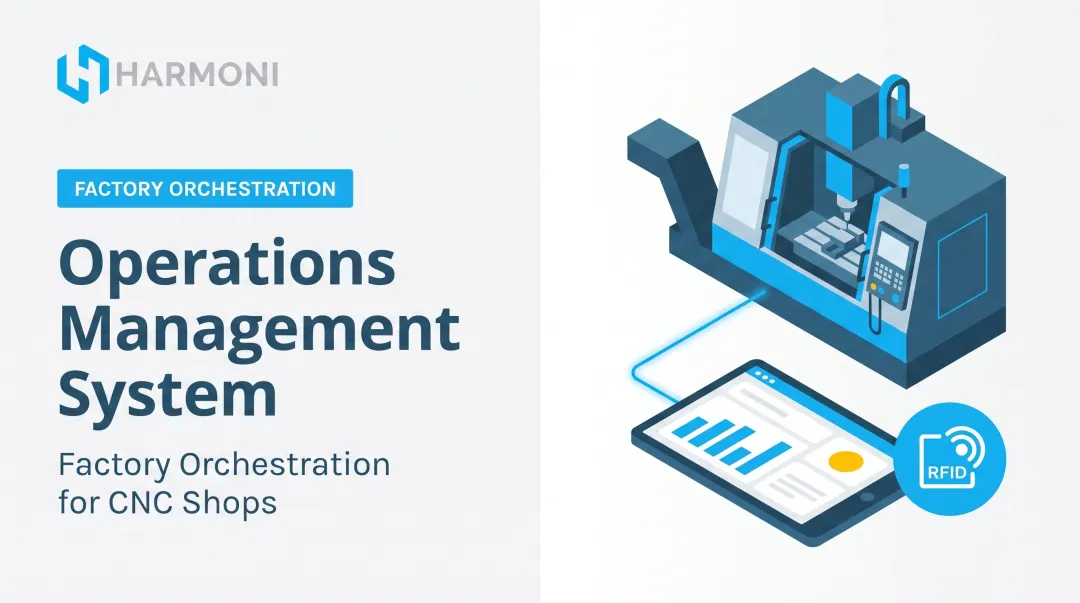
Harmoni addresses this directly. The platform's RFID system automatically matches the correct job to the right machine, operations, offsets, and work instructions — eliminating the manual selection steps where errors originate.
The measured results from real deployments show what that means in practice:
- 17 productive hours gained per employee per month at WessDel, after automating labor entry that previously cost 11 minutes per transaction
- 10% reduction in delinquent jobs from the same RFID-driven workflow deployment
- 22% scrap reduction in two months at one shop, by automating the connection between job, revision, and CNC program
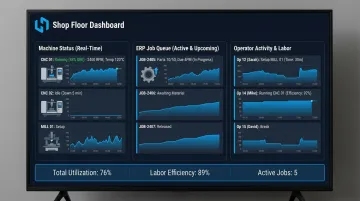
The unified dashboard view combines live machine data, ERP job data, and operator activity — giving managers the ability to catch problems during production rather than after. Machine Specialties, Inc. (MSI), a high-precision aerospace and defense manufacturer with 300+ employees, achieved near-elimination of part count errors after deploying Harmoni across their entire shop floor in early 2024.
What to Look for When Evaluating Manufacturing SaaS
Integration Depth Over Feature Count
The feature list matters less than the answer to one question: can this platform connect to your existing ERP, machines, and systems without requiring custom development?
Look for vendors with documented, maintained integrations across the systems your facility actually runs:
- ERP: Named compatibility with Epicor, Infor, JobBOSS2, ABAS, ODOO, or your specific platform
- CNC machines: Tested connectivity with Fanuc, Siemens, Haas, Mazak, Heidenhain, and others — including legacy equipment
- Data flow: Bi-directional shop floor-to-ERP sync, not one-way exports
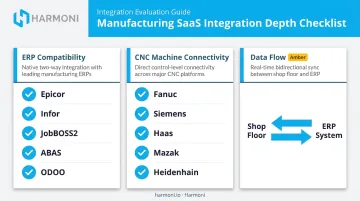
Harmoni's ERP and machine compatibility spans exactly this list, with bi-directional shop floor-to-ERP data flow and native compatibility with major CNC controls regardless of machine age.
Deployment Timeline and Vendor Support
Ask for realistic go-live timelines with references from similar manufacturers — and verify them before signing.
Epicor's Kinetic ERP offers qualified migrations in as little as 90 days. JobBOSS2 estimates 3–6 months for job shop implementations. Complex MES implementations with heavy customization often run 12–18 months. Know what you're buying.
A credible SaaS vendor provides structured onboarding support, not a configuration manual. Harmoni's installation at WessDel completed in under one week — that kind of timeline is only possible when integration work is already done and the vendor is genuinely invested in go-live success.
Real-Time Visibility vs. Data Storage
Not all manufacturing SaaS delivers visibility at the same speed. Some platforms store data and generate end-of-shift reports. Others surface problems during production — while there's still time to act.
Evaluate platforms on this distinction. Ask vendors: what does a manager see when a machine goes down unexpectedly? What happens when a quality check fails? How quickly does that information reach someone who can act on it?
Frequently Asked Questions
Which software is best for manufacturing?
The best answer depends on the operational need. ERP handles planning and financials, MES monitors production execution, QMS manages quality compliance, and factory orchestration platforms coordinate real-time shop floor activity — and the strongest stacks combine multiple purpose-built tools that integrate cleanly with each other.
What is the difference between SaaS and on-premise manufacturing software?
SaaS is cloud-hosted and subscription-based — the vendor manages infrastructure, updates, and security. On-premise software is installed locally and requires the manufacturer's IT team to maintain and upgrade it. SaaS generally offers lower upfront cost and faster deployment, though implementation timelines vary by category and complexity.
What is a Manufacturing Execution System (MES) and do I need one?
An MES monitors and controls production processes in real time, filling the gap between ERP planning and physical shop floor activity. Manufacturers with complex, high-mix production environments typically see the strongest benefit — though emerging factory orchestration platforms can address similar gaps with broader scope.
How long does it take to implement SaaS software in a manufacturing facility?
It varies significantly by platform and scope. Cloud-native ERP migrations can run 90 days to 6 months for qualified deployments, while complex MES implementations with extensive customization can take much longer. Key factors include integration complexity, user count, and the vendor's onboarding process.
Can SaaS manufacturing software integrate with existing ERP systems and CNC machines?
Yes. Enterprise-grade manufacturing SaaS platforms are built with integration in mind. Harmoni, for example, connects natively to Epicor, Infor, JobBOSS2, ABAS, and ODOO on the ERP side, and to Fanuc, Siemens, Haas, Mazak, Heidenhain, DMG MORI, and others on the machine side. Integration depth should be a primary evaluation criterion, not an afterthought.
What are the biggest challenges manufacturers face when adopting SaaS?
The most common barriers are data security concerns, operator resistance to changing established workflows, and the complexity of integrating modern SaaS with older machines or existing on-premise systems. Phased rollouts and hands-on vendor implementation support reduce these risks substantially.