
Introduction
Managing a manufacturing workforce isn't a scheduling problem — it's an execution problem. Plant managers are juggling rotating shifts across multiple machines, tracking labor against ERP job orders, and trying to spot production problems before a shift ends rather than after a scrapped part confirms one.
The labor picture isn't getting easier. BLS data from June 2026 puts U.S. manufacturing employment at 12.6 million workers, with 529,000 open positions and a monthly quits rate that keeps supervisors constantly backfilling seats. The Manufacturing Institute projects 3.8 million manufacturing openings by 2033, with nearly half potentially unfilled.

That pressure demands more than basic scheduling. Modern manufacturers need software that handles shift complexity and payroll compliance — and tools that coordinate operators, machines, and ERP workflows on the shop floor in real time.
This guide covers both layers: the enterprise WFM platforms that manage scheduling and compliance at scale, and the factory orchestration platforms that go deeper into shop floor execution.
Key Takeaways
- Two distinct problems require two distinct tool types: scheduling/compliance vs. real-time shop floor execution
- Enterprise platforms (UKG, Dayforce, Indeavor) excel at union rules, payroll accuracy, and multi-site scheduling
- Factory orchestration (Harmoni) connects operators, machines, and ERP data in real time to close execution gaps that administrative tools can't reach
- Implementation speed matters: purpose-built platforms often deploy in weeks; enterprise WFM typically takes months
- Start with your gap: compliance problems need WFM; shop floor visibility problems need orchestration
What Is Manufacturing Workforce Management Software?
Manufacturing workforce management (WFM) software is a digital system that helps plants schedule shifts, track time and attendance, enforce labor compliance, and monitor workforce productivity — purpose-built for shift-based industrial environments where generic HR tools fall short.
In manufacturing specifically, WFM must handle:
- 24/7 rotating crew schedules (2-2-3, continental, and custom patterns)
- Union contract enforcement — seniority rules, overtime equity, mandatory rest windows
- Multi-site labor tracking across facilities
- Production-demand forecasting tied to order volume and output targets
The global WFM market reached $9.57 billion in 2025 and is projected to hit $15.67 billion by 2030 at a 10.4% CAGR — with manufacturing as one of the primary growth segments.
Advanced WFM platforms extend into factory orchestration: real-time integration with CNC machines, ERP workflows, and operator activity that turns scheduling data into shop floor accountability. The tools below cover that full spectrum, from enterprise compliance suites to execution platforms built for the shop floor.
Best Manufacturing Workforce Management Software in 2026
These tools were evaluated against real manufacturing demands: shift complexity, compliance depth, ERP integration, shop floor usability, and operational visibility.
Harmoni
Harmoni is a factory orchestration platform built for mid-to-large precision manufacturers — sitting between ERP systems, MES platforms, CNC machines, and frontline operators to eliminate wasted time, prevent production errors, and deliver real-time shop floor visibility.
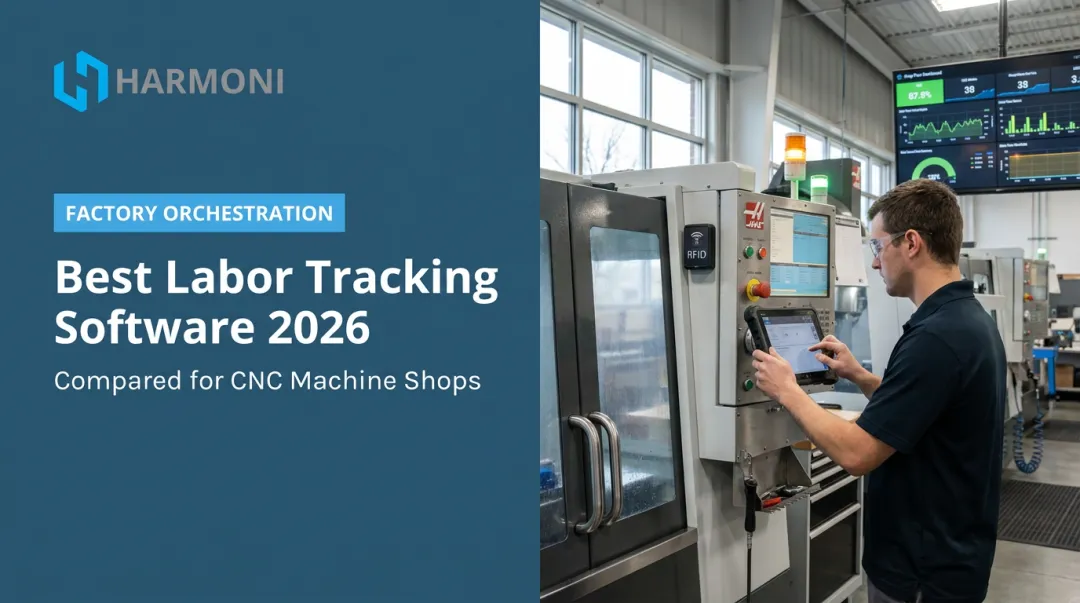
Where traditional WFM tools manage schedules and payroll from the office, Harmoni deploys a centralized command center at each workcenter. Long-range RFID technology automatically detects nearby employees and active jobs, triggering the correct CNC programs, work instructions, and digital checksheets at the machine without operator hunting. Machine data, operator activity, and ERP workflows converge into a unified real-time dashboard, so managers can identify problems while they're happening, not after the shift ends.

The platform natively integrates with major ERPs (Epicor, Infor, Infor Visual, ECI JobBoss/JobBoss2, ABAS, ODOO) and CNC controls from Mazak, Haas, Fanuc, Heidenhain, Siemens, DMG MORI, Makino, and Fadal. No machine replacement required — Harmoni retrofits to existing equipment.
One documented outcome: at WessDel, Harmoni reduced ERP transaction time from 11 minutes to seconds, yielding 17 productive hours gained per employee per month and a 5x return on ongoing platform costs.
| Attribute | Details |
|---|---|
| Best For | Mid-to-large precision manufacturers (CNC machining, aerospace, defense, automotive) needing real-time shop floor execution visibility beyond scheduling and payroll |
| Key Features | Factory orchestration (automation, process control, observability); RFID-based operator detection; real-time machine + ERP + operator dashboards; accurate job costing; automated CNC program loading; digital work instructions |
| Pricing | Contact Harmoni for pricing at harmoni.io or sales@harmoni.io |
UKG Pro Workforce Management
UKG Pro is one of the most established enterprise WFM platforms for large manufacturing operations, combining the legacy Kronos time-and-attendance engine with HR, payroll, and talent tools in a single suite designed for unionized, high-volume shift environments.
Two capabilities separate it from generalist schedulers:
- Union rule automation: Enforces seniority-based overtime distribution, mandatory rest windows, and contract-specific pay rules directly in the scheduling engine, cutting grievances before they reach arbitration
- Production-demand forecasting: Pulls from historical output and order volume to align staffing against expected workload, not last week's headcount
Gartner Peer Insights rates UKG Pro WFM at 4.1/5 from 432 reviews in 2026, and UKG received a 5/5 for workforce and advanced scheduling in the Q4 2025 Forrester Wave for HCM Solutions.
| Attribute | Details |
|---|---|
| Best For | Large unionized manufacturing plants needing automated union rule enforcement and advanced labor forecasting |
| Key Features | Union rule automation; rotating crew scheduling; multi-state payroll compliance; real-time attendance monitoring; mobile self-service; production-demand labor forecasting |
| Pricing | Contact sales for pricing; free demo available |
Dayforce (Ceridian)
Dayforce is an enterprise HCM platform with a standout single-database architecture: scheduling, compliance monitoring, and payroll all run from one source of truth, so labor costs update the moment a schedule change is approved rather than at the end of the pay period.
For manufacturing specifically, two features carry real operational weight:
- Continuous gross-to-net payroll calculation: Compliance errors surface before payroll closes, not after a DOL investigation
- Dayforce Wallet (earned wage access): A direct retention lever in a market where manufacturing quits hit 180,000 in May 2026 alone. Dayforce's own 2021 research claims Wallet reduces 90-day attrition by up to 25% among hourly employees
Dayforce was named a Leader in Gartner's 2025 Magic Quadrant for Cloud HCM Suites for the sixth consecutive year, with manufacturing customers including Spirit AeroSystems, Spectrum Brands, and Sherwin-Williams.
| Attribute | Details |
|---|---|
| Best For | Mid-to-enterprise manufacturers needing real-time compliance monitoring and continuous payroll accuracy across multi-site operations |
| Key Features | Single-database scheduling + payroll; continuous gross-to-net calculation; real-time compliance alerts; Dayforce Wallet (earned wage access); multi-country support |
| Pricing | Contact sales for pricing; free demo available |
Connecteam
Connecteam is a mobile-first workforce management platform designed for deskless frontline teams — well-suited for smaller or mid-size manufacturing operations that need fast scheduling, reliable clock-in, and team communication without an enterprise implementation timeline.
Three features translate directly to manufacturing use:
- Kiosk mode turns a single tablet into a shared punch clock with selfie photo capture at clock-in to deter buddy punching
- Built-in team chat replaces personal messaging apps for shift coordination without IT overhead
- Digital safety checklists attach directly to the clock-in flow, making compliance part of the punch rather than a separate step
It won't handle complex CBA rules or production-demand forecasting, but for teams that need a reliable digital foundation fast, the $29/month entry price delivers clear value.
| Attribute | Details |
|---|---|
| Best For | Deskless manufacturing teams needing fast deployment, mobile scheduling, and frontline communication tools |
| Key Features | Kiosk clock-in with selfie verification; drag-and-drop scheduling; team chat; GPS geofencing; digital safety checklists |
| Pricing | From $29/month (billed annually for first 30 users); 14-day free trial available |
Indeavor
Indeavor is a workforce scheduling platform built specifically for complex 24/7 manufacturing environments — particularly operations with intricate union agreements, certification requirements, and multi-facility coverage obligations.
Its deterministic scheduling engine ingests union contracts, seniority rules, fatigue limits, and certification requirements directly, automatically applying all of them when building rosters and filling open shifts. Automated shift bidding broadcasts open positions only to workers who are qualified, eligible, and not at a fatigue-rule limit, covering gaps without manager phone calls. Deployments typically complete in 60–90 days.
| Attribute | Details |
|---|---|
| Best For | Large multi-facility manufacturers with complex union contracts, certification tracking, and 24/7 shift coverage requirements |
| Key Features | Automated union rule enforcement; shift bidding; fatigue management; certification-based assignment filtering; real-time labor analytics |
| Pricing | Contact sales for pricing; free demo available |
How We Chose the Best Manufacturing WFM Software
These tools were assessed against real manufacturing demands — not generic workforce scheduling. A common mistake: selecting retail-oriented scheduling tools that struggle with 24/7 rotation patterns, union rule complexity, and production-tied labor forecasting, then spending months patching gaps.
Deloitte's 2025 Smart Manufacturing survey found 46% of large manufacturers had moderate-to-significant difficulty filling planning and scheduling roles — making systems that encode plant rules and constraints, rather than relying on manual interpretation, a direct business need rather than a nice-to-have.
Core evaluation factors:
- Shift and rotation modeling — Does it handle 2-2-3 and continental patterns without manual patching?
- Compliance automation — Does it enforce union and labor rules before publication, not after a grievance?
- ERP and machine integration — Does it connect labor data to production activity?
- Shop floor usability — Will non-desk workers actually use it without a training marathon?
- Implementation timeline — How quickly does it deliver measurable value?

Beyond the core five, pricing transparency, multi-site scalability, and the depth of manufacturing-specific vendor support were also weighted in the evaluation.
The compliance stakes justify that scrutiny. A 2024 DOL investigation recovered $154,009 in back wages and assessed $128,589 in penalties against a plastics manufacturer that failed to include attendance and quality bonuses in overtime calculations for 743 workers. A system that performs in a demo but miscalculates overtime on a union contract creates the exact liability it was supposed to prevent.
Conclusion
Manufacturing workforce management has two layers, and they require different tools.
Enterprise platforms like UKG Pro, Dayforce, and Indeavor own the scheduling and compliance layer — shift modeling, union rule enforcement, payroll accuracy. If your core problem is grievance reduction, overtime compliance, or payroll accuracy across a large hourly workforce, those platforms are built for exactly that.
The shop floor execution layer is a different problem: who is working on what job, on which machine, against which ERP work order, right now. That's where scheduling software stops and factory orchestration platforms like Harmoni begin.
Harmoni connects operators, machines, and ERP workflows into a unified real-time view — so managers catch problems during production instead of discovering them in the next shift review.
Identify which gap you're closing before you select a platform. Scheduling and compliance problems call for enterprise WFM tools. Real-time shop floor visibility is a separate challenge — one that requires a purpose-built solution.
Manufacturers looking to go beyond scheduling can explore Harmoni's factory orchestration platform at harmoni.io, request a demo at harmoni.io/demo, or reach the team directly at sales@harmoni.io.
Frequently Asked Questions
What is the best workforce management software for manufacturing?
It depends on the problem being solved. UKG Pro and Dayforce lead for scheduling, compliance, and payroll across large hourly workforces. Platforms like Harmoni serve manufacturers who need real-time shop floor execution visibility — connecting operators, machines, and ERP data — where traditional scheduling tools fall short.
What are the 4 pillars of workforce management?
The four core pillars are time and attendance tracking, employee scheduling and shift planning, labor forecasting and demand planning, and compliance management (labor law, union rules, and regulatory adherence). In manufacturing, a practical fifth layer applies: shop floor execution and real-time operational visibility.
What is the difference between workforce management software and factory orchestration software?
WFM software handles HR-layer functions — scheduling, payroll, attendance, and compliance. Factory orchestration software coordinates real-time activity between operators, machines, and ERP systems on the shop floor, addressing execution gaps rather than administrative ones. The two are complementary and often deployed together.
Can manufacturing workforce management software integrate with ERP systems?
Most enterprise WFM platforms integrate with SAP, Oracle, Infor, Epicor, and similar systems. Factory orchestration platforms like Harmoni go further, sitting between ERP and the shop floor to combine job data with live machine and operator activity.
How long does it take to implement workforce management software for a manufacturing plant?
Enterprise platforms like UKG and Dayforce typically require multi-month implementations depending on configuration complexity. Indeavor states 60–90 day deployments. Purpose-built manufacturing platforms like Harmoni are designed to deploy in weeks — making implementation timeline a critical selection factor alongside features.
What features should I prioritize when choosing manufacturing workforce management software?
Key priorities to evaluate:
- Shift rotation and scheduling complexity handling
- Union rule automation
- ERP and machine integration capability
- Shop floor clock-in usability for deskless workers
- Real-time labor analytics and compliance tracking
The weight of each depends on plant size, union status, and whether the primary need is administrative accuracy or operational visibility.