Introduction
A defective batch ships to an aerospace customer. No one can pinpoint which machine ran it, which operator was at the controls, or which process step introduced the error. What started as a quality issue becomes a containment crisis: production halted, engineers pulling paper travelers, supervisors interviewing operators, and a customer relationship at risk.
This scenario plays out regularly in precision manufacturing environments. The root cause isn't the defect itself. It's the absence of a system that would have caught it before it shipped.
This guide covers what supply chain traceability systems actually are, the four types manufacturers need to understand, the technologies that power them, how to implement one, and how real-time visibility turns traceability from a reactive tool into a proactive control layer.
Key Takeaways
- Traceability means reconstructing a product's full history — not just knowing where it is today
- Aerospace, automotive, and medical device manufacturers face binding traceability requirements under AS9100, IATF 16949, and FDA QMSR
- Four traceability types matter: upstream, downstream, internal, and external — and high-performing shops build all four into their quality systems
- Real-time data capture prevents defects; after-the-fact data capture only documents them
- ERP integration is non-negotiable: traceability data without job context cannot drive meaningful corrective action
What Is a Supply Chain Traceability System?
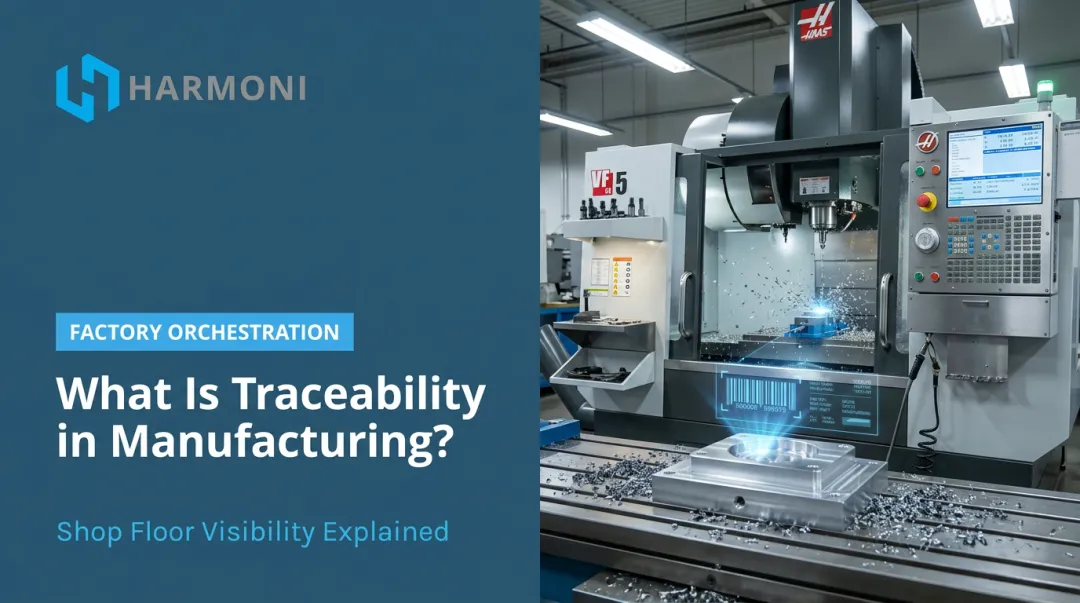
A supply chain traceability system is the combination of tools, processes, and data records that track a product's movement, transformation, and history at every stage — from raw material receipt through production operations and final delivery. The result is a continuous, verifiable chain of custody that can be reconstructed on demand.
Tracking vs. Traceability
These terms are often used interchangeably, but GS1's Global Traceability Standard draws a clear directional distinction:
- Tracking follows a product downstream — locating it through later observations as it moves forward through the supply chain
- Tracing reconstructs a product's history upstream — identifying its origin, characteristics, and prior handling through earlier recorded observations
Most manufacturers need both. Locating a shipment today is useful. Knowing which raw material heat, which machine, and which operator produced it becomes critical when something goes wrong.
Supporting both tracking and tracing requires capturing three distinct categories of data. A complete traceability system addresses each one:
The Three Core Data Layers
- Identity and origin — what the product is, its lot or serial number, and where the materials came from
- Process history — what operations were applied, on which equipment, by whom, and under what parameters
- Disposition — where the product went after leaving each stage
Internal vs. Supply Chain Traceability
These two scopes address different parts of the chain:
- Internal traceability covers what happens inside a single facility — machine parameters, operator assignments, inspection results, program versions
- Supply chain traceability spans multiple organizations and tiers, following material from raw stock supplier through subcontractors to the end customer
Aerospace, defense, and precision machining manufacturers need both. A shop may have excellent internal records but no visibility into incoming material certifications. Neither alone satisfies a Tier 1 prime's audit requirements.
Regulatory Dimension
Three major standards define traceability requirements across regulated manufacturing sectors:
| Standard | Relevant Clauses | Scope |
|---|---|---|
| AS9100 Rev D | 8.5.2, 8.5.1(n) | Aerospace — product identification, traceability, evidence of completed operations |
| IATF 16949:2016 | 8.5.2, 8.5.2.1 | Automotive — identification and traceability, supplemental requirements |
| FDA QMSR / ISO 13485 | 7.5.9, 820.35 | Medical devices — traceability procedures, UDI recording, batch records |
Boeing's supplier quality requirements take this further: Boeing D6-87282 requires quality records traceable to supplied products to be retained for at least 10 years from actual shipment, with metallic raw materials requiring documented chain of custody including heat and lot identity.
Why Traceability Matters in Manufacturing
Regulatory Compliance and Auditability
In aerospace and defense manufacturing, traceability records aren't generated for internal use — they're generated because customers and regulators will ask for them. AS9100 clause 8.5.1(n) requires evidence that planned production and inspection operations were completed, including identification of the operator and inspector where applicable. Without a system that captures this automatically, shops either rely on paper travelers (which go missing) or reconstruct records during audits (which creates risk).
Quality Control and Scrap Reduction
When a non-conformance is detected, the first question is always: how many other parts are affected? Without lot-level traceability, the answer is usually "we don't know" — which means over-containment, excessive scrap, and unnecessary rework. With traceability, a single query identifies:
- Every part in the affected lot
- Every operation that touched it
- Whether the suspect condition existed at each stage
Accurate Job Costing
Traceability data and job cost accuracy are directly connected. When actual machine time, operator time, and material consumption are captured per job, cost reporting reflects reality. Without that data, shops estimate — and estimates distort profitability analysis in ways that often don't surface until margins have already eroded.
Platforms like Harmoni address this by integrating CNC spindle data and operator labor data with ERP records, so managers can compare actual versus planned costs using factual data rather than time studies or operator self-reporting.
Recalls and Containment Speed
NHTSA reported 950 vehicle recall campaigns affecting over 29 million vehicles in calendar year 2024 alone. The speed at which a manufacturer can identify and contain affected parts directly determines the scope and cost of that event. Digital traceability systems compress containment from days to hours by providing immediate, queryable records rather than manual searches through paper files.
Contract Eligibility
Traceability capability has become a prerequisite for supplier qualification. Shops pursuing contracts with aerospace Tier 1 primes must demonstrate that their quality records meet retention, accessibility, and completeness requirements — and that those records are generated systematically, not reconstructed retroactively.
The Four Types of Supply Chain Traceability
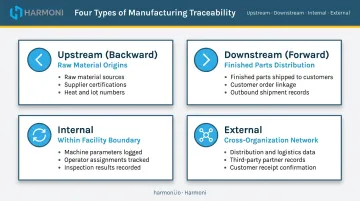
GS1's traceability framework recognizes two directional dimensions (upstream/downstream) and two organizational dimensions (internal/external). Together they form four distinct traceability types that manufacturers should understand:
| Type | Direction | What It Covers |
|---|---|---|
| Upstream (backward) | Toward origin | Raw material sources, supplier certs, heat/lot numbers |
| Downstream (forward) | Toward customer | Where finished parts or assemblies were shipped |
| Internal | Within facility | Machine parameters, operator assignments, inspection results, program versions |
| External | Outside facility | Distribution, logistics, customer receipt |
Which Types Matter Most for Precision Manufacturers
Internal traceability is where CNC machining and aerospace environments spend most of their compliance effort. Regulators and OEM customers typically require documentation of:
- Which machine ran which operation
- What operator performed or verified the work
- What CNC program was used and at what revision
- What inspection results were recorded at each stage
Internal records alone don't satisfy a full audit. Upstream traceability — confirming that incoming material ties to a certified heat and meets the drawing specification — is just as critical in aerospace environments where raw material substitution or counterfeit parts carry serious consequences.
Manufacturers that close this loop build integrated systems where a single query returns the complete history: from raw stock receipt and supplier certification, through every machining operation and inspection step, to the specific customer shipment.
Technologies That Enable Traceability
Barcodes and QR Codes
Barcodes and QR codes form the baseline of most traceability implementations. They identify parts, jobs, travelers, and materials at each stage — scannable at receiving, workcenters, inspection, and shipping. Low cost, widely compatible, and straightforward to deploy.
The limitation is structural: they require someone to scan them. If an operator skips a scan, the record has a gap. Barcodes document what someone chose to record — not necessarily what actually happened.
RFID
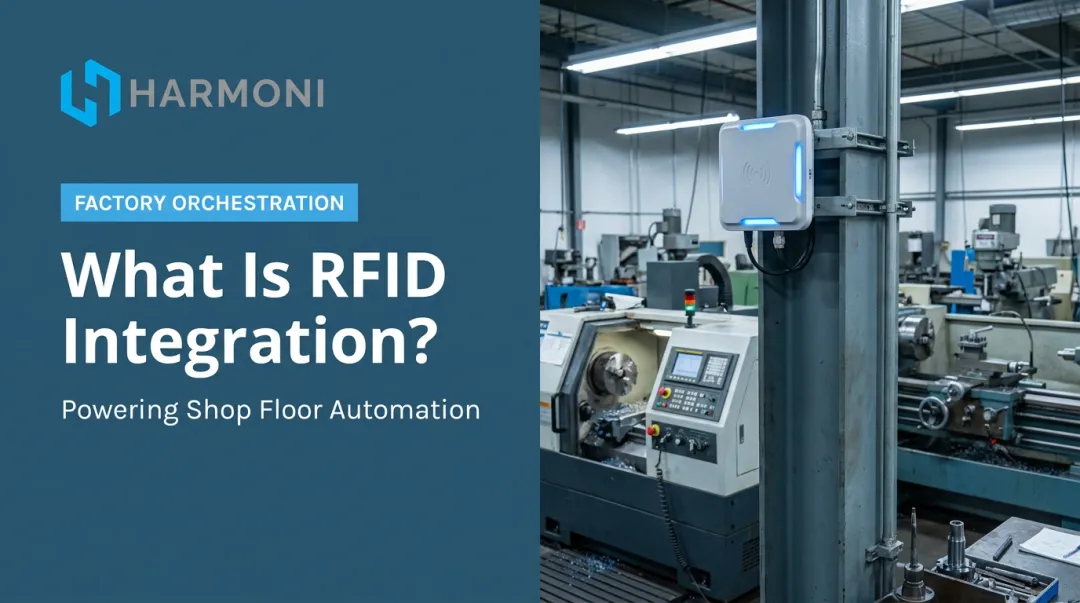
RFID enables contactless, automatic identification without requiring line-of-sight scanning. Parts, job travelers, or operator badges can be read automatically as they move through the shop, capturing timestamps and associations (including which operator is at which machine) without manual intervention.
Harmoni's factory orchestration platform uses long-range RFID to automatically detect nearby employees and job assignments at each workcenter, linking operator identity to machine activity and ERP records in real time. This creates a continuous traceability record at each operation without relying on operators to initiate data capture.
IoT Sensors and Machine Data
Connected CNC machines stream real-time process data including spindle speed, cycle time, feeds and speeds, and alarm states. This serves as process traceability: evidence that a part ran within specified parameters. MTConnect, now at Version 2.5 (February 2025), provides an open semantic standard for collecting this data across machines from multiple control manufacturers.
One critical caveat applies: machine data only functions as traceability evidence when tied to specific job and part records. Key requirements include:
- Timestamp data linked to a named job order and part number
- Operator identity associated with the machine session
- Process parameters mapped to the routing step, not just the machine
- Records connected to ERP job records for audit retrieval
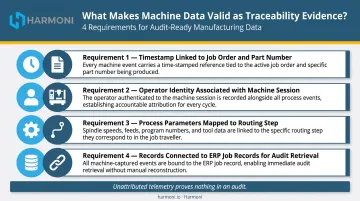
Unattributed telemetry proves nothing in an audit.
ERP and Factory Orchestration Software
ERP systems hold the plan: routings, material specifications, job orders, and BOM structures. Factory orchestration platforms like Harmoni capture what actually happened — operator activity, machine performance, cycle times, quality checksheet results — and link that execution data back to ERP job records.
The gap between these two layers is where most traceability failures occur. A shop may have complete ERP records of what was planned and complete machining logs of what ran. But if those datasets aren't linked at the job and part level, the resulting records can't reconstruct a part's full production history.
Blockchain (Emerging)
Blockchain creates tamper-proof, distributed records suited to multi-tier supply chains where trust between parties must be established without a central authority. NIST has studied its application to manufacturing traceability, noting its value for cross-organizational data sharing where auditability and integrity are paramount.
For most job shops and precision manufacturers, blockchain is more relevant to external supply chain traceability between organizations than to internal shop floor data capture.
How to Implement a Traceability System
Step 1 — Define Scope and Data Requirements
Before selecting any technology, define what you're actually trying to trace:
- Scope — which products and processes require traceability records (all jobs, or only regulated contract work)?
- Data Points — lot numbers, material certs, machine parameters, operator IDs, CNC program versions, inspection results?
- Access Rights — quality engineers, customers, regulatory auditors, production supervisors?
- Retention Period — how long must records be kept? (Boeing requires 10 years minimum from shipment.)
Starting with scope prevents the common mistake of deploying a system that captures everything but answers nothing during an audit.
Step 2 — Select Technologies and Integrate Systems
Match technology to environment:
- High-volume, repeat parts → barcodes or RFID for fast, consistent identification
- High-mix, compliance-critical environments → RFID plus machine data capture for automatic, operator-independent records
- Multi-tier supply chain requirements → ERP integration with upstream material cert management
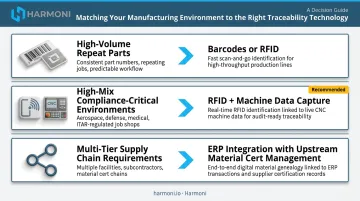
The most critical decision at this stage is whether the traceability system integrates with your ERP. Traceability data without job context is unverifiable. ERP integration links captured shop floor events to planned job records — proving a specific part was produced to a specific routing, by a qualified operator, at documented parameters.
Harmoni connects to major CNC controls (Mazak, Haas, Fanuc, Heidenhain, Siemens, DMG MORI, Makino, Fadal) and integrates natively with Epicor, Infor, Infor Visual, JobBoss, ABAS, and ODOO — and deploys in weeks without requiring machine replacement.
Step 3 — Validate, Train, and Improve
- Run a pilot on a defined product line or work cell before full rollout
- Train operators on data capture workflows — explain why each scan or check-in matters
- Audit record completeness regularly, not just during customer audits
- Define how traceability data feeds into corrective action processes — the data is only valuable if it's used
That last point plays out clearly in practice. WessDel, an aerospace and defense machine shop, completed Harmoni's installation in under one week, with operators seeing productivity gains from day one. Within the first few months, they had expanded into work instructions, program loading, digital checksheets, and cycle time analysis. Phased rollout consistently outperforms big-bang deployments — in capability adoption and operator buy-in.
How Real-Time Shop Floor Visibility Strengthens Traceability
Traditional traceability systems have a structural limitation: they capture data after the fact. Records are written at job close, shift end, or during an audit review. By that point, an entire lot may have been produced, inspected, and packaged — with a non-conformance baked in throughout.
The Cost of After-the-Fact Discovery
The difference between catching a defect at the machine versus catching it at the customer is measured in orders of magnitude — in scrap, rework, expediting, and customer relationship cost. World Economic Forum lighthouse data supports this: Continental Automotive's deployment of digital shop floor solutions was associated with a 10% reduction in field incidents, while GE HealthCare's AI-driven defect detection delivered a 73% reduction in customer complaints. Both outcomes share a common driver — defects caught in process, not after shipment.
What Real-Time Traceability Looks Like
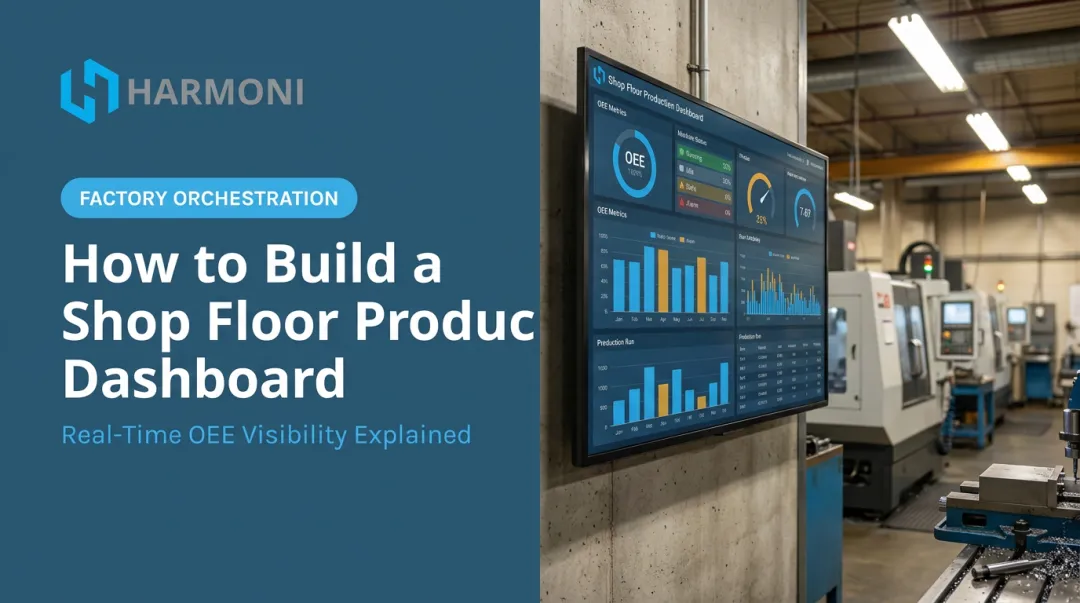
When machine data, operator activity, and job status are captured continuously and automatically, traceability shifts from a documentation function to an operational control layer. Supervisors can verify — in real time — whether:
- The right job is running on the right machine
- A qualified, identified operator is at the controls
- The correct CNC program and revision is loaded
- The job is running within expected cycle time parameters
Intervention becomes possible before a defect is produced, not after an entire batch has been completed.
Harmoni as a Factory Orchestration Layer
Harmoni sits between ERP systems, machines, and operators, combining machine data with RFID-captured operator activity and ERP job workflows into a unified operational layer. The results at customer sites reflect what real-time traceability actually delivers in practice:
- Machine Specialties, Inc. (MSI) — a high-precision aerospace, defense, and medical parts manufacturer — nearly eliminated part-count errors on complex, high-risk parts while giving management real-time shop floor visibility
- WessDel, a dedicated aerospace and defense shop, reduced a time-tracking process from 11 minutes per ERP transaction to seconds, generating 17 productive hours per employee per month and a 5x return on ongoing platform costs
- One additional Harmoni customer reduced scrap by 22% in two months after gaining visibility into which jobs were running at which parameters
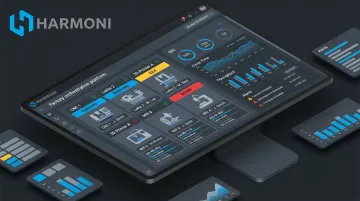
These outcomes are achievable without ripping out existing equipment. The platform deploys in weeks, integrates with existing ERP systems and machine controls, and includes a Government Cloud option for defense contractors handling Controlled Unclassified Information (CUI).
Frequently Asked Questions
What is a traceability system?
A traceability system is a set of tools and processes that track a product's movement and transformation through every stage of the supply chain — from raw material sourcing through production to final delivery. The result is a verifiable record that can be retrieved on demand for quality reviews, customer audits, or regulatory inspections.
What are the different types of traceability systems?
The four main types are upstream (backward) traceability, downstream (forward) traceability, internal traceability, and external traceability. Upstream traces a product to its raw material origins; downstream tracks where finished goods shipped; internal records what happened at each operation inside the facility; external follows the product through distribution. Most manufacturers need all four.
What is an example of a traceability system?
A precision aerospace parts manufacturer using RFID operator identification, CNC machine data capture, digital quality checksheets, and ERP integration can record — for every part — which operator ran which operation, on which machine, and against which inspection criteria. That complete record is queryable from raw stock receipt to customer delivery.
What technologies enable traceability?
The core technologies include barcodes and QR codes for part identification, RFID for automatic contactless data capture at the operator and job level, and IoT-connected machines for real-time process data. ERP or factory orchestration software ties all of those records together into one searchable, auditable system.
How does traceability help prevent production errors?
Real-time traceability lets supervisors verify that the right job is running on the right machine with the correct operator and program before a defect occurs — rather than discovering a non-conformance after an entire lot has been produced, inspected, and shipped.
Does a traceability system need to integrate with an ERP?
ERP integration is essential. ERP holds the job plan, routing, material specifications, and customer requirements. Without linking shop floor data to those records, captured data lacks the context needed to prove compliance, support accurate job costing, or reconstruct a part's full production history during an audit.