That moment—two minutes of silence between a capable person and a capable machine—is the worker-machine relationship in its most honest form. Two systems that depend entirely on each other, failing to communicate.
This isn't a rare edge case. It's the default state on shop floors where information flows through paper travelers, verbal handoffs, and disconnected ERP systems. The worker-machine relationship defines how efficiently a shop runs, how errors get caught or missed, and whether operators are set up to succeed before the first chip falls.
Key Takeaways
- The worker-machine relationship is the structured interdependence between operators and the machines they run, monitor, and maintain
- Automation reshapes this relationship rather than ending it—cognitive demands rise as physical ones shift
- Idle time is a systems problem, not a staffing problem: misaligned operator and machine cycles are the cause
- Information gaps at job start are the most common breakdown point, leading to setup errors and scrap
- Harmoni coordinates machines, ERP data, and operators together—from job start through completion
What Is the Worker-Machine Relationship?
The worker-machine relationship is the structured interdependence between a human operator and the machine—or machines—they are responsible for operating, monitoring, or maintaining. It covers three interconnected elements: the physical tasks the worker performs, the information they need to perform those tasks correctly, and the feedback loops that connect human action to machine output.
This is distinct from simple automation. Even in automated CNC environments, workers remain essential for setup, quality verification, exception handling, and changeover decisions. The machine executes the program; the operator validates everything the program cannot judge for itself.
Synchronous vs. Random Servicing
Industrial engineering has a precise framework for analyzing these relationships. The worker-machine process chart—classified by the Institute of Industrial and Systems Engineers (IISE) as a work design analysis tool—maps operator activity and machine activity on a shared timeline. The goal is to expose idle time on both sides and show where their rhythms align or break down.
Within this framework, two servicing models apply:
- Synchronous servicing — machine cycles and operator service times are regular enough to coordinate predictable visits; the operator can plan their movements across multiple machines
- Random servicing — machine demands are unpredictable, creating the possibility that multiple machines require attention simultaneously (machine interference)
Knowing which model applies determines how many machines one operator can effectively manage—and whether a staffing change will reduce idle time or simply move it from the operator to the spindle.
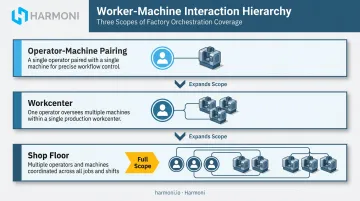
The relationship also operates at three distinct levels:
- Operator-machine pairing — the individual interaction between one worker and one machine
- Workcenter — one operator managing multiple machines
- Shop floor — many workers and machines coordinated across jobs and shifts
How the Worker-Machine Relationship Has Evolved
The progression from manual labor to mechanized production to modern CNC machining represents a fundamental shift in what the worker-machine relationship demands.
In pure manual production, the worker was the primary source of output. Mechanization transferred the physical work to the machine but required constant human intervention to keep it running.
Modern CNC environments shift the operator's role again: the machine executes complex programs autonomously, but skilled operators remain essential for setup validation, offset adjustments, quality checks, and responding to exceptions that no program anticipates.
Industry 4.0 introduced another layer. Machines now generate continuous data—spindle loads, cycle counts, alarm codes, temperature readings. Deloitte's 2025 smart manufacturing survey found that 92% of executives at large US manufacturers viewed smart manufacturing as a primary competitiveness driver, and 35% identified adapting workers to the "Factory of the Future" as a leading human-capital concern.
The problem isn't data volume. It's data delivery. More machine data only helps if it reaches the right operator at the right moment in a form they can act on.
The Skills Gap Dimension
As machines grow more sophisticated, operator demands shift from physical repetition toward cognitive work: interpreting data, adapting to variability, and making judgment calls mid-run. A 2024 Deloitte-Manufacturing Institute study projected 3.8 million US manufacturing positions to fill from 2024 through 2033, with up to 1.9 million potentially unfilled—and reported a 75% increase in demand for simulation-related skills from 2019 to 2023.
When the interface between operators and machines is poorly designed, onboarding takes longer, errors compound faster, and the gap between available workers and productive output widens — regardless of how many people are on the floor.
The Key Dimensions of Worker-Machine Interaction
Physical Interaction
Operators perform the tasks machines cannot: loading and unloading workpieces, changing tools, setting up fixtures, running visual inspections, and responding to alarms. The physical workload must be matched to machine cycle time.
If setup takes longer than a machine cycle, the machine idles. If the machine runs faster than a worker can keep up, the worker becomes the bottleneck. Neither outcome is acceptable when spindle time carries overhead cost whether the machine is cutting or waiting.
Cognitive and Informational Interaction
Before an operator touches a machine, they need to understand the job completely: material, tolerances, operation sequence, quality standards, and current revision. Operators who start without this information make more errors, take longer to set up, and are more likely to produce scrap on the first piece.
The most common sources of this information gap are:
- Paper travelers carrying outdated revision levels
- Verbal handoffs from prior shifts that omit critical setup details
- ERP systems disconnected from the shop floor, requiring operators to manually look up job details
- Prints stored in binders that haven't been updated after an engineering change
NIST's Digital Thread for Manufacturing project identifies manual verification and weak product-definition interoperability as risks capable of propagating incorrect manufacturing information across an entire job lifecycle—meaning a bad instruction at setup can produce bad parts through completion.
Temporal Synchronization
Every operator-machine pairing has a cycle. The machine runs for a fixed duration; the operator must be present at precisely the right moments within that cycle to keep production moving.
When these cycles are misaligned—either because job assignments don't account for actual machine run times, or because one operator is assigned too many or too few machines—idle time accumulates on one side or both.
Research from Dalisay et al. (2022) documented 29.73 total worker-hours of idle time across a 15-worker machine shop when job assignments weren't optimized to actual worker-machine time relationships. Separately, a precision-bearing manufacturing case with 17 work centers and 19 workers found 1.4%–11.1% optimality gaps when staffing constraints prevented continuous machine operation.
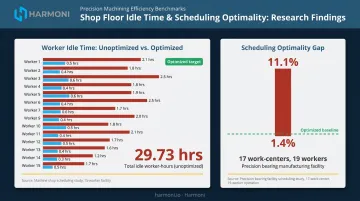
Schedules that appear feasible on paper fail when the operator needed for setup or monitoring is unavailable at the right moment.
Accountability and Traceability
In precision manufacturing, it matters not just that a part was made, but who made it, on which machine, under what conditions, and whether each step was executed correctly.
When no digital record links operator activity to machine output, the consequences compound quickly:
- Quality escapes reach the customer before the source is identified
- Repeat errors continue across shifts because no data connects the pattern to the cause
- Process improvement efforts stall without the baseline evidence to justify or validate changes
- Audits and corrective actions rely on memory rather than documented fact
Traceability isn't a compliance checkbox. It's the data infrastructure that makes everything else in the worker-machine relationship improvable.
What Happens When the Worker-Machine Relationship Breaks Down
The Information Gap at Job Start
The most common breakdown: an operator arrives at a machine without clear job routing. They search for the right program, reference an outdated print, or wait for a supervisor to confirm which job takes priority. Production hasn't started, the shift is already losing time, and the risk of a setup error producing the first part out of tolerance rises with every minute spent searching.
Idle Time Compounds Across a Shift
When operator cycles and machine cycles aren't synchronized, idle time doesn't stay isolated. It compounds. A two-minute wait at the start of a job, multiplied across multiple machines and multiple operators, across a full shift, represents meaningful lost spindle capacity—at full overhead cost.
Errors Move Downstream Without Feedback
When operators receive no confirmation that a step was completed correctly — no machine signal, no quality alert — mistakes travel downstream unchecked. In aerospace, defense, or medical manufacturing, a single undetected error can mean scrapped parts, rework cycles, or a failed customer inspection.
This isn't purely a human performance issue. The absence of feedback loops between worker action and machine output is a structural design flaw in how the production system is built.
The Accountability Void
Without a digital record of who ran which job, when, and under what conditions, production managers cannot identify error patterns, cannot accurately cost jobs, and cannot provide operators with meaningful performance feedback. Continuous improvement requires data. Without it, managers have no error patterns to act on, no accurate job costs to reference, and no baseline from which to improve.
How to Optimize the Worker-Machine Relationship on the Shop Floor
Start with Visibility
Optimization starts with accurate data on when machines are running, when they're idle, and what operators are doing at each machine state. Shift averages and estimates aren't enough.
In a CNC environment, that means capturing machine status (running, idle, alarm, setup) alongside operator presence and activity, tied to specific job numbers. A 46% utilization improvement reported by Coastal Machine and Supply after adding live downtime alerts—combined with fixture reorganization and redesigned work cells—illustrates what becomes possible when visibility is paired with an ownership structure for response.
Deliver Information at the Machine Before the Job Starts
Optimized worker-machine relationships depend on operators having job-specific information at the machine before production begins. That means:
- Current engineering drawings, not binder copies
- Setup sheets and tooling requirements specific to that part and revision
- Quality checkpoints with target values and inspection tools identified
- The correct CNC program already loaded—or loading automatically
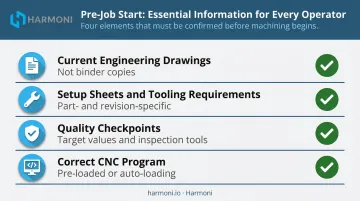
This is the operational definition of right information, right time, right place. Anything that requires an operator to leave the machine, make a phone call, or rely on memory introduces risk.
Orchestrate, Don't Just Connect
True optimization requires coordinating all inputs at once: the machine's current state, the ERP job order, the operator's skill and availability, and the engineering requirements for that specific part and revision. Dashboards alone don't get you there.
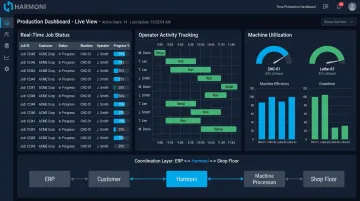
This is the principle behind factory orchestration platforms like Harmoni, which sit between ERP systems, machines, and operators to coordinate execution in real time. When a job's RFID tag is identified at the workcenter terminal, Harmoni surfaces the correct job instructions, engineering drawings, quality checkpoints, and machine program automatically, before the operator makes a single decision.
Production managers receive real-time dashboards and exception alerts with direct communication to the work cell. Problems get addressed during the shift, not discovered the next morning.
Machine Specialties, Inc. (MSI), a precision aerospace and defense manufacturer, documented measurable results after adopting Harmoni in early 2024:
- Near-elimination of part count errors on complex components
- A shift from spindle time to earned hours for accurate job costing
- Automated labor tracking that removed paper travelers entirely
What an Optimized Worker-Machine Relationship Looks Like
When these elements work together, the operational difference is concrete:
- Fewer job delays because operators have everything they need before the job starts
- Reduced scrap from setup errors because correct instructions and programs are delivered automatically
- Accurate job costing because operator time is tracked against machine time at the job level
- Managers who can identify problems mid-shift, not during the next morning's review
Frequently Asked Questions
What is the worker-machine relationship in manufacturing?
It describes the structured interdependence between human operators and the machines they operate, monitor, or maintain. This covers the physical tasks workers perform, the information they need to do those tasks correctly, and the feedback loops connecting human action to machine output.
How does automation affect the worker-machine relationship?
Automation changes but doesn't eliminate the relationship. Even in highly automated shops, operators remain essential for setup, quality verification, exception handling, and changeover. As machines grow more sophisticated, the cognitive and informational demands on those operators increase.
What is the ideal number of machines per operator?
It depends on each machine's cycle time relative to the operator's service time. Industrial engineers use tools like the worker-machine process chart and synchronous servicing analysis to calculate this ratio and minimize idle time for both parties.
What causes idle time in the worker-machine relationship?
Idle time results from misalignment between operator cycles and machine cycles—either the machine finishes and the operator isn't ready, or the operator is available but the machine is still running. Poor job assignment and information gaps at the start of jobs are the primary root causes.
How does the worker-machine relationship affect quality in precision manufacturing?
When operators lack real-time feedback on whether steps were completed correctly, errors move downstream undetected. In precision environments like aerospace or defense, this absence of feedback between worker action and machine output is a primary driver of scrap and rework.
What is factory orchestration and how does it improve the worker-machine relationship?
Factory orchestration is a coordination layer that connects machines, operators, ERP data, and engineering requirements in real time. It ensures operators have the right information at the right moment and gives managers visibility into production as it happens, not after the shift ends.