
Say that machine generates $180 an hour in billable output, and the loaded labor rate for the idle operator runs $32 an hour. A 90-minute stoppage, waiting on diagnosis and a part, costs roughly $270 in lost output plus $48 in paid-but-idle labor. That's nearly $320 gone before anyone even orders a replacement bearing.
Most shops track incidents like this because they're big and obvious. What they miss are the five-minute stops, the "where's the fixture" delays, and the shift-change confusion that never make it into a maintenance log but bleed margin all day, every day.
This article breaks down what downtime actually is, the real costs behind it, what's causing it on today's shop floors, and how real-time visibility changes the equation.
Key Takeaways
- Downtime splits into planned and unplanned categories, costing manufacturers an estimated 13.3% of planned production time annually
- Unplanned downtime costs more than planned downtime because there's no time to prepare for it
- Equipment failure remains a top cause, but disconnected ERP, MES, and machine systems are a growing contributor
- Reducing downtime requires real-time coordination between people, machines, and systems, not just maintenance schedules
- Job costing quickly turns inaccurate without job-level downtime tracking, eating into quoted margins
What Is Downtime in Manufacturing?
Downtime is any stretch of time when a machine, production line, or facility isn't actively producing parts. Uptime is the opposite: the machine is running, cutting metal, making progress against a job.
Here's the part most people get wrong: downtime isn't measured against a 24-hour clock. It's measured against scheduled production time, meaning the hours you actually planned to run. A machine sitting idle overnight when no shift is scheduled isn't downtime. A machine sitting idle for 40 minutes during a scheduled shift, waiting for a fixture, absolutely is.
This distinction matters because it ties directly into Overall Equipment Effectiveness (OEE), the standard metric for measuring how well equipment performs during scheduled runtime. OEE breaks down into three factors:
- Availability — Run Time divided by Planned Production Time
- Performance — how fast the machine ran compared to its ideal cycle time
- Quality — the percentage of parts that came out good on the first try

Downtime specifically eats into Availability. And it's not automatically a bad thing.
Not All Downtime Is a Problem
Preventive maintenance, tooling changeovers, and shift transitions are downtime by definition, but they're budgeted, expected, and necessary for keeping equipment reliable long-term. The issue is when downtime creeps beyond what's planned, or when it happens without anyone tracking it.
According to a 2018 NIST manufacturing report, manufacturers lose an estimated 13.3% of planned production time to downtime, with downtime-related costs representing nearly a quarter of total manufacturing cost. That's a broad benchmark across discrete manufacturing sectors, not a CNC-specific figure, but it illustrates the scale of the problem.
The sneaky part: a few minutes of downtime per job, multiplied across dozens of machines and three shifts, adds up to hours of lost capacity every week. Standard end-of-shift reporting rarely catches it, because nobody's writing down a four-minute delay looking for a missing tool offset.
Planned vs. Unplanned Downtime: The Two Types
Downtime comes in two flavors, and the difference between them determines how much it actually costs you.
Planned Downtime
Planned downtime is intentional: it's scheduled, budgeted, and built into the production calendar. Common examples include:
- Preventive maintenance windows
- Tooling and product changeovers
- Shift transitions and breaks
- Scheduled software or firmware updates
Even though it's expected, planned downtime still carries a cost. Every minute a machine sits idle for a changeover is a minute it's not cutting parts. Shops that batch similar jobs together or standardize changeover sequences can shrink this cost without cutting corners on maintenance.
Unplanned Downtime
Unplanned downtime is the expensive kind, showing up as:
- Equipment failure or unexpected breakdowns
- Machine jams or tooling breakage
- Part or material failures mid-run
- Material shortages that stop a job cold
Unplanned downtime costs more for one simple reason: nobody's ready for it. There's no spare part staged, no backup job queued, no operator briefed on what to do next. The delay cascades, downstream operations wait, and delivery dates slip.
There's also a safety dimension worth flagging. Unfamiliar restart and shutdown scenarios, the kind that happen when a machine goes down unexpectedly and gets brought back online in a rush, create real hazards.
OSHA estimates that proper lockout/tagout procedures prevent roughly 120 fatalities and 50,000 injuries every year, largely tied to hazardous energy release during servicing and unplanned restarts. Rushed, unfamiliar shutdown-and-restart sequences are exactly where those risks concentrate.
What Causes Manufacturing Downtime?
Downtime rarely has a single cause. It's usually a mix of mechanical issues, human factors, and process gaps stacking on top of each other.
Mechanical causes are the ones everyone expects:
- Equipment failure and worn parts
- Inadequate or deferred maintenance
- Water or oil leaks damaging components
- Aging machinery nearing end of service life
Human-driven causes get less attention but hit just as hard:
- Poor planning or scheduling
- Miscommunication between outgoing and incoming shifts
- Operator error, especially without standardized work instructions
- Lack of training on newer equipment or processes
Lean manufacturing has a helpful framework here: the 8 wastes, often remembered with the acronym DOWNTIME. Defects, Overproduction, Waiting, Non-utilized talent, Transportation, Inventory, Motion, and Excess processing. Several of these translate directly into production stoppages. Waiting for parts, materials, or approvals is downtime. Defects that force rework stop a line just as effectively as a broken spindle.
The Modern Cause Nobody's Tracking
Here's what's shifting the picture: disconnected systems. When your ERP, MES, machines, and operators aren't talking to each other in real time, jobs stall even when every machine on the floor is mechanically fine. An operator waits on a work order that hasn't synced. A program doesn't load because nobody confirmed the revision. The machine is ready. The information isn't.
A 2020 Plant Engineering and ATS survey of 171 maintenance professionals found that aging equipment and mechanical failure together account for 54% of unscheduled downtime. The remaining 46% traces back to operator error, training gaps, poor equipment design, and maintenance-strategy failures, categories where communication and system visibility make an outsized difference.

External factors matter too. Supply shortages, late material deliveries, and inventory shortfalls can stall a fully functional machine as quickly as any mechanical failure.
The True Cost of Downtime: Tangible and Intangible Impacts
Downtime costs split into two buckets: the ones you can put a dollar figure on, and the ones that damage the business in ways your spreadsheet never captures.
Tangible Costs
These are the numbers finance teams track:
- Lost production output during the stoppage
- Capacity that can't be recovered later
- Direct labor costs for idle or reassigned workers
- Inventory carrying costs when work-in-process sits waiting
A quick example: if a machine produces 4 units per minute at $12 profit per unit, one hour of downtime costs $2,880 in lost profit alone, before adding idle labor.
The general formula looks like this:
Cost of Downtime = (Average Hourly Labor Cost × Productivity Loss %) + (Lost Revenue per Hour × Hours Down)
Scale matters enormously here. Siemens' 2024 True Cost of Downtime report found that unplanned downtime at a large automotive plant runs $2.3 million per hour, or roughly $695 million annually. That's an automotive-sector figure, not a universal average, but it shows how fast costs compound at scale.
Intangible Costs
Harder to quantify, but just as real:
- Employee stress and burnout from constant firefighting
- Slower response times to customer orders and complaints
- Lost time for process improvement, since everyone's stuck reacting
Why Job Costing Falls Apart
This is where downtime stops being a scheduling issue and starts eating your margin. When downtime isn't tracked at the job level, your actual production costs run higher than what you quoted. You bid a job assuming smooth cycle times, then absorb 40 minutes of unlogged delay per shift without anyone noticing. Multiply that across a month of jobs, and margins erode invisibly.
Capturing this accurately requires granular, real-time data at the job and machine level, not end-of-shift manual logs where operators reconstruct their day from memory. That gap between logged time and actual time is exactly where profitable jobs turn unprofitable.
How to Reduce Downtime and Protect Your Margins
Cutting downtime isn't a single fix. It's a combination of maintenance discipline, standardized training, and, increasingly, real-time visibility into what's actually happening on the floor.
A solid foundation includes:
- Predictive maintenance — catch wear patterns before they become failures, rather than reacting after a breakdown
- Standardized operator training — reduce error-driven stops with consistent, documented procedures
- Clear shift-to-shift communication protocols — eliminate the "nobody told me" delays that stall jobs at handoff
Closing the Visibility Gap
Maintenance and training alone don't close the biggest gap: visibility. Most downtime doesn't announce itself.
It happens in scattered five- and ten-minute increments that never show up until the job's already scrapped or the shift's already over.
Real-time visibility into machine status, operator activity, and job progress flips that. Instead of discovering a problem at end-of-shift review, teams see it as it happens and can intervene while there's still time to fix it.
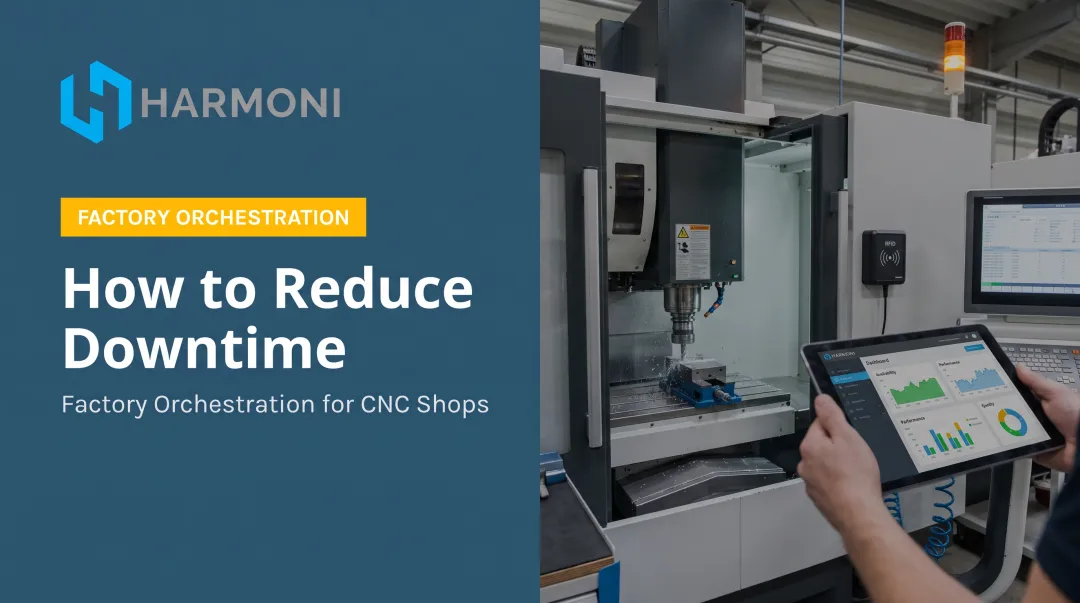
This is the exact gap Harmoni's factory orchestration platform was built to close. Using long-range RFID, the system automatically detects which operator and which job are present at a workcenter — no manual clock-ins or paper job cards required.
That data feeds into unified dashboards combining machine status, ERP transactions, and operator activity in one view. Instead of juggling three disconnected systems, your team sees everything in a single place.

The bigger point: closing the gap between what your ERP and MES say is happening and what's actually happening on the floor often prevents more downtime than adding another maintenance technician.
You can staff up on preventive maintenance all day. But if a job stalls because a program didn't sync or an operator can't find the current revision of a work instruction, that's a visibility problem, not a mechanical one.
Frequently Asked Questions
What is manufacturing downtime?
Manufacturing downtime is any period when a scheduled machine, line, or facility stops producing. It includes both planned stops, like maintenance, and unplanned stops, like equipment failure.
What are the two types of downtime?
Planned downtime covers scheduled events like preventive maintenance, changeovers, and shift transitions. Unplanned downtime covers unexpected events like equipment failure, jams, or material shortages.
How do you calculate downtime in manufacturing?
Downtime percentage equals time down divided by total scheduled production time, multiplied by 100. Downtime cost equals hourly labor cost times productivity loss percentage, plus lost revenue per hour times hours down.
What are the 8 wastes in manufacturing downtime?
The DOWNTIME acronym stands for Defects, Overproduction, Waiting, Non-utilized talent, Transportation, Inventory, Motion, and Excess processing. Several, especially Waiting and Defects, translate directly into production stoppages.
What is the main cause of unplanned downtime in manufacturing?
Equipment failure and aging machinery remain the leading mechanical causes, accounting for over half of unscheduled downtime in industry surveys. Disconnected systems and poor shift communication are increasingly common contributors too.
How much does downtime cost per hour in manufacturing?
Costs vary enormously by industry and plant size. Large automotive plants have reported costs as high as $2.3 million per hour, while smaller job shops face far lower but still significant losses per incident.