
Introduction
Unplanned downtime compounds fast. According to Siemens' 2024 True Cost of Downtime report, a single idle hour at a large automotive plant costs an estimated $2.3 million — more than $600 per second.
Across surveyed facilities, the average plant loses 27 production hours per month to unplanned downtime, costing roughly $253 million annually.
Most of those hours aren't purely mechanical failures — they're coordination failures. A machine stops and nobody knows for 20 minutes. An operator arrives at a job with no setup instructions. The ERP has the work order; the machine has the cycle data; the operator has neither.
In 2026, manufacturers who treat downtime as a machine problem alone will keep absorbing that cost. Those who treat it as a coordination problem — between machines, operators, materials, and systems — recover faster and prevent recurrence.
This article covers what downtime means on the shop floor, what causes it, what it actually costs, and the solutions that work.
Key Takeaways
- Unplanned downtime costs automotive manufacturers an estimated $2.3M per idle hour
- Planned downtime, unplanned failures, and operator idle time each require different solutions
- Equipment failure, human error, and poor visibility are the leading causes
- Predictive maintenance can reduce unplanned downtime by 30%–50% (McKinsey)
- Factory orchestration platforms unify ERP data, machine data, and operator execution in real time
What Is Downtime?
Downtime is any period when a machine, system, or resource cannot perform its intended function. In IT contexts, the term typically refers to servers or networks going offline. On the shop floor, it means machines stopped, production lines idle, and operators without productive work.
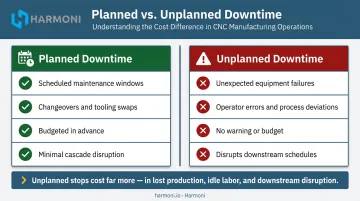
Manufacturing downtime breaks into two primary categories:
- Planned downtime — scheduled maintenance windows, changeovers, tooling swaps, and software upgrades. Both are predictable and factored into scheduling.
- Unplanned downtime — unexpected equipment failures, tooling breaks, operator errors, and process deviations. No warning, no budget.
Unplanned downtime costs far more than planned downtime — not just because of the lost production, but because everything downstream gets disrupted: schedules compress, labor idles, and quality problems surface downstream.
The Third Category Most Shops Overlook
There's a third type that traditional OEE tracking tends to miss: operator downtime. This is the idle time that accumulates when a worker hits any of these friction points:
- Doesn't know which job to run next
- Can't locate the setup sheet or work instructions
- Has to walk to a shared terminal to clock in
- Waits on a supervisor to answer a question
None of that registers as "machine downtime" in a standard report. It's real lost time, and it multiplies the cost of every mechanical stop.
What Is Technical Downtime in Manufacturing?
Technical downtime refers specifically to machine or equipment unavailability caused by mechanical, electrical, or control system failures. It's distinct from two other categories that often get conflated with it:
- Process downtime — the machine works, but production is waiting on materials, tooling, or instructions
- Organizational downtime — the machine works, but no operator is assigned or available
VDI 3423, the formal standard covering technical availability of machines and production systems, establishes terminology and calculation methods for this type of downtime. SEMI E10 covers the same ground for semiconductor and related equipment, defining scheduled and unscheduled downtime states for reliability tracking.
Why Categorization Matters
Most facilities track downtime per shift or per 24-hour period, but the useful distinction is why the machine was down. A machine that stopped because a servo failed needs a maintenance response. One that stopped because no operator was assigned needs a scheduling response. Treating both the same way wastes time and guarantees recurrence.
In precision manufacturing — CNC machining, aerospace, defense components — even a few minutes of unclassified technical downtime per shift can cascade: missed delivery windows, failed first-article inspections, scrapped parts.
Fixing the wrong category of downtime is worse than fixing nothing. You absorb the cost of the response and the machine goes down again next week for the same reason.
Common Causes of Manufacturing Downtime in 2026
Equipment Failure and Aging Machinery
Mechanical breakdown remains the leading cause of unplanned downtime. Plant Engineering's readership research identifies aging equipment and mechanical failure at the top of the list, alongside operator error and inadequate training. The same study found that **88% of facilities use preventive maintenance** — yet unplanned stops remain widespread, which tells you that scheduled maintenance alone isn't enough.
Human Error and Process Gaps
Incorrect setups, wrong tooling selections, and missed process steps are avoidable — but only if operators have standardized, accessible instructions. When work instructions live on paper travelers, in binders, or in someone's head, variation between operators is inevitable. A job that runs cleanly with one machinist produces scrap with another.
Shops that enforce digital workflows at the workcenter see this variation collapse — those that don't keep absorbing the cost one bad setup at a time.
Poor Visibility and Delayed Detection
Many facilities don't know a machine has stopped until production is already behind. The gap between when a problem starts and when it gets reported is itself a significant source of lost time — sometimes larger than the repair time itself.
With real-time awareness, most problems become 10-minute corrections. Without it, the same problem compounds into a 2-hour firefight before anyone has the full picture.
Information Silos Between Machines, Operators, and ERP
In most facilities, ERP systems hold job data, machines generate cycle and status data, and operators work from paper or memory — none of it connected in real time. The result is predictable: wrong-job starts, idle time between jobs, and rework loops that compound initial downtime.
Rockwell Automation's 2024 State of Smart Manufacturing survey found that manufacturers effectively use only 44% of the data they collect — a measurable indicator of how widespread this integration gap remains.
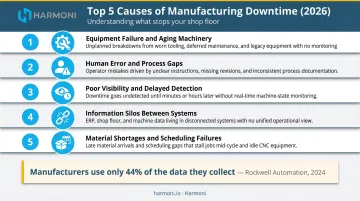
Material Shortages and Scheduling Failures
A machine can be mechanically perfect and still sit idle because the right material wasn't staged, or because the schedule didn't account for a late delivery. This is a systems coordination problem, not a maintenance problem — and it requires a different type of solution.
The Real Cost of Unplanned Manufacturing Downtime
Financial Impact
The Siemens estimate of $2.3M per hour applies to large automotive plants — based on survey data, not a universal average. Aerospace and precision machining facilities don't have equivalent published figures, but the cost structure is consistent across the industry.
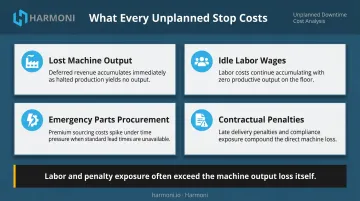
Every unplanned stop triggers the same categories of loss:
- Lost machine output and deferred revenue
- Idle labor wages with no corresponding production
- Emergency parts procurement at premium cost
- Contractual penalties for late delivery
The machine output loss is rarely the biggest number. Labor and penalty exposure often exceed it.
Labor Waste Multiplies the Machine Loss
When a machine stops, the operator assigned to that workcenter stops producing too. If that machine supports downstream operations, those operators start waiting as well. Labor costs during idle periods don't disappear — they accumulate on the cost side while output stops on the revenue side.
One documented example: time studies at a manufacturing facility found that each ERP transaction completed at a shared terminal (rather than at the machine) consumed an average of 11 minutes per operator. Multiply that across a shift and across a shop floor, and the labor waste from coordination inefficiency becomes substantial.
Quality and Scrap Costs
Unplanned stops mid-run are particularly damaging in precision environments. Process stability matters — an unexpected interruption to a CNC cycle, a missed inspection step, or a rushed restart after a tooling swap can push parts out of tolerance.
In high-mix, low-volume environments where setups are expensive and lot sizes are small, a single scrap event can erase the margin on an entire job.
Delivery and Compliance Risk
When scrap and delays accumulate, schedule impact follows quickly. In regulated industries — defense, aerospace, medical devices — chronic downtime isn't just an operational problem. It can trigger compliance reviews, jeopardize certifications, and damage customer relationships that took years to build.
Top Downtime Solutions for Manufacturers in 2026
Predictive and Preventive Maintenance
Preventive maintenance runs on fixed schedules regardless of machine condition. Predictive maintenance uses sensor data and condition monitoring to flag issues before failure occurs.
McKinsey's foundational research on manufacturing analytics found that predictive maintenance typically reduces machine downtime by 30%–50% and extends machine life by 20%–40%. That benchmark is from 2017 and doesn't isolate predictive versus preventive maintenance as a controlled comparison — but it's the strongest publicly available figure, and directionally consistent with more recent adoption data.
One important prerequisite: predictive maintenance requires reliable, real-time machine data streams. Manufacturers without machine connectivity can't take advantage of condition-based approaches. Connectivity is the foundation, not an add-on.
Standardized Digital Workflows for Operators
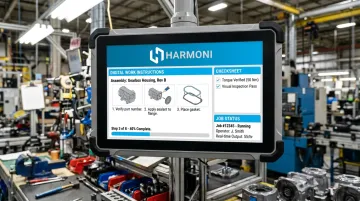
For manufacturers dealing with operator-driven downtime, replacing paper travelers, verbal instructions, and institutional knowledge with digital work instructions at the workcenter is one of the highest-leverage moves available.
Harmoni's platform delivers this directly at the machine, including:
- Digital work instructions and checksheets that enforce the same standardized process regardless of operator experience
- Automated CNC program loading that eliminates wrong-program starts and setup delays
- RFID-based operator identification that detects who is present and which job is active — removing manual sign-ins and the idle time between job transitions that traditional OEE tools never capture
Real-Time Machine Monitoring and Alerting
Supervisors who rely on shift-end reports are always reacting to history. Real-time dashboards that surface machine status, operator activity, and job progress as it happens allow problems to be addressed while they're still small.
Coastal Machine and Supply, a defense and space manufacturer, increased five-axis utilization by 46% after implementing machine monitoring — a result that reflects the compounding value of visibility across an entire fleet.
Root Cause Analysis and Post-Event Learning
Visibility tells you when a problem happened. Root cause analysis tells you why — and without that step, the same events recur. After each downtime event, classify the cause:
- Mechanical causes require maintenance intervention
- Organizational causes require scheduling or staffing changes
- Process causes require workflow standardization
Without this classification step, corrective actions are generic rather than targeted — and the same events recur.
Automation of Non-Productive Tasks
Administrative overhead quietly extends downtime events and inflates their real cost. Automating the following tasks removes that drag:
- Job tracking and status reporting
- Manual data entry between machine and ERP
- CNC program loading at the machine
These are inefficiencies that standard downtime reports never capture — but their cumulative impact on throughput is measurable.
How Real-Time Visibility and Factory Orchestration Reduce Downtime
The core limitation of traditional approaches isn't any single tool — it's the gap between them. ERP systems hold job and scheduling data. Machines generate performance data. Operators work from whatever's in front of them. No single system connects all three in real time.
Factory orchestration fills that gap. It's a platform layer that sits between ERP systems, machines, and operators — combining machine data with operator activity and ERP workflows into a unified operational view. The result is that supervisors see problems as they develop, not after the shift ends.
Harmoni pioneered this category. Its platform integrates natively with major CNC controllers (Fanuc, Haas, Mazak, Siemens/Sinumerik, Heidenhain, DMG MORI, Makino, Fadal) and ERP systems (Epicor, Infor, Infor Visual, JobBoss, ABAS, ODOO), deploying in weeks without replacing existing equipment.
Machine Specialties, Inc. (MSI), a high-precision aerospace, defense, and medical manufacturer with over 300 employees, deployed Harmoni across its entire shop floor integrated with Epicor — automating labor tracking, eliminating paper travelers, and gaining real-time visibility through dashboards and status lights.
The practical outcome of factory orchestration:
- Mechanical downtime events get flagged immediately and routed to maintenance
- Organizational downtime (wrong operator, unassigned job) surfaces through real-time labor tracking
- Process downtime (missing instructions, incorrect setup) gets stopped before it starts through digital workflows
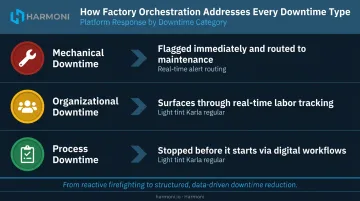
Facilities that make this shift move from reactive firefighting to structured, data-driven downtime reduction. Those that don't keep managing the same problems year after year.
Frequently Asked Questions
What is the meaning of downtime?
Downtime is any period when a machine, system, or resource cannot perform its intended function. In manufacturing, it includes planned downtime (scheduled maintenance, changeovers) and unplanned downtime (unexpected failures) — as well as operator idle time caused by unclear job assignments or coordination gaps that traditional OEE tracking often misses.
What is technical downtime?
Technical downtime is machine unavailability specifically caused by mechanical, electrical, or control system failures — as defined by standards like VDI 3423. It differs from process downtime (waiting for materials) and organizational downtime (no operator assigned). Accurate categorization matters because each type calls for a different fix.
What is the difference between downtime and outage?
Both terms describe periods of unavailability. "Outage" is more common in IT and telecommunications contexts. "Downtime" is the broader term used across both IT and industrial environments. In manufacturing, downtime covers machine stops, operator idle time, and production line stoppages regardless of cause.
What are the most common causes of manufacturing downtime?
The primary causes are unplanned equipment failure, human error during setup or operation, delayed detection of machine stops, poor ERP-to-shop-floor coordination, and material or scheduling shortages. Each requires a targeted solution — the right fix depends entirely on the root cause, not just the symptom.
How much does unplanned machine downtime cost?
Siemens estimates one idle hour at a large automotive plant costs $2.3 million — incorporating lost revenue, idle labor, emergency parts, and contractual penalties. Idle operators, downstream bottlenecks, and scrap from interrupted runs compound that figure well beyond the immediate output loss.
What is the difference between planned and unplanned downtime?
Planned downtime is scheduled in advance — maintenance windows, changeovers, upgrades — and can be budgeted and minimized through efficient scheduling. Unplanned downtime occurs without warning, disrupts production schedules, creates idle labor, and frequently generates downstream quality and delivery problems that extend its true cost well beyond the immediate stop.