
Introduction
Walk onto most shop floors today and you'll find the same problem: production data lives in one system, machine status in another, and quality records sit in a binder or a separate app. The ERP shows numbers that don't match what's actually happening at the machine.
Operators re-enter data that already exists somewhere else. Supervisors find out about downtime an hour after it started.
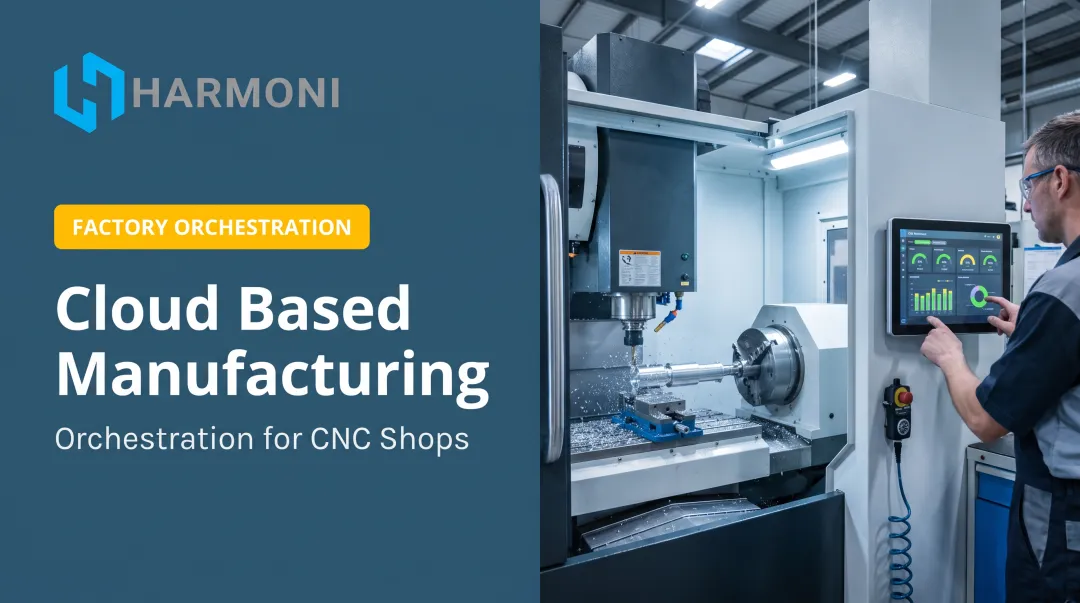
Cloud-based manufacturing software fixes this by connecting production, machines, operators, and ERP data into a system everyone can see in real time. For US manufacturers, that means better job costing, faster response to problems, and labor accountability that doesn't rely on a paper traveler.
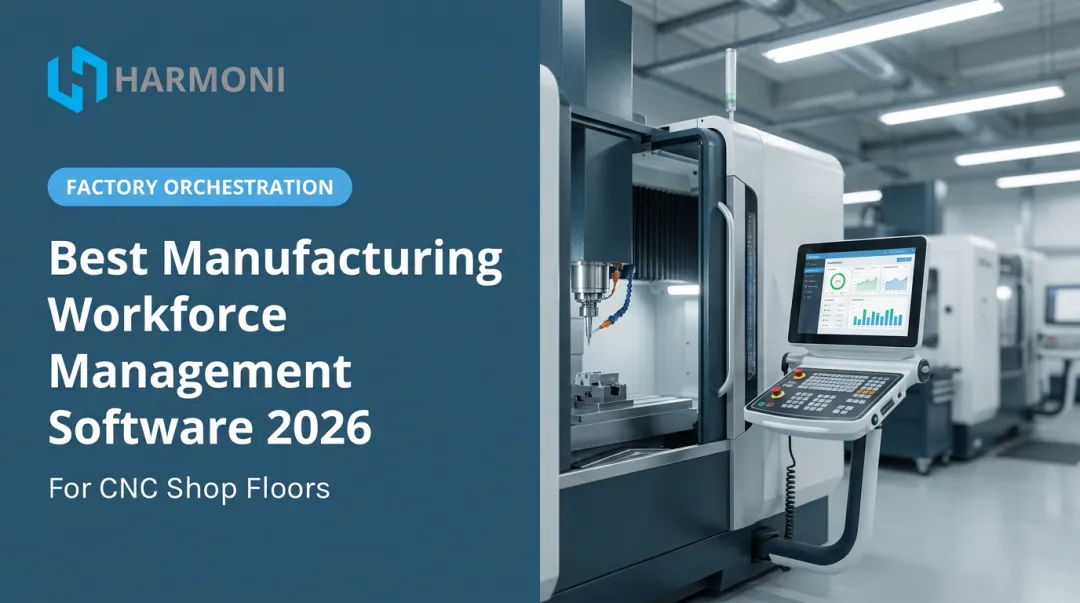
This guide ranks the top cloud-based manufacturing platforms for 2026. But there's a catch: "manufacturing software" covers several different categories, and the right pick depends heavily on whether you need an ERP, an MES, a QMS, or a factory orchestration layer that ties existing systems together.
Key Takeaways
- Treat ERP, MES, QMS, and factory orchestration as distinct tools—each solves a different problem
- Score vendors on workflow fit, shop floor visibility, integration depth, security, and total cost of ownership
- Purpose-built platforms go deeper on execution; broad ERPs prioritize finance and multi-site flexibility
- Machine data delivers the most value when paired with operator activity, job status, and quality records
- Require every finalist to demo on your real equipment, integrations, and compliance requirements
Overview of Cloud-Based Manufacturing Software in the US Manufacturing Market
Cloud-based manufacturing software is internet-accessible software hosted and maintained by a provider rather than on your own servers. It can cover one function or several, including planning, production execution, quality, inventory, maintenance, or financial management.
The category gets confusing fast because vendors often use overlapping language. Here's how the four main types actually differ:
- ERP (Enterprise Resource Planning): Connects financials, procurement, inventory, orders, planning, and costing across the business
- MES (Manufacturing Execution System): Manages and records real-time production execution, labor, machine activity, work instructions, and quality checkpoints
- QMS (Quality Management System): Controls inspections, nonconformances, corrective actions, documents, and audit records
- Factory orchestration: Coordinates people, machines, systems, and engineering requirements across the production environment, often sitting between ERP and MES rather than replacing either

This isn't just semantic hairsplitting. The ISA-95 standard formally separates enterprise planning from shop-floor control specifically because mixing the two creates integration headaches and data ownership conflicts. Buyers who understand this boundary ask better questions during vendor demos.
Investment in this space is accelerating. According to Deloitte's 2026 US Manufacturing Industry Outlook, 80% of manufacturing executives surveyed plan to invest 20% or more of their improvement budgets in smart-manufacturing initiatives. They name cloud computing, sensors, and data analytics as foundational technologies.
That's a planning signal, not proof that every shop has already adopted cloud tools, but it tells you where budget is heading into 2026.
The rankings below include both specialized manufacturing platforms and broader systems. Each one is evaluated against the operational problem it's actually designed to solve.
Best Cloud-Based Manufacturing Software for 2026
Every product on this list was assessed against the same criteria:
- Category fit and cloud availability
- Manufacturing workflow depth and real-time visibility
- Integration capability and security documentation
- Implementation risk, plus evidence from current product materials and independent reviews
Harmoni Factory Orchestration Platform
Harmoni is a cloud-based factory orchestration platform that sits between ERP systems, MES platforms, machines, and operators. It doesn't replace your ERP. It coordinates the systems you already have so information flows both ways in real time. The platform is built on three pillars:
- Automation: Long-range RFID identifies operators and jobs at the machine, automatically loading the correct CNC program, work instructions, and offsets
- Process control: Digital work instructions, engineering revision control, and digital quality checksheets replace paper travelers
- Observability: Real-time machine data collection and OEE tracking (Availability, Performance, Quality) feed live shop-floor dashboards Harmoni's centralized command center at each workcenter handles job clocking, ERP entry, document access, and quality data collection, all authenticated through multi-factor login. Native integrations cover Epicor, Infor, Infor Visual, ECI JobBoss/JobBoss2, ABAS, and ODOO, with custom integration available for legacy ERPs. Machine connectivity spans Mazak, Haas, Fanuc, Heidenhain, Siemens, DMG MORI, Makino, and Fadal controls. Comparison snapshot:
- Best fit: Mid-to-large CNC machining shops, aerospace and defense manufacturers, precision and high-mix job shops, automotive component makers, and healthcare/medical device manufacturers running programmable equipment
- Core outcomes: Reduced wasted operator time, fewer production errors, stronger accountability, better labor visibility, and earlier problem detection while a job is still running
- Validate before buying: Confirm deployment timeline for your machine mix, ERP integration needs, ITAR/CUI security docs, and time-to-value evidence against your workflows Manufacturers running Government Cloud deployment for CUI-handling contracts should also confirm current CMMC alignment documentation directly with Harmoni's team.

ProShop ERP
ProShop combines ERP, MES, and QMS functionality specifically for precision and job-shop environments. It's marketed as web-based and fully paperless, with a built-in quality system covering document control, certificates of conformance, revision control, and full inventory traceability. Comparison snapshot:
- Best fit: Small-to-medium machine shops, fabricators, contract manufacturers, and regulated industries needing tight quality documentation
- Core features: Estimating, quoting, routing, finite scheduling, quoted-versus-actual job costing, shop-floor reporting, and inspection data tied to work orders
- Validate before buying: Confirm the exact scope of any FedRAMP-related hosting assessment and budget hands-on time for onboarding ProShop published a July 2026 note stating an independent, FedRAMP-recognized assessor evaluated its AWS GovCloud hosting against the FedRAMP Moderate baseline related to DFARS 252.204-7012. That covers the hosting environment, not a stated FedRAMP certification for ProShop itself. Reviews are mixed on onboarding: G2 users report a steep learning curve, while Software Advice reviewers describe the opposite. Pricing isn't publicly listed, so request a quote covering training, data migration, and regulated-workflow setup before you compare alternatives.
Epicor Kinetic
Epicor Kinetic is a broad manufacturing ERP with cloud, on-premises, and hybrid deployment options. Current product materials list forecasting, MRP, advanced planning and scheduling, production operations, business intelligence, financial reporting, and multi-site visibility. Comparison snapshot:
- Best fit: Larger or more complex manufacturers with multi-site operations, deeper supply-chain needs, or financial reporting requirements that go beyond a single-plant job shop
- Core features: Cloud delivery flexibility, MRP, shop-floor and production management modules, quality tracking, inventory, and integrations supported through Epicor's authorized partner network
- Validate before buying: Ask partners for same-size manufacturer references and a quote broken down by modules, sites, and licensing Implementation complexity is real. A current G2 review page shows a 9-month average time to implement, with a learning curve cited as a common limitation. Public pricing isn't disclosed.
Plex Smart Manufacturing Platform
Plex unifies MES, QMS, ERP, and supply-chain planning in a single cloud platform, built as multi-tenant SaaS with edge-to-cloud data flow. It's aimed at manufacturers who want production monitoring, connected-worker tools, and quality management running natively together instead of stitched across systems. Comparison snapshot:
- Best fit: Aerospace, automotive and tire, industrial manufacturing, and precision metalforming operations prioritizing real-time production data over complex job-shop estimating
- Core features: MES, production monitoring, quality management, asset performance tracking, finite scheduling, and machine connectivity built into the same environment
- Validate before buying: Resolve the 99.9% vs. 99.5% uptime discrepancy in writing, and test cost plus legacy integration in a proof of concept Plex's security page claims ISO/IEC 27001 certification, SOC 1 and SOC 2 Type 2 audits, and a 99.9% uptime SLA, but the platform page separately advertises 99.5% availability. G2 reviewers also flag cost concerns for smaller businesses and friction integrating legacy systems.
Acumatica Cloud ERP
Acumatica is a flexible cloud ERP covering financials, inventory, distribution, CRM, and manufacturing management. Its current licensing model uses transaction-tier consumption pricing based on monthly transaction volume, plus named-user licensing, rather than a strict per-seat model. Comparison snapshot:
- Best fit: Growing or multi-entity manufacturers wanting a flexible business platform that spans manufacturing, distribution, and finance without a rigid user cap
- Core features: MRP, BOMs, routings, production scheduling, inventory and costing, and shop-floor time tracking connected to work orders and WIP
- Validate before buying: Confirm native machine connectivity in a proof of concept, and model transaction volume plus partner costs before committing Acumatica's manufacturing pages describe shop-floor data connections but don't confirm native machine connectivity. G2 reviewers praise its flexibility while flagging dense onboarding and customization complexity.
How We Chose the Best Cloud-Based Manufacturing Software
This evaluation prioritizes documented manufacturing fit over brand recognition or raw feature counts. Here's what actually shaped the rankings:
Workflow coverage. We traced each platform from quoting through purchasing, production, quality, shipping, and job costing, noting where functionality is native versus where you'll need an add-on or a third-party integration.
Real-time visibility. Does the system capture machine status, operator activity, material movement, downtime, and quality events while production is still happening, or only after the fact in a report?
Integration architecture. This covers ERP/MES/QMS relationships, machine connectivity, API access, and who owns the master data. A platform that can't preserve context as data moves between systems creates more work, not less.
Security and compliance. For manufacturers touching aerospace, defense, healthcare, or automotive work, we checked for:
- Role-based access controls and audit trails
- Encryption, backups, and data residency
- Independent security reports (SOC 2, ISO 27001) and uptime commitments
- Industry-specific alignment, such as ITAR/CMMC handling for defense contractors or ISO 13485 support for medical device makers
Total cost of ownership. Subscription price is only part of the equation. We factored in modules, users, devices, integrations, data migration, training, and the operational risk of switching systems mid-year.

Conclusion
There's no universal "best" cloud-based manufacturing software, only the best fit for your operational gap. Each category fills a different role:
- ERP — connected business planning and finance
- MES — execution visibility
- QMS — quality control
- Factory orchestration — coordinates people, machines, and the systems you already own Score vendors against your own workflows, integration landscape, compliance requirements, and total cost—not a generic feature checklist or the longest demo. If your gap is real-time coordination across ERP systems, machines, operators, and workcenters, Harmoni's factory orchestration approach is worth a closer look. Request a demo or call (888) 341-4097 to walk through your specific shop floor setup.
Frequently Asked Questions
What is the best cloud-based job shop software?
It depends on your shop's size, job complexity, and compliance needs. A full job-shop ERP like ProShop suits precision shops needing quoting, scheduling, and quality in one system. A factory orchestration platform like Harmoni fits shops that already have an ERP but need better execution visibility.
What is cloud-based manufacturing software?
It's hosted manufacturing software accessed through the internet rather than installed on local servers. Depending on the vendor, it may manage ERP, MRP, MES, QMS, inventory, production, quality, or orchestration functions.
What is the difference between cloud ERP and MES?
ERP manages enterprise planning, finance, procurement, inventory, and costing at the business level. MES focuses on real-time production execution: labor tracking, machine activity, work instructions, and quality events happening on the shop floor right now.
What features should manufacturers look for in cloud-based software?
Prioritize workflow integration, scheduling, job costing, shop floor data capture, machine connectivity, quality traceability, and open APIs. Match each feature to a specific operational outcome you need to fix—not a generic checklist.
Is cloud manufacturing software secure?
Security follows a shared responsibility model: the vendor secures the platform infrastructure, while you're responsible for access controls and configuration. Review role-based access, encryption, audit trails, independent security assessments, and data residency terms before signing.
How much does cloud-based manufacturing software cost?
Pricing varies widely by users, modules, sites, integrations, and implementation support. Compare total cost of ownership, including training, data migration, and support, rather than judging vendors on subscription price alone.