Nobody made a "bad" decision. The operator followed what was in front of him. The instruction just hadn't caught up to reality.
In high-mix, precision-driven environments like aerospace, defense, automotive, and medical device manufacturing, this scenario plays out more often than shops like to admit. Modern Machine Shop points to incorrect offset entries and unrecognized trial-machining surfaces as common, well-documented sources of production scrap, and the fix usually traces back to how clearly the setup information was communicated in the first place.
This guide defines manufacturing work instructions, breaks down what belongs in one, and looks at how manufacturers are moving away from static paper toward real-time, connected guidance at the machine.
Key Takeaways
- Work instructions tell operators exactly how to perform one task, step by step
- They differ from SOPs (the broader process) and work orders (ERP job scheduling)
- Strong instructions include purpose, tools, safety steps, visuals, and sign-off tracking
- Standardized job training, like the NIST-backed TWI Job Instruction method, can cut new-hire ramp-up time roughly in half
What Are Manufacturing Work Instructions?
A manufacturing work instruction is a detailed, task-level document that guides an operator through exactly how to perform one specific step in a production process, such as machine setup, a machining operation, an assembly task, or an in-process inspection. Where a process document tells you what happens across a job, a work instruction tells you how to do one piece of it, correctly, every time.
Depending on the industry and the software platform in use, you'll hear these called by different names:
- Job instructions
- Operator instructions
- Visual work instructions
- Work guides or job aids (informal terms, not standardized by ISO or ASQ, but common on the floor)
Why manufacturing leans on these documents so heavily: tight tolerances, expensive raw materials, machine-specific programs, and heavy regulatory scrutiny all raise the stakes of any deviation. ISO guidance treats work and test instructions as low-level, specific quality documents, and ASQ defines a job instruction as documentation covering setup, inspection, rework, or operator activity.
This documentation is where quality gets built into the part, not just recorded after the fact.
Manufacturing Work Instructions vs. SOPs vs. Work Orders
These three documents get confused constantly, and mixing them up creates real problems on the floor.
- SOP (Standard Operating Procedure): Defines the overall process. Example: "Steel Frame Assembly SOP" covers the full sequence from receiving raw stock to final packaging.
- Work instruction: Defines how to execute one step within that process. Example: "How to Set Torque on Base Frame Bolt Pattern" specifies the exact tool, torque value, and sequence for that single operation.
- Work order: A scheduling and tracking document tied to a specific job in the ERP. It tells the shop what needs to run and when. It's not a reference an operator follows at the machine.
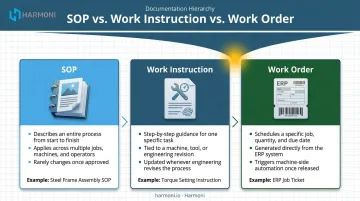
The SOP is the map, the work order is the trip ticket, and the work instruction is the turn-by-turn direction at the one intersection where people keep getting lost.
Why Manufacturing Work Instructions Matter
Reduced Scrap and Rework
Clear, standardized steps eliminate guesswork on fixturing, offsets, and tooling changes. That guesswork is exactly what Modern Machine Shop flags as a recurring cause of production-run scrap. Every trial-machining surface that carries a target dimension, rather than being left to operator judgment, is one less chance for an expensive part to end up in the scrap bin.
Faster Onboarding During a Labor Crunch
The skilled labor shortage isn't slowing down. Deloitte and The Manufacturing Institute project that US manufacturers may need up to 3.8 million net new employees between 2024 and 2033, with roughly 1.9 million of those roles at risk of going unfilled.
Detailed work instructions let new hires and cross-trained operators run unfamiliar jobs without shadowing a veteran for weeks. NIST's research on Training Within Industry supports this: a standardized job-breakdown method can cut the time to develop a productive new hire roughly in half.
Regulatory and Quality Compliance
Standards bodies don't treat this as optional:
- ISO 13485 (medical devices) explicitly lists work instructions among the documented information required to control production
- AS9100 (aerospace) requires documented evidence that production and inspection steps were completed as planned
- IATF 16949 (automotive) calls for standardized work covering what, how, and why a task is performed
Consistency Across Shifts and Machines
High-mix, low-volume shops often run the same part on different machines across different shifts. Without a shared instruction, output quality drifts based on who's standing at the controls. Standardized instructions keep the result uniform no matter which shift or machine touches the job.
A Foundation for Shop Floor Visibility
Well-structured work instructions do more than prevent errors. They create a record of what was supposed to happen, which becomes the baseline for tracking labor, job costing, and accountability across the shop. That's a natural bridge into broader operational visibility tools, which we'll come back to shortly.
What Should a Manufacturing Work Instruction Include?
A generic template misses half of what a machine shop actually needs. Here's what belongs in one.
Core elements every instruction needs:
- Task title and purpose/scope
- Required tools and materials
- Safety and PPE requirements
- Numbered, sequential steps
Manufacturing-specific fields generic templates skip:
- Machine or program number
- Part number and drawing revision
- Torque, tolerance, or dimensional specs
- Inspection and quality checkpoints built into the sequence, not tacked on at the end
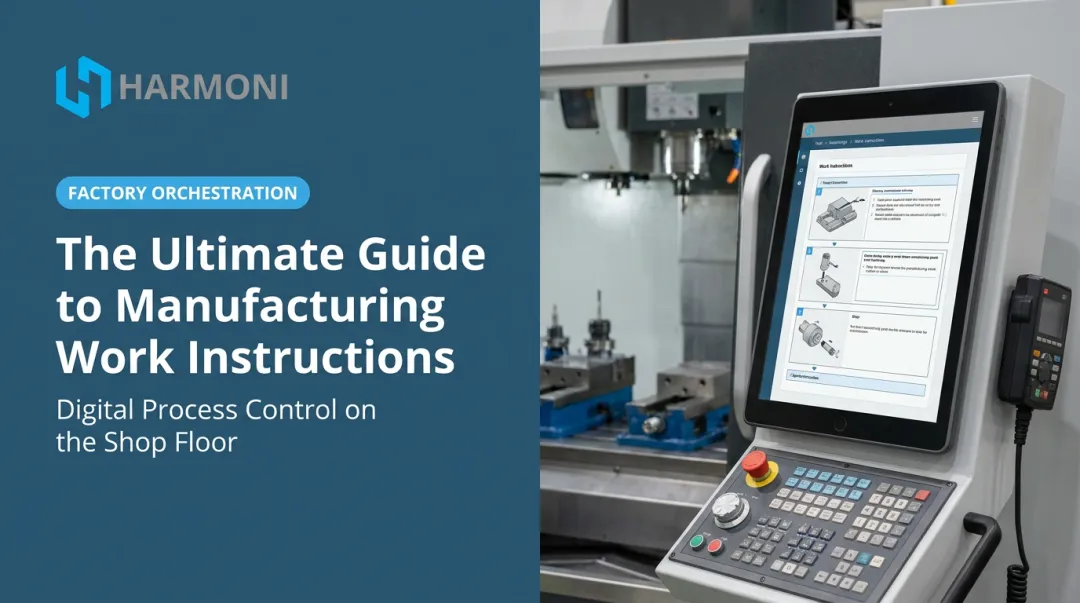
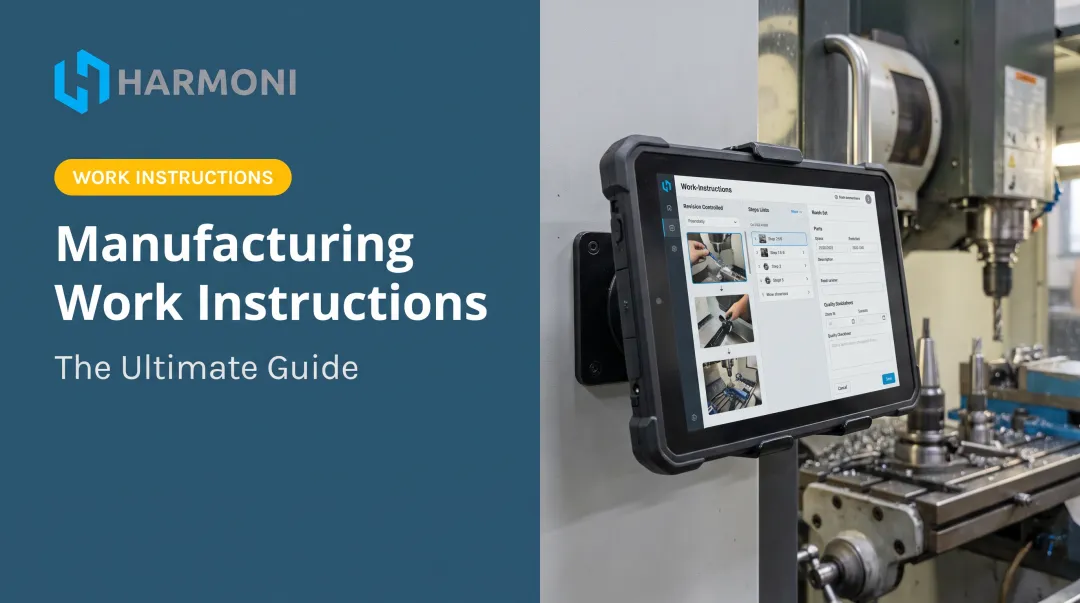
Visuals matter more than most shops give them credit for. A photo of correct fixture placement or a diagram of a tool path communicates faster than a paragraph of dense text, and operators retain it longer.
Every instruction also needs a sign-off and revision section so supervisors can approve changes and maintain version control. Without it, you can't prove during an audit which version was in use on any given day. Digital work instruction platforms, like Harmoni's, close this gap by locking revision history automatically so operators only ever see the current approved version.
Example of a Manufacturing Work Instruction
Take "How to Set Up a CNC Fixture for Part #4521":
- Title & purpose: Establish correct fixture alignment before running Operation 20 on Mazak VTC-800
- Tools: Torque wrench (calibrated), fixture plate #4521-B, indicator base
- Steps: Mount fixture plate, indicate to 0.0005", torque clamps to 35 ft-lb in specified sequence, verify part seating
- Quality check: Confirm alignment with go/no-go gauge before releasing to production
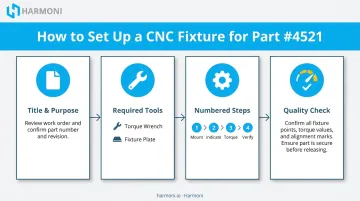
This single instruction lives inside the broader "CNC Machining SOP," which covers the entire job flow from material staging to final packout. The SOP tells you the process exists and why it matters. The work instruction above is what the operator actually reads at the machine.
How to Write Effective Manufacturing Work Instructions
Good instructions rarely come from someone sitting at a desk.
- Source input from the floor. Experienced operators and process engineers know where hesitation points really occur, since they run the equipment daily — a program written two years ago rarely reflects current shop reality.
- Single-action steps. Break the task into one action per step, using plain language and consistent terms across shifts. Avoid jargon that changes depending on who's supervising that day.
- Flag safety steps clearly. Bold or visually highlight critical safety steps, such as lockout/tagout requirements, so they never get buried in paragraph four.
- Test it on someone else. Hand the instruction to a different operator and watch where they pause or guess — each hesitation point reveals a gap in the instruction rather than a training failure.
NIST's Job Instruction method backs this testing approach directly: preparation, presentation, trial run, and follow-up. You validate an instruction by watching someone perform the task, rather than by proofreading it at a desk. Digital work instructions, like Harmoni's, add version control so operators always see the current approved step, not an outdated printout.
From Paper to Real-Time: Modernizing Work Instructions on the Shop Floor
Paper and static PDF instructions carry a built-in expiration problem. Versions go out of date the moment engineering issues a revision, but nobody physically pulls the old copy off the shop floor. Operators under time pressure skip steps. And when something goes wrong, there's no record of what actually happened at the machine, just what was supposed to happen.
That's pushing manufacturers toward connected, digital work instructions delivered directly at the workcenter, tied to the actual job running at that moment. No more hunting through a shared drive or a binder for the right revision.
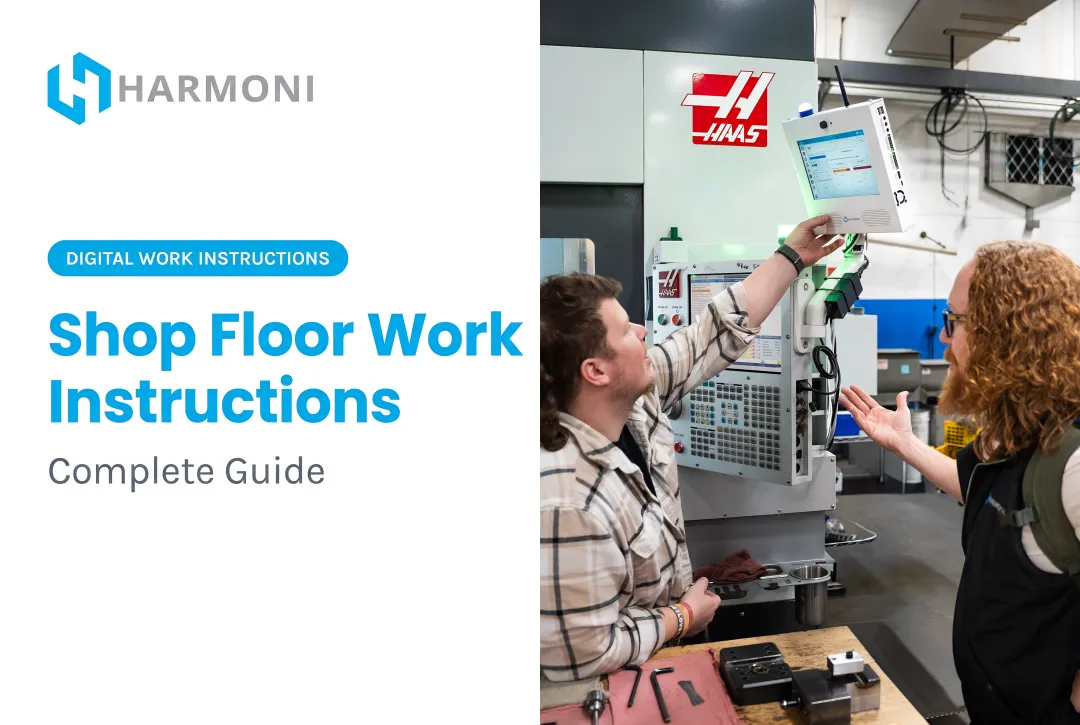
This is the concept Harmoni was built around as a factory orchestration platform. Using long-range RFID, Harmoni identifies the operator and the job automatically at each workcenter. It then surfaces the correct work instructions, CNC program, and specs tied to the current part revision, all without anyone manually retrieving a document.
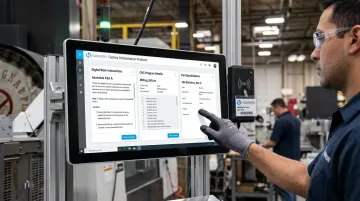
Combined with digital quality checksheets, the same screen that shows the setup steps also captures the in-process inspection data as the job runs.
The resulting benefits:
- Fewer errors from operators working off outdated instructions
- Better labor visibility since activity is tracked as it happens
- More accurate job costing, since execution is captured in real time instead of reconstructed after the fact
These benefits aren't just theoretical. A shop featured in Modern Machine Shop, MSI, reported nearly eliminating errors in part counts on complex, high-risk parts after standardizing on this kind of real-time system. The change also produced a measurable reduction in communication friction between machinists, engineers, and managers.
The data visibility gained from that shift was directly credited with contributing to revenue growth for the shop.
Frequently Asked Questions
What is a work instruction?
A work instruction is a step-by-step document explaining exactly how to perform one specific task, such as a machine setup or an inspection. It's distinct from broader process documents like SOPs, which cover an entire job flow rather than a single step.
What should a work instruction include?
At minimum: a title and purpose, required tools and safety requirements, sequential numbered steps, and supporting visuals. In manufacturing, add machine/program numbers, part revisions, and tolerance specs.
What is an example of a work instruction?
A common example is "How to Set Up a CNC Fixture for Part #4521," covering the specific tools, torque values, alignment steps, and quality check needed before that operation runs.
What are work instructions called?
Common alternate terms include job instructions, operator instructions, and visual work instructions. "Job aid" and "work guide" are informal shop-floor terms rather than standardized industry labels.
Are work instructions required for quality certifications like AS9100 or ISO 13485?
Yes, both standards expect them. ISO 13485 requires documented work instructions to control production. AS9100 requires proof that steps were completed as planned, though not always via a standalone document.
Who is responsible for creating work instructions in a manufacturing facility?
Typically engineers, supervisors, or experienced operators author them. The best instructions include direct input from the people who perform the task daily, since they catch the details a desk-written version tends to miss.