Key Takeaways
- Manufacturing SOPs standardize how work gets done — removing reliance on memory, habit, or undocumented institutional know-how
- Well-written SOPs support ISO 9001, OSHA, AS9100, and other compliance requirements across regulated industries
- Effective SOPs follow a structured writing process: define scope, gather stakeholder input, choose the right format, draft, test on the floor, and schedule regular reviews
- SOP format should match the task: numbered steps for linear processes, flowcharts for decision-heavy ones, visual aids for complex setups
- Most manufacturers lose quality, time, and money not from missing SOPs — but from SOPs that exist on paper and get ignored on the shop floor
What Are SOPs in Manufacturing?
A manufacturing SOP is a documented, step-by-step set of instructions that defines how a specific process or task should be performed. It covers not just the actions, but the sequence, safety requirements, responsible roles, and expected outcome at each stage.
The key word is standard. SOPs are the official reference for how work should be done — not how one experienced operator happens to do it, and not what a new hire picked up from whoever trained them. When processes rely on memory or informal knowledge passed between shifts, the result is variation. SOPs remove that variable.
Common Manufacturing Use Cases
SOPs are used across virtually every production function:
- Machine setup and changeover
- Quality inspections and first-article verification
- Preventive maintenance procedures
- New operator onboarding and cross-training
- Safety protocols (including OSHA-mandated lockout/tagout procedures)
- Regulatory compliance and vendor audits
SOP Formats Used on the Shop Floor
No single format fits every task. Common options include:
- Numbered step-by-step procedures — best for linear, sequential tasks
- Flowcharts — suited to processes with decision points (for example, what to do when a measurement falls out of spec)
- Visual and photo-aided SOPs — effective for complex machine setups where spatial orientation matters
- Video-supported instructions — increasingly used for high-turnover operations or tasks that are difficult to describe in text alone
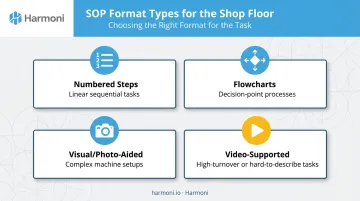
The right format depends on the complexity of the task and the experience level of the operators who will use it.
Why SOPs Matter: Key Benefits for Manufacturers
Reducing Process Variation and Defects
The most direct benefit of a well-implemented SOP is consistency. When every operator — regardless of shift, tenure, or experience — completes a task the same way, variation shrinks. Fewer defects, more predictable cycle times, less scrap.
A 2022 controlled manufacturing experiment published in the Journal of Operations Management quantified this directly: digital work instructions reduced mean defects from 3.55 to 1.69 and cut mean assembly time from 9.52 to 8.37 minutes compared to paper-based instructions. Better instruction delivery — nothing else changed — drove both results.
Compliance and Audit Readiness
SOPs are not optional in regulated manufacturing. Specific legal requirements include:
- OSHA 29 CFR 1910.147 — requires documented energy-control procedures for lockout/tagout, with annual periodic inspections
- OSHA 29 CFR 1910.119 — requires written operating procedures for processes involving highly hazardous chemicals, with annual employer certification
- ISO 9001:2015 — requires controlled documented information needed to operate and demonstrate conformity of processes
- AS9100D — applies ISO 9001 requirements plus aviation, space, and defense controls
- FDA QMSR — incorporates ISO 13485:2016 by reference, effective February 2, 2026, for medical device manufacturers
Auditors don't just want to see that procedures exist. They want documented evidence that those procedures are current, controlled, and followed. An outdated SOP can create as much of an audit finding as a missing one.
Onboarding, Cross-Training, and Accountability
When processes are clearly documented, new operators reach competency faster. Experienced workers can take on new responsibilities without a prolonged ramp-up — because the knowledge lives in the document, not just in the heads of senior staff. The same research that measured defect reduction also found time-on-task improvements with structured digital instructions, confirming that clear procedural guidance benefits both new and experienced operators.
Accountability follows directly from standardization. SOPs define who is responsible for each step, which gives plant managers a measurable baseline. When delays, errors, or non-compliance surface, they can act on data rather than instinct. Without a defined standard, there's nothing to measure actual performance against.
Lean Manufacturing and Waste Reduction
According to the Lean Enterprise Institute, standardized work uses takt time, a precise work sequence, and standard in-process inventory as its foundation — documenting the current process across shifts, reducing variability, and easing operator training.
This directly addresses the eight wastes of lean: defects, overproduction, waiting, underutilized talent, transportation, inventory, overprocessing, and motion. Once a standard is documented, deviations become visible. And visible deviations can be eliminated.
What a Strong Manufacturing SOP Should Include
A complete SOP needs all of the following components to be both usable and audit-ready:
| Component | Purpose |
|---|---|
| Document header | Title, SOP ID, version number, effective date, author, approver |
| Purpose and scope | What process this covers, which machines/departments/roles it applies to |
| Roles and responsibilities | Who performs each step, who approves, who is notified of exceptions |
| Required materials, tools, and PPE | Everything the operator needs before starting |
| Numbered step-by-step procedure | Plain-language instructions with specific values, not vague guidance |
| Quality control checkpoints | Acceptance criteria and what to do when readings fall outside tolerance |
| Safety warnings and regulatory references | OSHA standards, GMP requirements, relevant certifications |
| Document control / revision history | Version log, change descriptions, approval signatures, effective dates |
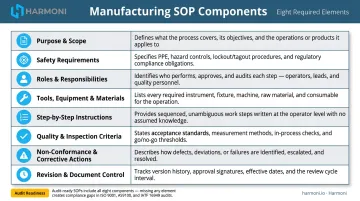
An SOP missing version control or QC checkpoints creates real compliance and usability risk. An operator working from an outdated revision may use wrong tolerances, skip required inspections, or follow a process that's already been corrected — turning the document into the source of the defect.
SOP vs. Work Instruction
These two documents serve related but distinct purposes:
- SOPs define the "what" and "why" of a process at a higher level : the overall procedure, quality expectations, and compliance context
- Work instructions provide granular, operator-level detail for individual steps such as specific machine parameters, tooling setups, and measurement methods
Most manufacturers use both. A practical rule: if the document answers "what is the process and why does it exist," it's an SOP. If it answers "exactly how does an operator execute step 4," it's a work instruction. Confusing the two leads to SOPs that are too granular to maintain or work instructions too vague to use.
How to Write an SOP in Manufacturing: Step by Step
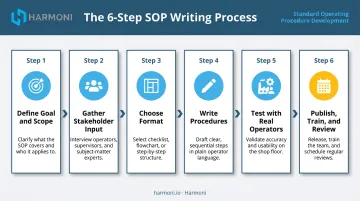
Step 1: Define the Goal and Scope
Start by identifying the process to be standardized and the objective it needs to achieve — whether that's reducing quality escapes, addressing a recurring safety incident, or preparing for an upcoming audit. Define which machines, departments, products, and roles the SOP applies to, and note any exceptions.
Step 2: Gather Input from the Right Stakeholders
The most effective SOPs are written with frontline operators, not just for them. The people who perform the task daily know where the real failure points and process variations exist — information that won't appear in an equipment manual.
Gather input from:
- Machine operators and technicians performing the task
- Supervisors who manage quality and throughput for the process
- Engineers who designed or modified the process
- Technical documentation: equipment manuals, regulatory standards, historical defect reports, and maintenance logs
Step 3: Choose the Right Format
Match the format to the task and the audience:
- Numbered steps for linear processes with a fixed sequence
- Flowcharts for tasks involving decision points (for example: if the first-article dimension is out of tolerance, halt production and notify the supervisor; if within tolerance, proceed)
- Visual aids or annotated photos for complex machine setups where position and orientation matter — particularly useful in CNC machining, where visual references tied to specific machine parameters can cut setup errors and misalignment
Step 4: Write Clear, Actionable Procedures
Write each step in plain language using active voice. Avoid passive constructions and vague guidance. Each step should specify what to do, how to do it, and what to check for if something goes wrong.
Include specific values wherever possible:
- ✓ "Set the coolant flow to 2.5 GPM" — actionable
- ✗ "Set to the appropriate level" — not actionable
Step 5: Test the SOP with Real Operators
Before finalizing, run the SOP in a live production environment with the workers who will actually use it. Watch where they hesitate, where they interpret instructions differently than intended, and where they slow down. Collect structured feedback and revise accordingly.
An SOP that looks complete on paper but creates friction on the floor will be ignored under production pressure.
Step 6: Publish, Train, and Set a Review Schedule
Once approved, distribute the SOP to all relevant personnel and conduct training before implementation begins. Establish a formal review cadence — at minimum annually, and immediately following any process change, new equipment installation, regulatory update, quality incident, or product recall.
OSHA's lockout/tagout standard explicitly requires at least annual periodic inspection of energy-control procedures. That discipline applies to all manufacturing SOPs: treat them as living documents, not one-time deliverables.
Manufacturing SOP Example: CNC Machine Setup and First-Article Inspection
A CNC machine setup and first-article inspection SOP is one of the most common — and highest-stakes — procedures in precision manufacturing. Here's how the components map to the actual workflow:
Purpose: Ensure that first-article parts meet print specifications before a full production run begins.
Scope: Applies to all CNC machining workcenters.
Procedure steps:
- Load the approved CNC program for the specified part number and revision
- Verify tooling offsets against the setup sheet
- Confirm workholding and fixturing match the engineering drawing
- Run the first part at reduced feed rate
- Measure all critical dimensions against blueprint tolerances using calibrated gauging
- Record measurements on the first-article inspection checksheet
- Compare results to acceptance criteria
- Obtain supervisor sign-off before releasing the full production run
Quality control checkpoint: If any dimension falls outside tolerance, production halts immediately. The operator notifies the supervisor, documents the non-conformance on the quality record, and quarantines the part pending disposition. Root cause must be confirmed and corrected before the run resumes.
The same structure — purpose, scope, steps, and a documented exception path — works for virtually any shop floor procedure, from equipment changeover and preventive maintenance to end-of-shift inspection. The key is that every scenario, including the failure case, is defined in advance rather than improvised under pressure.
From Written SOPs to Real-Time Execution on the Shop Floor
The Execution Gap
Most manufacturers invest real effort in writing SOPs. The problem is what happens after they're published.
Paper binders accumulate revisions that don't reach the floor. Digital files sit on shared drives no one checks mid-shift. Operators revert to habit under time pressure — especially when hunting down the right procedure takes longer than just doing the job from memory.
In the turbine-blade repair study cited in our research, paper-instruction users routinely skipped zoning and measurement steps. Those steps existed in the SOP. They just weren't present at the point of use.
Closing this gap requires embedding SOP access directly into the workflow — not storing it somewhere operators have to retrieve it.
How Harmoni Addresses the Gap
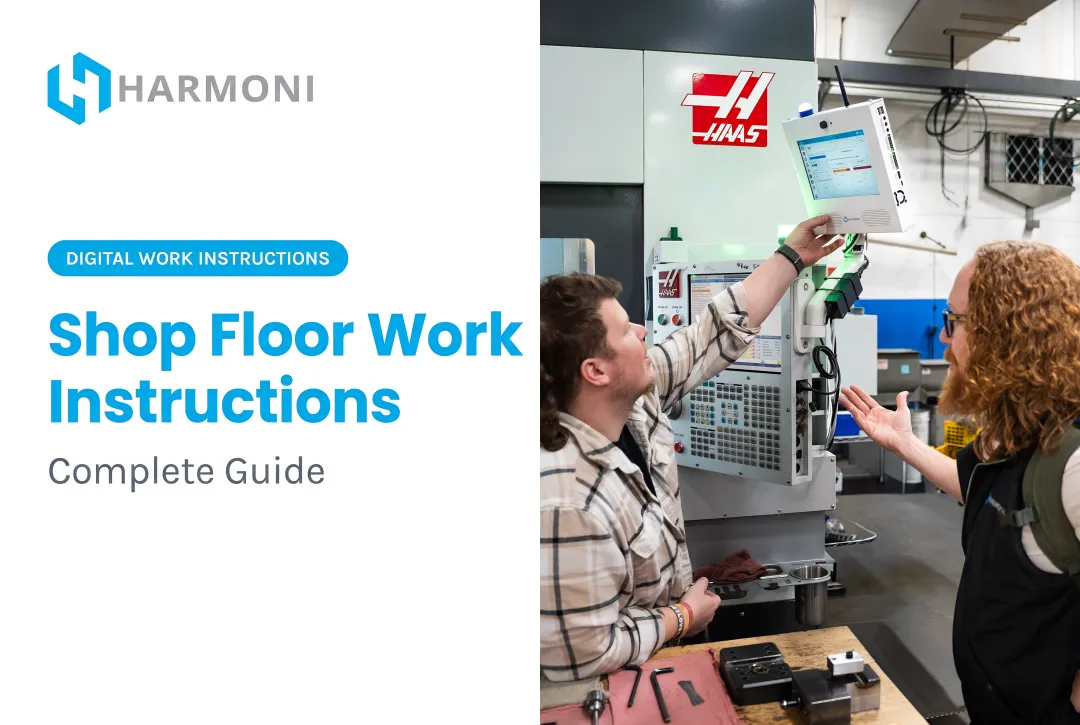
Harmoni's factory orchestration platform is designed specifically for this problem in CNC machining and precision manufacturing environments. Rather than storing SOPs somewhere operators have to retrieve them, Harmoni surfaces the correct job instructions, setup requirements, and quality checkpoints automatically at each workcenter — triggered by RFID-based operator identification the moment the right operator arrives at the right machine.
Three capabilities drive this:
- Ties work instructions to specific part numbers and revision levels, so operators receive the current version without manually checking version control. At one documented machine shop, replacing paper-based SOPs with RFID-triggered digital instructions contributed to a 22% scrap reduction in two months, with incorrect revision access cited as a direct factor.
- Automatically loads the correct CNC program, settings, and offsets when an operator is identified at the workcenter — removing a manual step that is a common source of setup errors.
- Captures quality checkpoints digitally as operators progress through the job, creating a timestamped record and flagging out-of-tolerance conditions in real time rather than after a full run.
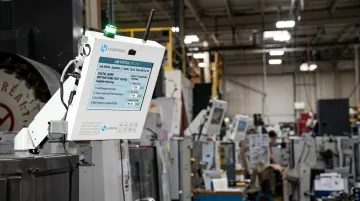
At WessDel, a precision aerospace and defense machine shop, implementing Harmoni's platform delivered 17 productive hours gained per employee per month and a 10% reduction in delinquent jobs — outcomes rooted in eliminating the manual, paper-dependent workflows that create execution gaps.
Observability: Seeing Deviations While They're Happening
When SOP execution runs through an orchestration layer, deviations become visible as they occur. Harmoni's shop floor dashboards and exception alerting allow plant managers to identify when a machine parameter drifts or a checkpoint is incomplete — and respond while the job is still running, not during a post-production quality review.
For aerospace, defense, and medical device manufacturers operating under AS9100, ITAR, CMMC, or ISO 13485 requirements, this creates an audit-ready evidence trail. Every event is automatically logged:
- Operator authentication and machine access
- Work instruction version accessed
- Checksheet entries with pass/fail status
- Machine, timestamp, and operator identity for every action
This replaces manual sign-in logs and paper-based access records with a continuous, automated compliance record.
Manufacturers who move from static SOPs to live, orchestrated process control gain accurate job costing, labor visibility, and production performance data that paper SOPs cannot provide. To see how this works in practice, request a free demo at harmoni.io/demo.
Frequently Asked Questions
What is an SOP in manufacturing?
A manufacturing SOP is a documented, step-by-step set of instructions that standardizes how a specific process or task is performed. It covers the sequence of steps, safety requirements, quality checkpoints, and roles responsible for execution, replacing reliance on memory and informal tribal knowledge.
What are the steps to create an SOP in manufacturing?
- Define the goal and scope
- Gather input from frontline operators and technical documentation
- Choose the right format for the task
- Write clear step-by-step procedures with specific values
- Test the SOP with real workers in a live environment
- Publish, train, and establish a formal review schedule
What is an example of a manufacturing SOP?
A CNC machine setup and first-article inspection SOP covers loading the approved program, verifying tooling offsets, running a first part, measuring critical dimensions against blueprint tolerances, recording results on the inspection checksheet, and obtaining supervisor sign-off before the full production run begins.
What is an SOP checklist?
An SOP checklist is a simplified, checkbox-format version of a standard operating procedure used to verify that each required step has been completed in sequence. It's commonly used for machine setups, quality inspections, and shift handovers in manufacturing environments.
Why are SOPs important in manufacturing?
SOPs reduce process variation, support regulatory compliance and audit readiness, accelerate operator onboarding, establish clear accountability, and provide the documented baseline needed for lean manufacturing and continuous improvement initiatives.
How often should manufacturing SOPs be reviewed and updated?
SOPs should be reviewed at minimum annually, and immediately following any significant process change, equipment update, regulatory revision, quality incident, or product recall. OSHA explicitly requires annual inspection for lockout/tagout energy-control procedures, and that same standard of discipline applies across all manufacturing SOPs.