Introduction
Picture this: a new operator arrives at a workstation on their second week. No written procedure exists for the operation, so they watch a coworker run the previous job and try to replicate the setup from memory. An hour later, quality flags a batch of parts outside dimensional tolerance. The shop eats the scrap, reruns the job, and holds the order while engineering investigates — all because nobody wrote down how the operation should be performed.
That scenario plays out on manufacturing floors every day — and the fix is simpler than most shops expect.
This guide covers what work instructions are, what they must include, how to write them, and how digital systems are changing how instructions reach operators at the machine.
Key Takeaways
- Work instructions are task-level documents — more granular than SOPs — that tell operators exactly how to perform one discrete operation
- Effective instructions require a title block, materials list, numbered steps with visuals, safety requirements, and quality checkpoints
- Undocumented tribal knowledge is a measurable operational risk — the 2024 Deloitte-Manufacturing Institute study projects 2.8 million manufacturing retirements by 2033
- Digital work instructions reduce defect rates — one peer-reviewed study recorded 1.69 mean defects with digital instructions versus 3.55 with paper
- The most advanced manufacturers connect instructions directly to live ERP job data, eliminating setup confusion at the point of production
What Are Manufacturing Work Instructions?
A manufacturing work instruction is a task-level document that guides an operator through one specific production operation — answering what to do, in what sequence, with which tools, to what standard, and what to do when something goes wrong.
The definition is straightforward. Getting it right on the shop floor is where most manufacturers struggle.
How Work Instructions Differ from Other Documents
Work instructions sit at the bottom of the documentation hierarchy — closest to the person doing the work. They are not:
- Quality policies — broad statements of intent
- Standard Operating Procedures (SOPs) — process-level documents covering who does what and why
- Engineering drawings — geometric specifications for the finished part
Work instructions translate all of the above into concrete, executable steps for a specific operator at a specific workstation.
What Makes Manufacturing Instructions Unique
That translation has to meet a higher bar than most procedure documents. Manufacturing work instructions carry three requirements general documentation doesn't:
- Precision to specification — torque values, surface finish tolerances, dimensional limits, and measurement methods must be exact
- Consistency at scale — the same output is required whether the operator is running the job for the first time or the five hundredth
- Connectivity to the broader system — inspection records, CNC programs, and production data all depend on the instruction being current and accurate
Why Manufacturing Work Instructions Matter
Standardization Cuts Variability
Without a documented standard, every operator develops their own approach. Two operators running the same part number can produce different outputs — and neither may be aware the other's method exists. Work instructions create the single agreed-upon baseline that eliminates this drift.
APQC benchmarking data places median scrap and rework costs at 1.0% of sales for manufacturers — a figure that compounds quickly across high-volume or high-mix operations. Standardized instructions are among the most direct ways to reduce it.
Knowledge Retention as Workforce Risk Management
Experienced operators carry years of process knowledge in their heads — which fixtures run which parts, which tools last longer on certain materials, where the tricky dimensions are. When those operators retire, that knowledge often leaves with them.
The 2024 Deloitte-Manufacturing Institute workforce study projects that US manufacturers will need 3.8 million additional workers between 2024 and 2033, with approximately 2.8 million openings attributable to retirements. Documented work instructions are the most reliable way to capture that institutional knowledge before those operators are gone.
Compliance and Audit Readiness
In regulated industries, documented work instructions are not optional — they are evidence of process control:
- ISO 9001:2015 requires documented information sufficient to support controlled production conditions
- IATF 16949:2016 explicitly requires standardized work, operator instructions, and visual standards at the task level
- AS9100 Rev D adds production instruction requirements tied to inspection evidence, acceptance criteria, and first-article verification
- OSHA mandates written energy-control procedures (lockout/tagout) and operating procedures for processes involving highly hazardous chemicals
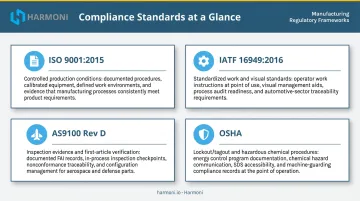
Well-maintained instructions reduce audit exposure — and when nonconformances do occur, they give investigators a documented baseline to trace exactly where and why the process deviated.
Key Components of Effective Manufacturing Work Instructions
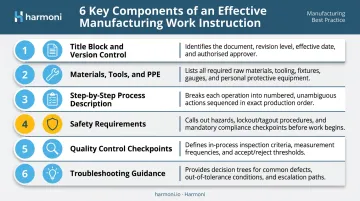
Every work instruction — regardless of industry, process, or complexity — needs these six elements:
1. Title Block and Version Control
The header must include:
- Document title and unique identifier
- Revision number and effective date
- Author and approver names
- Scope (which part numbers, operations, or machines apply)
An operator working from an outdated printout is a compliance failure waiting to happen. Version control is what prevents that.
2. Required Materials, Tools, and PPE
List everything needed before the first step begins:
- Raw materials and consumables
- Cutting tools, fixtures, and gauges
- Measuring instruments and calibration status
- Required personal protective equipment
Placing this list at the top prevents mid-operation interruptions and ensures operators are properly equipped and protected before they start.
3. Step-by-Step Process Description
This is the core of the document. Each step should:
- Be numbered sequentially
- Describe one discrete action only
- Use plain language in active voice, present tense
- Be paired with a photo, diagram, or short video wherever text alone risks misinterpretation
One action per step is a critical discipline. When a step contains multiple actions, operators skip sub-steps under time pressure. That's where errors begin.
4. Safety Requirements and Emergency Procedures
Include in every instruction:
- Lockout/tagout requirements for the specific machine
- Hazardous material handling rules
- PPE reminders at the point they're relevant
- Immediate steps if an operator suspects an unsafe condition
Even routine operations carry risk. Safety requirements embedded in the instruction — not in a separate binder nobody reads — are far more likely to be followed.
5. Quality Control Checkpoints
Define measurable accept/reject criteria at each critical step:
- Dimensional tolerances and measurement method
- Torque specifications and verification method
- Visual inspection standards (ideally with reference photos)
- Sampling frequency and required records
These checkpoints let operators self-verify before advancing. Problems caught at the source cost a fraction of what final inspection rejects do.
6. Troubleshooting Guidance
Include a brief list of the most common failure modes, their likely causes, and corrective actions. Document specific error codes, out-of-tolerance conditions, and machine alarm responses. This is how institutional knowledge — the kind that lives in a veteran operator's head — gets encoded into a repeatable process that works on any shift.
How to Write Manufacturing Work Instructions Step by Step
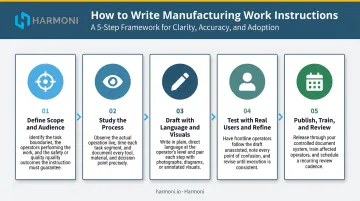
Step 1: Define Scope and Know Your Audience
Prioritize which operations need formal work instructions first. Focus on tasks that are:
- High-risk or high-consequence if performed incorrectly
- Performed infrequently (low repetition = high memory dependency)
- Complex or multi-step with branching decisions
- Highly variable in output across operators
Then determine the skill level of the intended operator. A new hire needs more explicit detail than an experienced machinist. That gap determines how granular each step needs to be.
Step 2: Study the Process Before You Write
Observe the operation performed by the shop's best operators — more than once. Watch for steps that happen automatically, without conscious thought, because those are the first steps that get omitted from a written document.
Then interview those operators directly. Ask: What would you tell a new person the first time they ran this job? What's the most common mistake? What's the step that's easy to do wrong?
Cross-reference engineering drawings, material specs, and applicable regulatory standards before drafting anything.
Step 3: Draft Using Clear Language and Visuals
Keep the writing tight and unambiguous. Each step should follow these rules:
- One action per step, written in active voice and present tense
- Technical terms defined at first use — never assumed
- Visuals added wherever a photo or diagram outperforms prose
A well-placed photo eliminates more ambiguity than three sentences of description. If the critical tolerances on a part feature are visually complex, a diagram with callouts is worth the effort to produce.
Step 4: Test with Real Users and Refine
Hand the draft to someone who has never performed the operation. Watch them attempt it using only the written instruction. Note every point of hesitation, every question they ask, every step they misinterpret — all of that is a documentation gap.
Then repeat with an experienced operator to verify technical accuracy. Incorporate both rounds of feedback before marking the document as approved.
Step 5: Publish, Train, and Establish a Review Cadence
Once approved, implement the instruction at the workstation and train all affected operators. Then establish a formal review schedule: at minimum annually, and immediately whenever the process, tooling, material, machine, or regulatory requirement changes.
Designate a document owner responsible for version control and for removing outdated copies from circulation. Without a named owner, version drift is inevitable — and operators working from stale instructions are the most common reason work instructions fail in practice.
SOP vs. Work Instructions: Understanding the Difference
SOPs and work instructions serve different levels of the same process — and conflating them is one of the most common documentation mistakes in manufacturing.
| SOP | Work Instruction | |
|---|---|---|
| Level | Process | Task |
| Answers | What, why, who | How, exactly |
| Audience | Management, quality, all stakeholders | The operator doing the work |
| Scope | Entire process or department | One specific operation |
| Detail | Procedural overview | Step-by-step execution |
A concrete example: an SOP governs the incoming inspection process — who performs it, which standards apply, how results are documented, and what happens when a supplier fails. The work instruction tells the inspector exactly how to set up and use a CMM to measure a specific part feature, which dimensions to check, what the accept/reject limits are, and what to do if a dimension falls outside tolerance.
The work instruction inherits the standards set by the SOP and translates them into operator-level actions. Without the SOP, there's no governing framework. Without the work instruction, that framework never reaches the operator's hands.
Going Digital: Elevating Work Instructions on the Modern Shop Floor
The Problem with Paper
Paper-based work instructions have a fundamental limitation: they're static at the point of creation and increasingly inaccurate from that moment forward. The problems compound quickly:
- Updates require printing, distributing, and physically retrieving outdated copies from every workstation
- No record of which version an operator actually followed
- No tracking of whether the instruction was read at all
- Cannot integrate with machine data, ERP systems, or quality records
In high-mix environments with frequent engineering changes, paper instructions become a compliance liability almost immediately.
What Digital Work Instructions Enable
The shift to digital removes those limitations and adds capabilities paper cannot replicate:
- Pushes version updates to all connected workstations simultaneously — no reprinting, no distribution lag
- Embeds photos, diagrams, and video clips directly at the relevant step
- Logs timestamped acknowledgment records showing who accessed which version
- Captures checksheet data at the same screen, tied to the same job record
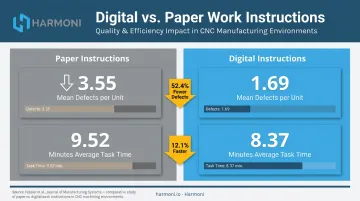
Research supports the quality impact. A peer-reviewed controlled experiment found that participants using digital instructions produced a mean of 1.69 defects compared to 3.55 defects with paper instructions — a statistically significant result at p < .01 — and completed the task in 8.37 minutes versus 9.52 minutes with paper.
Connecting Instructions to Live Operations
Leading high-mix operations are moving beyond static digital documents toward systems where work instructions respond to what's actually happening on the floor in real time.
This means the right instruction appears automatically at the right workstation, for the right job, without the operator searching for it. When a job loads, the instruction loads with it.
Harmoni's factory orchestration platform takes this approach. Using long-range RFID technology, it automatically detects which employee is at which workstation and which job is active, then surfaces the correct work instructions, CNC program, engineering requirements, and setup sheets on the operator's screen without any manual lookup. The right job, part, and revision are matched automatically — eliminating the setup confusion that drives scrap in high-mix operations.
Operators get a centralized command center at each workcenter: work instructions, quality checksheets, and production data in one place, without leaving the machine. Managers get real-time dashboards that combine machine performance (including OEE), ERP data, and operator activity in a single unified view.
When evaluating a digital work instruction system for your operation, prioritize these capabilities:
- Real-time ERP and machine data integration
- RFID or operator ID-based automatic job detection
- Version control with documented audit trail
- Multimedia support for visual-heavy operations
- Production performance dashboards alongside process data
- Fast deployment — look for systems that go live in weeks, not months
Harmoni deploys in weeks with no machine replacement required, retrofitting to existing equipment regardless of age or manufacturer.
Frequently Asked Questions
What are manufacturing instructions?
Manufacturing instructions are detailed, task-specific documents that guide how a product is made, inspected, or packaged in a production environment. They include specifications, step-by-step procedures, required materials, and quality checks, supporting consistent output and regulatory compliance.
What is the difference between SOP and WI?
SOPs describe what a process does, why it exists, and who is responsible. Work instructions define exactly how an operator performs one specific task within that process — granular, step-by-step, and operator-facing within the framework the SOP sets.
What is an example of a manufacturing work instruction?
A CNC machinist's work instruction might cover loading the correct fixture, verifying tool offsets against the setup sheet, running a first-article inspection, and recording dimensional results against specified tolerances. It also defines exactly what to do if a critical dimension measures out of spec.
What should be included in a manufacturing work instruction?
Six elements belong in every work instruction: a title block with version and approval data, required tools/materials/PPE, numbered steps with visual aids, safety and lockout/tagout requirements, quality checkpoints with accept/reject criteria, and troubleshooting guidance for common failure modes.
How often should manufacturing work instructions be updated?
At minimum annually, and immediately whenever a process, tool, material, machine, or regulatory requirement changes. A designated document owner and formal version control process are essential to keeping instructions accurate, current, and compliant.
What is the difference between paper and digital work instructions?
Paper instructions are static, hard to update simultaneously across workstations, and offer no traceability. Digital instructions push real-time updates to every workstation, embed multimedia at the relevant step, track operator acknowledgment, and integrate directly with ERP and quality systems.