
Introduction
Your ERP tells you what to build this week. It has no idea what's happening at machine six right now.
Maybe the operator is three hours behind because nobody caught a tooling issue until the second shift. Maybe someone's running last month's program revision on a rush order. That gap between planned and actual is where scrap, missed deadlines, and blown job costs live.
A 2023 survey of manufacturing professionals found 62% reported delays tied to inventory data, throughput times, and equipment-capacity utilization, largely because core processes still aren't fully automated (SME and Laserfiche, 2023).
Paper travelers, spreadsheets, and disconnected point systems can't close that gap.
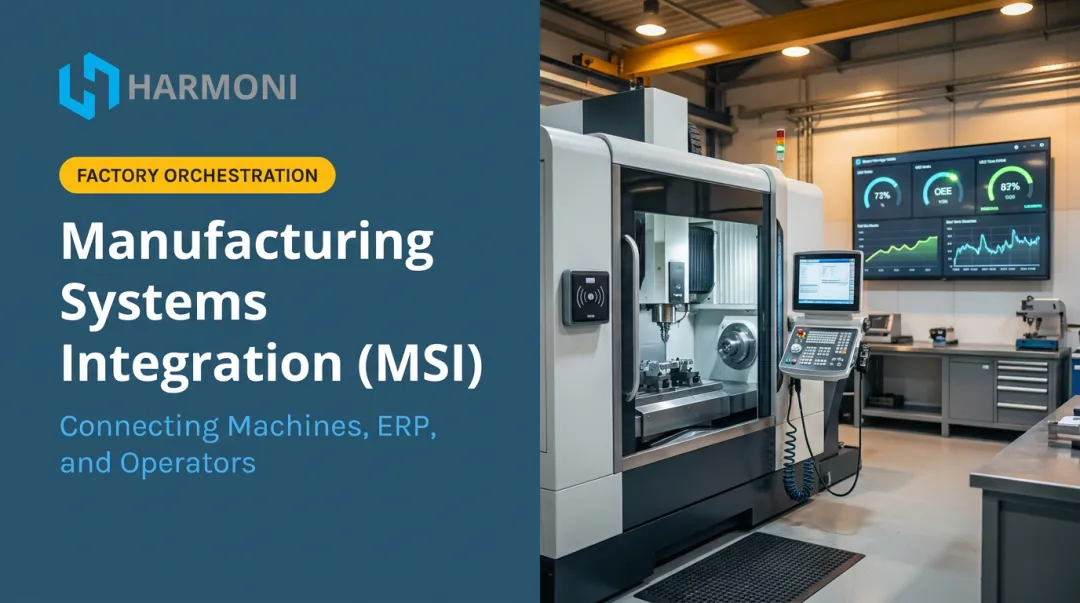
This article breaks down what a Manufacturing Operating System (MOS) actually is, how it differs from ERP, MES, and MOM, and what to look for when evaluating one. You'll also see how a factory orchestration platform like Harmoni puts the concept into practice on the shop floor.
Key Takeaways
- A MOS connects ERP, machines, and operators into one real-time operational view instead of disconnected silos
- Real-time visibility catches downtime, quality issues, and missed steps while a job is still running, not after
- The strongest MOS platforms integrate natively with existing ERP and CNC controls and deploy in weeks, not years
- Automating manual data entry and paperwork frees operators to spend more time actually making parts
What Is a Manufacturing Operating System (MOS)?
A Manufacturing Operating System is a centralized software platform that coordinates people, machines, systems, and workflows to manage production in real time. Think of it as a control tower for the shop floor: scheduling, materials, quality, maintenance, and labor all feed into one operational view instead of sitting in separate silos.

That's a different model than paper travelers or spreadsheet trackers, which rely on someone manually writing down what happened after it already happened. By the time that data reaches a supervisor, the job is done, the scrap is made, and the only thing left to do is figure out why.
How MOS Relates to MOM
MOS is often used alongside, and sometimes confused with, Manufacturing Operations Management (MOM) software. MOM, as defined under the ISA-95 standard, covers production, quality, maintenance, and inventory activities at the operations level. A MOS is broader: it's the operational framework that orchestrates how people and systems act on that data, not just where the data gets logged.
Who Actually Deploys a MOS
MOS platforms show up most often in environments where precision and traceability aren't optional:
- CNC machining and precision job shops
- Aerospace parts manufacturing (AS9100 environments)
- Defense manufacturing (ITAR/CMMC-regulated work)
- Automotive component production (IATF 16949)
- Healthcare and medical device manufacturing (ISO 13485)
Demand for that coordination keeps rising. A Rockwell Automation 2024 survey of 1,567 manufacturers across 17 countries found that 95% were using or evaluating smart-manufacturing technology, up from 84% a year earlier. Adoption is climbing, yet plenty of shops still reconcile systems that don't talk to each other.
MOS vs. ERP, MES, and MOM: How They Differ
Each of these systems covers part of the manufacturing stack. None of them, on their own, closes the loop between planning and execution.
ERP handles financials, planning, and order management. It's essential for running the business, but it operates on a business-planning horizon of days, weeks, and months, not machine-by-machine, minute-by-minute reality. It can tell you what's due Friday. It can't tell you why machine three has been idle for 40 minutes.
MES manages execution at the machine level: tracking work orders, capturing production data, supporting traceability. Its limitation is scope. MES typically doesn't capture operator context, business-side workflows, or the full picture of why something happened, just that it did.
MOM covers scheduling, quality logging, and maintenance tracking under the ISA-95 framework. It's a valuable data source, but it's not built to make decisions or coordinate action across systems in real time.
A MOS, or orchestration layer, sits between all three. It turns disconnected data points (an ERP job number, a machine cycle, an operator's badge) into coordinated, real-time action across people, machines, and systems.
| System | Primary Focus | Data Type | Operating Cadence |
|---|---|---|---|
| ERP | Financials, planning, order management | Business/transactional | Days to months |
| MES | Machine-level execution tracking | Production/machine | Minutes to shifts |
| MOM | Quality, maintenance, scheduling logs | Operational records | Shift to daily |
| MOS | Orchestration across people, machines, ERP | Unified/real-time | Seconds to minutes |
Key Benefits of a Manufacturing Operating System
Catch Problems in Real Time—Not After the Shift
The core value of a MOS is timing. Instead of learning about downtime or a quality deviation in a shift-end report, managers see it as it unfolds. NIST's Manufacturing Extension Partnership notes that real-time data lets workers make faster process changes that improve efficiency and reduce defects before they compound (NIST MEP).
Standardized execution steps and live deviation flags extend that same advantage to quality. One documented shop cut scrap by 22% in two months after adopting real-time checksheet monitoring that flags out-of-tolerance trends mid-cycle—not after the batch is finished.
Get Manual Work Off Operators' Plates
Data entry, status updates, and paperwork eat into productive time every shift. A MOS automates those steps so operators spend more time cutting parts and less time filling out forms.
At WessDel, a CNC machine shop, operators used to walk to shared ERP terminals to clock in and log job transactions—a process averaging 11 minutes per transaction. Moving that work to RFID-based tracking at the machine recovered 17 productive hours per employee per month.
The same tracking answers who is on which job, at which machine, and for how long. That removes guesswork from labor reporting and keeps execution consistent from shift to shift instead of depending on who is running the floor.
Cost Jobs on Actuals, Not Estimates
Replacing estimates with actuals changes how quoting works. A MOS captures:
- Actual operator labor time per job
- Actual machine cycle and spindle time
- Quantities completed and scrapped, with reasons
Finance and estimating get real numbers instead of guesses—which sharpens quoting accuracy and margin decisions.

Core Pillars of an Effective MOS
An effective MOS rests on three pillars: automation, process control, and observability. Together they connect operators, machines, and business systems so work on the floor matches what the plan assumes.
Automation
Automating data capture removes the manual steps that slow operators down and introduce errors. Common friction points include:
- Searching for the right program on a USB drive
- Typing in offsets by hand
- Walking to a shared terminal to clock in
When these steps happen automatically the moment an operator reaches the machine, both speed and accuracy improve.
Process Control
Standardized, enforced workflows mean the correct work instructions, engineering revision, and quality checksheet reach every operator regardless of shift or experience level. That closes one of the most common sources of scrap: someone working from an outdated drawing or an unapproved program revision.
Observability
Unified dashboards combining machine, ERP, and operator data give leadership one source of truth. Rather than measuring performance against a machine's theoretical top speed, an effective MOS benchmarks actual cycle time against the estimate built into the ERP. That ties floor performance directly to job costing accuracy, not abstract efficiency percentages.
How to Choose the Right MOS for Your Shop
Judge every MOS candidate on three practical tests: whether it connects to what you already run, how fast it shows results, and whether operators will use it without a fight.
Integration Capability
The system should connect natively with your existing ERP (Epicor, Infor, ABAS, JobBoss) and machine controls (Fanuc, Siemens, Heidenhain, Mazak, Haas) without months of custom coding. Native integration means labor, cycle time, and quality data flow automatically. No CSV exports. No manual reconciliation.
Speed to Value
Prioritize platforms that deploy in weeks, not the multi-year timelines tied to traditional ERP rollouts. A platform that needs a year of implementation before showing results has already cost you a year of scrap, downtime, and lost visibility.
Usability and Adoption
Adoption decides whether the system pays off. Look for interfaces that need minimal training. The strongest options work automatically as an operator approaches the machine, instead of demanding logins and manual navigation.
Quick evaluation checklist:
- Native connectors for your ERP and CNC controls (not custom-only builds)
- Deployment measured in weeks, with early visibility into labor and machine data
- Operator experience that works with little training or automatic identification
How Harmoni's Factory Orchestration Platform Delivers on the MOS Promise
Harmoni is a factory orchestration platform built to sit between ERP systems, machines, and operators. It puts the Manufacturing Operating System idea to work on the floor—coordinating people, machines, and ERP transactions so CNC machining, aerospace, defense, and precision shops get consistent execution day to day.
RFID-Driven Automation at Every Workcenter
Harmoni uses long-range RFID to automatically detect employees and jobs as they approach a machine. Tags on employee badges and job paperwork trigger automated actions:
- Clock operators in automatically, eliminating trips to shared terminals
- Load the correct CNC program and revision without manual selection
- Surface work instructions and setup sheets instantly
- Push labor and job data directly into the ERP

Each workcenter runs through a centralized command center. Operators can pull up digital quality checksheets, request support, and authenticate into restricted jobs with a PIN or facial recognition, all without leaving the machine.
Built for Regulated, High-Precision Environments
Harmoni's integration list covers the ERP and machine tool platforms discrete manufacturers already run:
- ERP: Epicor, Infor, Infor Visual, JobBoss/JobBoss2, ABAS, ODOO
- CNC controls: Mazak, Haas, Fanuc, Heidenhain, Siemens, DMG MORI, Makino, Fadal
For defense contractors handling Controlled Unclassified Information, Harmoni offers a Government Cloud deployment with machine-level multi-factor authentication and audit logging aligned to CMMC and DFARS requirements.
Shops using Epicor, JobBoss, or ABAS can typically expect out-of-the-box connectivity. WessDel's president described the Epicor integration as working "seamlessly... out of the box."
If your shop is running any combination of these systems and wants to see what real-time orchestration looks like on your own floor, a free demo is the fastest way to find out.
Frequently Asked Questions
What are the four main types of manufacturing systems?
The four commonly recognized production systems are job shop, batch, repetitive/assembly line, and continuous process manufacturing. A MOS supports execution consistency across all of them, though it delivers the most value in job shop and batch environments common to CNC machining.
What are the 7 types of manufacturing processes?
Common process families include casting, forming, machining, joining, additive manufacturing, finishing, and molding/shaping. A MOS helps standardize and track execution regardless of which process types a facility runs.
What is the difference between an MES and a Manufacturing Operating System?
MES focuses on machine-level execution and production tracking. A MOS sits between ERP, MES, machines, and operators, adding the operational context and coordination that ties those systems together on the shop floor.
How long does it typically take to implement a Manufacturing Operating System?
Modern MOS platforms like Harmoni can deploy in weeks for core functionality, with additional features rolled out over the following months. Traditional ERP or MES rollouts, by contrast, can take months or years.
Is a Manufacturing Operating System only useful for large manufacturers?
MOS platforms deliver the strongest results for mid-to-large manufacturers with complex, multi-machine operations. That said, the core benefits of visibility, accountability, and fewer errors scale to any shop running multiple jobs at once.
Which industries benefit most from a Manufacturing Operating System?
Industries with high precision and traceability demands see the biggest impact: CNC machining, aerospace, defense, automotive, and healthcare/medical device manufacturing. Each depends on consistent execution and auditable records that a MOS is built to provide.