Introduction
Most manufacturers are running multiple industrial systems at once — MES, ERP, SCADA, PLM — and the pressure to connect them keeps growing. For most operations, the MES-to-ERP relationship is where that pressure is felt most acutely.
These two systems are often discussed together, yet they serve entirely different purposes. Confusion about where one ends and the other begins leads to gaps in data, misaligned expectations, and costly integration projects that don't deliver what was promised.
This article answers the questions that matter most: What do MES and ERP actually do? How do they differ? What do you gain by integrating them? And what problems does integration still leave unsolved?
Key Takeaways
- MES manages real-time shop floor execution; ERP handles enterprise-wide operations — finance, HR, procurement, and supply chain
- The two systems are complementary — MES is tactical and production-focused, ERP is strategic and business-wide
- Integrating them connects shop floor data directly to back-office systems, improving traceability and faster decisions
- Even with integration, a real-time execution gap often persists between plans and what operators actually do on the floor
- A factory orchestration layer bridges this gap — coordinating operators, machines, MES, and ERP into one real-time system
What Are MES and ERP Systems?
Both systems serve manufacturing operations, but they operate at entirely different levels. MES governs what happens on the plant floor in real time. ERP governs the business processes — planning, finance, procurement — that surround and support production.
What Is a Manufacturing Execution System (MES)?
MES is specialized software that monitors, tracks, and controls the real-time transformation of raw materials into finished goods. It collects data from machines, sensors, barcodes, and operator inputs to give plant personnel an accurate picture of production as it happens. Per ISA-95, MES sits at Level 3 of the manufacturing automation hierarchy, coordinating personnel, equipment, and material in production.
Core MES functions (as defined by MESA's functional model) include:
- Production scheduling and dispatching
- Work order management and resource allocation
- Real-time quality control
- Part traceability and material genealogy
- Machine process monitoring and data collection
- Regulatory compliance documentation
What Is an Enterprise Resource Planning (ERP) System?
ERP is an enterprise-wide software platform that integrates data and workflows across all business departments into a single centralized database. As Gartner defines it, ERP tools share common processes and data, covering broad end-to-end operational processes across the organization.
Core ERP functions include:
- Financial management (accounts payable/receivable, general ledger)
- Inventory planning and procurement
- Bill of materials (BOMs) and production order management
- Supply chain coordination
- Human resources and payroll
- Sales order processing and demand planning
Understanding what each system does in isolation is the starting point. The more pressing question for most manufacturers is how they differ in practice — and what happens when they work together.
MES vs. ERP: Key Differences Manufacturers Need to Understand
| Dimension | MES | ERP |
|---|---|---|
| Scope & Focus | Shop floor production execution | Enterprise-wide business operations |
| Primary Users | Operators, process engineers, plant managers | Planners, finance, procurement, executives |
| Data Type & Timing | Real-time machine and process events | Cross-functional data across weeks, months, years |
| System Integration | Connects to machines, sensors, CNC controllers, IoT devices | Connects to CRM, HR platforms, procurement tools, and MES |
| Strategic vs. Tactical | Tactical — optimizes daily manufacturing execution | Strategic — supports long-term planning and financial management |
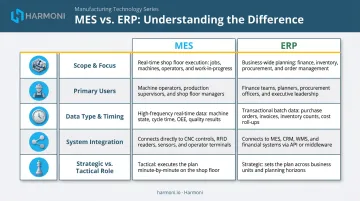
Scope and Focus
MES answers one question: how are things being made right now? ERP answers a different question: how is the business performing, and what resources do we need?
A practical example: MES tracks which machine is running which job at what cycle time. ERP tracks whether the raw materials for that job were procured on budget and whether the order will be delivered on time.
Primary Users
MES is used daily by operators, process engineers, and plant managers who need granular production data immediately. ERP is the domain of planners, finance teams, procurement staff, and executive leadership — people who use data for reporting, forecasting, and resource allocation decisions.
Data Capture and Timing
MES captures manufacturing events in real time and demands immediate action. A deviation on the line must be caught and corrected before the shift ends, not analyzed in next week's report.
ERP captures data across departments continuously, but much of it — financial records, HR data, customer history — remains relevant over weeks, months, or years. The time horizons are different by design.
Integration Architecture
MES connects directly to machines, sensors, and factory floor hardware: IoT devices, barcodes, CNC controllers. ERP integrates with other business software systems — CRM, HR platforms, procurement tools, and MES — via APIs or middleware.
Strategic vs. Tactical Role
MES optimizes day-to-day manufacturing execution in response to real-time events. ERP supports long-term planning, resource allocation, and financial performance management. Run separately, each system operates with a blind spot. Connected, they give manufacturers both the execution data and the business context to act on it.
The Benefits of Integrating MES and ERP
MES and ERP can operate independently, but the real operational value comes when they share data in a continuous, bidirectional loop — creating a connected thread from production order to finished goods to financial reporting.
Unified Production and Financial Visibility
Without integration, job costing relies heavily on estimates and manual entries. With MES feeding real-time production actuals — cycle times, labor hours, material consumption, scrap rates — back into ERP, finance teams get accurate data for inventory valuation, cost accounting, and profitability analysis. That means fewer end-of-month surprises and tighter control over margins.
Elimination of Data Silos and Manual Reporting
Manual data transfer between the shop floor and ERP is a common pain point: supervisors re-key production data, errors creep in, and management sees a picture that's hours (or days) behind reality.
Integration automates that data transfer and establishes a single source of operational truth. The ISA-95 standard defines exactly this Level 3-to-Level 4 interface, specifying how schedule, resource, and production performance information flows between systems.
Better Production-to-Procurement Alignment
The bidirectional workflow looks like this:
- ERP releases a production order with schedule, BOM, and resource requirements
- MES receives it and schedules execution at the workcenter level
- MES updates ERP on work-in-process status, material usage, and output quantities
- ERP adjusts inventory and triggers procurement as consumption data arrives
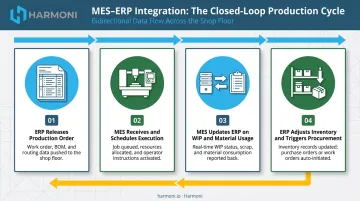
This closed loop reduces the lag between what's happening on the floor and what procurement and planning teams act on.
Regulatory Compliance and Traceability
MES captures granular production records — every process step, parameter, batch, and operator action. ERP organizes those records into audit-ready formats. Together, they support the end-to-end traceability required in regulated industries.
Common regulatory requirements this combination supports:
- Medical device: 21 CFR Part 11 mandates secure, time-stamped audit trails for electronic records
- Aerospace: AS9100 requires documented identification and traceability across production
- Defense: ITAR and CMMC obligations demand controlled access and data integrity
MES-generated records, organized within ERP, provide the documentation backbone these requirements demand — though neither system alone guarantees compliance.
Faster Response to Demand Changes
When ERP detects a surge in customer orders, MES can adjust production schedules in near-real time. When MES identifies a machine failure or quality hold, that signal flows back to ERP to update delivery commitments and procurement plans — cutting stockout risk and avoiding overproduction.
In practice, this means a job shop can respond to a same-day rush order or a failed inspection without a phone call chain. The systems surface the constraint and trigger the right downstream actions automatically.
The Execution Gap: What MES-ERP Integration Still Leaves Unsolved
MES-ERP integration is necessary but often not sufficient for mid-to-large manufacturers with complex, high-mix production environments. Even when data flows correctly between systems, a real-time execution gap frequently persists — at the exact point where plans meet people.
The Gap Between Plans and Operator Actions
ERP plans the work; MES tracks what happened. Neither system actively guides operators at each workcenter in real time with the right job priorities, setup instructions, engineering documents, and quality checks.
The result is predictable: wasted time searching for information, inconsistent execution across shifts, preventable errors that only surface after the fact, and limited accountability when something goes wrong.
Why This Matters in High-Mix Precision Manufacturing
In CNC machining, aerospace, defense, and precision manufacturing environments, the stakes are higher than in repetitive production. Frequent job changeovers, complex tooling setups, tight tolerances, and strict traceability requirements mean that even small operator missteps can result in:
- Scrap and rework that consumes margin
- Compliance failures that affect regulatory standing
- Delivery delays that damage customer relationships
MES tracks these outcomes after they occur, and ERP reflects them in financial reports. Neither prevents them at the moment of execution.
How Factory Orchestration Bridges the Gap
A factory orchestration platform sits between ERP, MES, machines, and operators — coordinating them all in real time. MES monitors, ERP plans, but orchestration actively guides what should happen next.
Harmoni pioneered the factory orchestration category and is built specifically for this purpose. The platform surfaces the right information at each workcenter through machine-side operator command centers and uses long-range RFID to automatically detect nearby employees and associate them with the correct job.
Rather than replacing MES or ERP, Harmoni operates as a flexible orchestration layer that improves how both systems perform — connecting engineering documents, quality requirements, CNC programs, and ERP transactions at the moment of execution. Real-time dashboards bring machine data, ERP workflows, and operator activity into a single unified view.
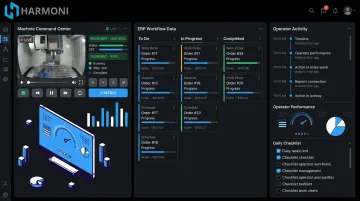
The Three Pillars an Orchestration Layer Adds
Beyond what MES-ERP integration provides, orchestration adds three dimensions:
- Automation: Removes non-productive manual steps — automated CNC program loading, RFID-triggered job identification, and automated time record entry eliminate the need for operators to manually interact with the ERP system
- Process Control: Prevents errors before they occur through digital work instructions, engineering revision control, digital quality checksheets, and multi-factor authentication that confirms the right operator is running the right job with the right program
- Observability: Delivers real-time floor visibility while it is happening — not reconstructed from end-of-shift reports or ERP timestamps
How to Decide on the Right System Configuration
Start by identifying where your visibility gaps are most costly.
- Prioritize ERP first if you lack enterprise-wide financial control — procurement visibility, accurate inventory, cost accounting, and HR management
- Add or upgrade MES if production traceability, scheduling, and real-time quality data are the primary gaps
- Evaluate an orchestration layer when both MES and ERP are in place but execution inconsistency, operator errors, poor labor visibility, or inaccurate job costing persist
That last scenario is more common than manufacturers expect. The systems are in place, data flows between them — but the floor still runs on tribal knowledge and paper travelers.
Operators make judgment calls without the right information in front of them. Fixing that gap requires more than data exchange; it requires connecting people, machines, and workflows into a single coordinated system.
Three practical factors to evaluate when moving forward:
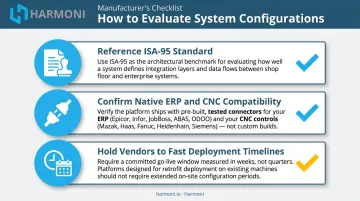
- Reference ISA-95 as your integration standard — it defines the functional boundary and information models for MES-ERP data exchange, making it useful when comparing vendor approaches
- Confirm native compatibility with your existing ERP (Epicor, Infor, JobBoss, ABAS, ODOO, and others) and your CNC machine controls before committing to any platform
- Hold vendors to fast deployment timelines. Measurable improvements should arrive in weeks, not after six-to-twelve-month implementations. Harmoni deploys in weeks with no machine replacement required. The WessDel installation was operational in under one week, with operators performing ERP transactions directly at their machines from day one.
Frequently Asked Questions
What are MES and ERP systems?
MES (Manufacturing Execution System) is shop floor software that monitors and controls real-time production. ERP (Enterprise Resource Planning) is an enterprise-wide platform managing finance, HR, procurement, and supply chain. Both are critical in modern manufacturing but serve different operational layers.
Is MES the same as ERP?
No. MES focuses exclusively on manufacturing execution at the shop floor level, while ERP manages the entire business. They are complementary systems that work best when integrated — each handles what the other cannot.
What is the difference between ERP, CRM, and MES?
ERP is the business management backbone integrating finance, operations, and supply chain. CRM (Customer Relationship Management) manages customer interactions and sales pipeline. MES manages the real-time manufacturing process on the shop floor. Both CRM and MES typically integrate with ERP as purpose-built complements.
How do MES and ERP systems work together?
MES and ERP share data bidirectionally. ERP sends production orders and planning data to MES; MES returns real-time production actuals, material consumption, and work-in-process status for inventory updates, cost accounting, and reporting.
Do you need both an MES and an ERP?
Mid-to-large manufacturers typically need both. ERP alone lacks granular shop floor data capabilities; MES alone cannot manage enterprise financials, procurement, or HR. The right configuration depends on your operation's size, complexity, and regulatory environment.
What gaps can remain even after MES and ERP are integrated?
Even with integration, an execution gap often persists: ERP plans the work and MES tracks what happened, but neither system actively guides operators in real time. A factory orchestration layer addresses this by coordinating people, machines, and systems at the moment of execution.