Introduction
Most production problems aren't discovered while they're happening — they surface in the next morning's report, during inspection, or worse, after a customer complaint. By then, the scrap is cut, the deadline is missed, and the cost is already locked in.
Manufacturers running without systematic shop floor execution control face this reality every shift. They're managing from lagging data: end-of-shift summaries, manual time cards, and supervisor estimates that describe what happened rather than what's happening now.
That gap between what happened and what's happening now is exactly what an MES closes. Its value isn't abstract — it shows up in shift-by-shift outcomes: fewer errors, less wasted labor, and job costs that reflect what production actually consumed.
This article explains what an MES does in practice, which benefits drive the most measurable impact, and what it costs manufacturers to operate without one.
Key Takeaways
- MES connects shop floor execution to business systems, closing the gap between planned production and actual output
- The most measurable benefits are real-time visibility, scrap reduction, labor accountability, and accurate job costing
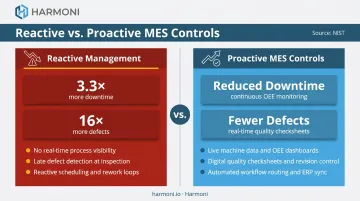
- Manufacturers relying on reactive management face 3.3x more downtime and 16x more defects than those with proactive controls in place
- MES delivers the highest ROI when it's fully adopted and connected to both ERP and machine data
- For high-mix, precision operations, MES is the operational foundation needed to scale without losing control
What Is a Manufacturing Execution System?
A manufacturing execution system (MES) is software that monitors, tracks, and controls manufacturing in real time — from the moment a work order is released to the moment a finished part ships.
Where it fits in the operational stack matters. MES occupies the middle layer between two distinct worlds:
- ERP systems — handle business planning: scheduling, procurement, and financials
- Shop floor — machines and operators handling physical production
- MES — bridges the two, connecting what was planned to what is actually happening
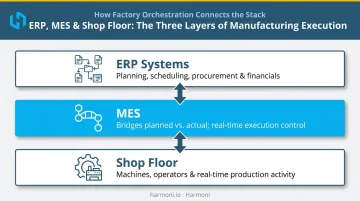
That gap is where most production losses occur. Without MES, planned schedules and actual shop floor conditions stay out of sync — and managers only find out after the damage is done.
The ISA-95 international standard defines MES as the Level 3 manufacturing operations layer — sitting above equipment controls and below enterprise planning systems. It's a standards-based boundary that keeps MES distinct from SCADA, DCS, and ERP.
The goal is giving decision-makers the control and visibility they need to prevent problems, reduce waste, and hit production targets consistently across every shift.
Key Benefits of an MES
The benefits below aren't abstract features. They're measurable operational outcomes tracked through KPIs like OEE, scrap rate, labor utilization, on-time delivery, and job cost accuracy.
Real-Time Production Visibility and Execution Control
MES gives managers and supervisors a live view of what is happening across every workcenter — which jobs are running, which machines are active, where WIP is stalled, and where production is falling behind schedule.
It creates this visibility by collecting data automatically from machines, operators, and work orders. Instead of waiting for end-of-shift reports, supervisors can act on problems as they develop.
Why this matters: The gap between "what the schedule says" and "what's actually happening" is where most production losses occur. Real-time visibility closes that gap. When a supervisor can see a delay forming at 10 a.m. rather than reading about it at 6 p.m., the cost of that incident drops significantly, because the window for corrective action is still open.
NIST research found that manufacturers relying heavily on reactive management had 3.3x more downtime and 16x more defects than those with proactive controls. That's the operational cost of delayed information.
KPIs impacted:
- Overall Equipment Effectiveness (OEE)
- On-time delivery rate
- Production schedule adherence
- Machine utilization
- Cycle time variance
Highest-value applications: Real-time visibility pays off most in high-mix, low-volume operations (CNC job shops, aerospace parts producers) where every job is different and manual tracking breaks down fast. It's also critical for multi-shift operations, where handoff communication is a consistent failure point.
Platforms like Harmoni extend this further. Harmoni's Visual Factory module delivers real-time dashboards across every machine and workcenter, with andon-style status lights that surface deviations as they happen, giving supervisors immediate context without walking the floor.
Error Prevention, Scrap Reduction, and Quality Consistency
Real-time visibility surfaces where production is breaking down. Preventing those breakdowns from producing bad parts is the next layer of MES value.
MES enforces process steps, flags deviations before they compound, and ensures operators follow the correct procedures for every job, preventing errors rather than detecting them after the fact.
It does this by surfacing the right work instructions, quality checkpoints, and process parameters at the right time, tied to the specific job and operation. MES captures quality data inline, not retrospectively. The ambiguity that leads to mistakes (wrong revision, missing step, outdated procedure) is removed from the equation.
Why this matters: Scrap and rework are two of the most controllable cost drivers in manufacturing. Without systematic process control, they recur at the same rates indefinitely. MES breaks that cycle by building quality into execution, not inspection.
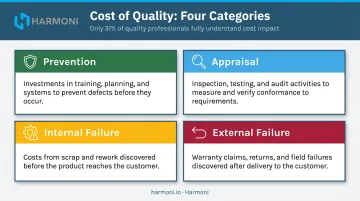
The cost structure of poor quality is well-documented. ASQ identifies four cost-of-quality categories: prevention, appraisal, internal failure (scrap and rework before delivery), and external failure (warranty claims and returns). Critically, only 31% of quality professionals say they fully understand the impact of quality costs on financial performance, meaning most manufacturers are absorbing costs they haven't fully measured.
In regulated industries, the stakes are higher. The FDA logged 108 medical device recall entries in 2024 alone. A single non-conformance event in aerospace, defense, or healthcare manufacturing can trigger recalls, regulatory scrutiny, or lost contracts. Prevention costs a fraction of what correction does.
Harmoni addresses this directly: digital work instructions and quality checksheets are automatically tied to each job based on the RFID-detected part and revision. The correct documentation appears at the operator's screen without manual retrieval, eliminating the revision-control errors that drive nonconformances in precision environments.
KPIs impacted:
- Scrap rate
- Rework rate
- First-pass yield (FPY)
- Cost of quality
- Customer return rate
- Non-conformance incidents
Highest-value applications: Regulated industries (aerospace, defense, medical devices) where traceability and compliance documentation are mandatory, and precision manufacturing where tolerance windows are narrow and a single bad part is expensive.
Labor Visibility, Accountability, and True Job Costing
Reducing scrap improves margins. But if labor time is estimated rather than measured, those margin gains remain incomplete.
MES tracks exactly who worked on each job, for how long, and what the outcome was. That data gives managers an accurate picture of labor utilization and provides the foundation for costing each job correctly.
By capturing operator clock-ins, job assignments, setup times, and run times at the workcenter level, MES eliminates the guesswork in labor reporting. Estimated hours get replaced with actual hours. That distinction changes how manufacturers understand their own profitability.
Why this matters: Inaccurate job costing is a silent margin killer. When labor and machine time are estimated rather than measured, manufacturers routinely underprice jobs, misallocate resources, and can't identify which product lines or customers are actually profitable.
The practical cost of this gap is visible in real operations. WessDel, a manufacturer of satellite components from titanium and beryllium alloys, found that manual ERP time entry consumed an average of 11 minutes per transaction per operator. After implementing Harmoni's RFID-based labor tracking, that same transaction took seconds, recovering 17 productive hours per employee per month.
The impact extended beyond time savings. WessDel achieved a 5x return on ongoing platform costs and reduced late jobs by 10%, driven by the accuracy improvement in labor data.
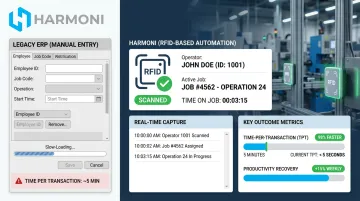
Beyond efficiency, visibility drives accountability. When operators know their time is tracked and supervisors can see idle time and bottlenecks in real time, behavior shifts and process inefficiencies surface faster. The data also compounds: accurate actual-vs-estimated comparisons over time improve quoting accuracy and pricing decisions.
KPIs impacted:
- Labor utilization rate
- Actual vs. estimated job cost variance
- Idle time
- Operator efficiency
- Gross margin per job
Highest-value applications: Labor visibility and job costing accuracy are critical for job shops and contract manufacturers running high-mix operations, where pricing accuracy directly determines profitability, and for any operation where labor represents a significant share of total production cost.
What Happens Without an MES in Place
Without execution control in place, production decisions run on manual data collection, supervisor observation, and end-of-shift reports. By the time a problem surfaces, hours or days have passed — and fixing it costs far more than catching it early would have.
The consequences compound:
- Inconsistent results across shifts and operators — process adherence depends on individual memory and habit rather than enforced procedure
- Higher error and scrap rates — deviations aren't caught until inspection or customer complaint
- Reactive firefighting — supervisors spend their time fixing problems instead of preventing them
- Inaccurate job costing — distorted pricing, hidden unprofitable work, unreliable growth decisions
- Scalability limits — what one experienced supervisor can manage manually breaks down as headcount, job complexity, and shift count increase
These aren't hypothetical risks. NIST estimates that preventable maintenance-related losses in U.S. discrete manufacturing total $119.1 billion — including $18.1 billion in downtime and $100.2 billion in lost sales. The underlying driver in most of those cases is reactive, after-the-fact problem management.
The financial damage rarely shows up as a single line item. It bleeds through thinner margins, inflated scrap rates, and underpriced jobs — which is why shops operating this way often don't recognize the full cost until they benchmark against a more controlled operation.
How to Get the Most Value from Your MES
An MES investment pays off in proportion to how thoroughly it's adopted. Partial use produces partial results. Manufacturers who see the highest returns treat MES data as a daily management tool — not a background reporting system.
Three conditions maximize MES value:
Consistent application across all workcenters and shifts — an MES bypassed by some operators or ignored on certain shifts produces incomplete data. Incomplete data makes the whole system less trustworthy and less actionable. Full adoption isn't optional if the goal is accurate KPIs.
Regular review tied to specific improvement targets — the data MES produces is only valuable when someone is accountable for acting on it. Build review cadences into daily standups and weekly production meetings. Assign ownership to specific metrics.
Integration with the broader technology stack — MES creates the most value when it operates as part of a connected ecosystem rather than a standalone island. When MES data connects to ERP, machine controls, and operator workflows simultaneously, the picture it produces is complete enough to drive real decisions.
Harmoni functions as a factory orchestration layer that coordinates people, machines, ERP workflows, and engineering requirements in real time. For manufacturers with existing MES platforms, Harmoni bridges the gap between enterprise planning and actual shop floor execution — ensuring MES data translates into consistent on-floor action.
A peer-reviewed 2024 MDPI case study of Andimec, an Italian high-mix machining SME with 15 CNC machines, linked MES to ERP, developed KPIs including OEE and machine cycle efficiency, and reported 7% higher profitability in the first year versus the prior three-year average. Consistent adoption and metric accountability drove that result, not the technology alone.
That kind of ROI depends heavily on how fast the system reaches full deployment. Manufacturers should prioritize solutions that go live in weeks and deliver early operational wins, rather than multi-year rollouts that push returns further into the future. Harmoni completed the WessDel installation in under a week, with operators live on the system from day one.
Conclusion
The core value of an MES comes down to three things: control over how production actually runs, clarity about what is happening in real time, and consistency in how processes are executed regardless of shift, operator, or job complexity.
These advantages compound over time. The longer an MES is in use with full adoption, the richer the historical data, the more accurate the benchmarks, and the more precise the improvement targets become. A manufacturer 18 months into consistent MES use has a different ability to diagnose problems and set targets than one relying on manual reporting.
The right frame for MES is ongoing operational discipline: using real data daily to make faster decisions on the shop floor, catch problems before they compound, and tighten execution across every shift. That discipline builds on itself — and the manufacturers who treat it that way consistently outperform those who don't.
For shops looking to extend that visibility further — connecting MES data with machine activity, operator workflows, and ERP transactions in real time — Harmoni's factory orchestration platform is built to sit alongside existing MES systems and close the gaps that manual reporting leaves behind.
Frequently Asked Questions
What does a manufacturing execution system (MES) do?
MES monitors, tracks, documents, and controls the manufacturing process in real time from work order release to finished goods. It gives managers live visibility into production status, operator activity, machine performance, and quality outcomes — replacing after-the-fact reporting with in-the-moment awareness.
What are the benefits of a manufacturing execution system (MES)?
The top practical benefits are real-time production visibility, reduced scrap and rework, improved labor accountability, accurate job costing, and better quality consistency. Together, these contribute to lower production costs, higher on-time delivery rates, and more reliable gross margins per job.
Is MES the same as SCADA?
No. SCADA (Supervisory Control and Data Acquisition) monitors and controls equipment at the machine level, while MES operates at the production management level, coordinating work orders, labor, quality, and scheduling across the shop floor. They serve different layers of the operational stack and work best together.
How does MES integrate with ERP systems?
MES sits between ERP and the shop floor: ERP handles business planning (scheduling, procurement, shipping) while MES handles execution. Together, they create a closed loop where planned production is compared against actual output in real time, surfacing discrepancies before they affect delivery or cost.
What industries benefit most from MES?
MES delivers the most value in regulated and precision-driven industries, including aerospace, defense, automotive, medical devices, and CNC machining, where traceability, compliance documentation, and execution consistency are both operationally and legally critical.
How long does it take to implement an MES?
Timelines vary by scope, but modern MES platforms and complementary tools like factory orchestration software are designed to deploy in weeks rather than months. Harmoni, for example, completed one customer installation in under a week, with measurable operational improvements beginning immediately.