Upgrading your manufacturing operations usually sounds like a massive headache. Upending current workflows, halting production, and throwing away expensive legacy equipment are common fears when factory managers hear the words “digital transformation.” The reality on the shop floor is that systems rarely talk to one another. Your enterprise resource planning (ERP) software lives on a server, while the machines on the floor operate in complete isolation.
Factory orchestration solves this communication breakdown without requiring a massive overhaul of your current setup. Instead of tearing down the infrastructure you rely on, modern orchestration platforms bridge the gap between your existing software and physical machinery. You get the benefits of real-time data and automated workflows while keeping your current investments fully intact.
Harmoni takes a unique approach to this integration challenge. By utilizing a composable architecture, the platform connects directly with your native ERPs and machine sensors. This creates a unified ecosystem where data flows freely. Let us look closely at how this architecture connects your entire operation seamlessly, avoiding the dreaded rip-and-replace scenario.
The no-rip-and-replace philosophy
Most factory software solutions force you to adapt your processes to fit their rigid frameworks. Harmoni flips this dynamic by adapting to your factory. We call this the no-rip-and-replace approach. You have already invested heavy capital and countless hours into your current equipment and software. Factory orchestration should maximize that investment.
Harmoni achieves this through composable architecture. Think of it like building blocks. Instead of a monolithic software suite that takes over everything, composable architecture uses modular components that plug into your existing ecosystem exactly where you need them. If you only need to connect a specific cluster of legacy machines to your ERP, you can deploy the specific modules required for that task.
This flexibility means deployment happens in weeks, not years. Your team experiences minimal downtime, and operators do not have to learn an entirely new system from scratch. They simply get better, faster data in the environments they already know.
Native ERP integrations
The brain of your manufacturing business is your ERP. It handles scheduling, inventory, and order management. However, when the ERP is disconnected from the actual production floor, you are running your business on delayed information.
Harmoni features native integrations with major systems like Epicor, JobBOSS, E2, and Infor, alongside a wide range of other popular ERP platforms. Because these integrations are native, they do not require messy, custom-coded workarounds that break every time the software updates. The orchestration platform communicates directly with the ERP’s application programming interface (API).
When a new order drops into your ERP, Harmoni reads that data instantly. It then translates the order requirements into actionable schedules for the shop floor. Conversely, as parts are completed on the floor, Harmoni feeds that production data back into the ERP in real-time. Inventory levels update automatically. Billing cycles trigger without manual data entry. This bi-directional data flow eliminates the paperwork and human error that typically slow down production tracking.
Bridging the gap: Machine connectivity
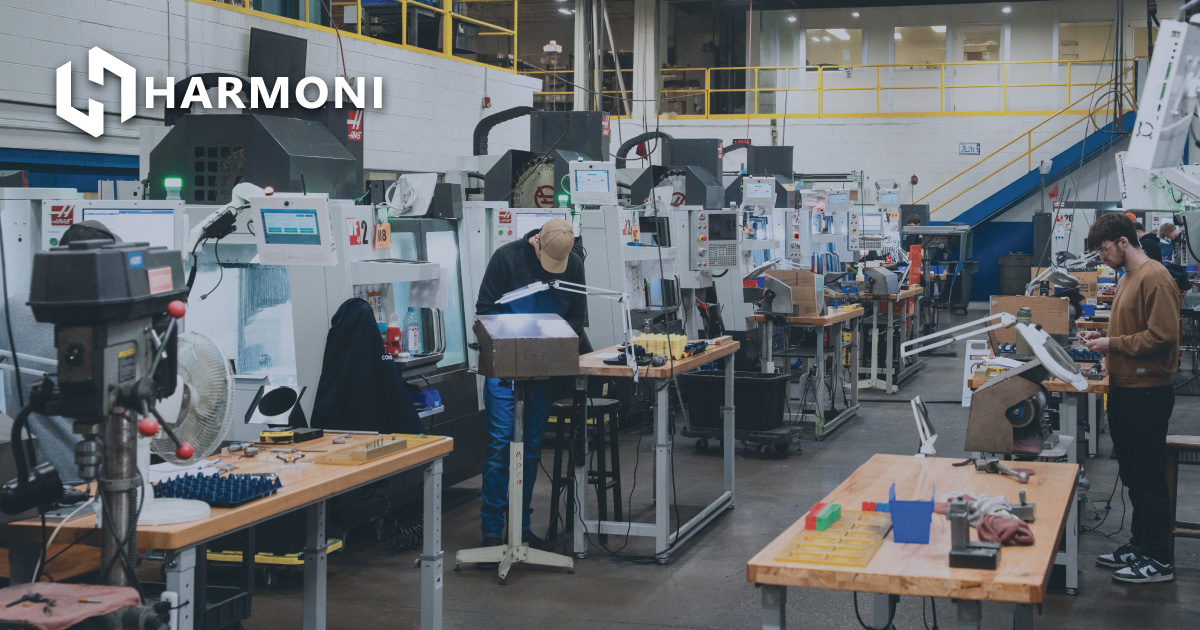
Software integration is only half the battle. The physical machines on your floor need to participate in this data exchange. Factories usually operate a mix of brand-new, highly connected equipment and decades-old legacy machines that still run perfectly well. Factory orchestration brings all of them online.
Breathing life into legacy machines
Older machines often lack digital interfaces. They were built for durability, not data collection. Harmoni connects to these workhorses using edge computing devices and external sensors. By attaching simple, non-invasive sensors to monitor vibration, temperature, or cycle counts, you can pull vital performance data from a machine built in 1985.
These sensors send data to a local edge device, which processes the information and securely transmits it to the Harmoni platform. You suddenly gain visibility into the uptime, cycle times, and maintenance needs of equipment that previously operated in the dark.
Plugging into modern equipment
Newer machines usually come equipped with programmable logic controllers (PLCs) and built-in IoT capabilities. Harmoni connects directly to these modern systems using standard industrial protocols like MTconnect, FANUC FOCAS, OPC UA or MQTT.
Because the platform standardizes data from both new and old machines, factory managers get a single, cohesive dashboard. You can compare the efficiency of a brand-new CNC machine alongside a legacy press, identifying bottlenecks across the entire production line.
Take control of your factory floor
Connecting your factory does not have to be an expensive, multi-year headache that disrupts your output. By leaning on composable architecture and native integrations, you can unite your ERP and your machinery into one intelligent ecosystem.
Start by identifying the biggest data blind spots in your production line. Map out where paper trails are slowing down your operators and where legacy machines are failing without warning. Once you know where the gaps are, you can deploy targeted orchestration modules to close them. Reach out to the Harmoni team today to schedule a technical walkthrough and see how easily our platform plugs into your existing setup.
