October 20, 2026
How to Track Labor Against Jobs Without Making Operators Hate the System
Read More
A Manufacturing Execution System (MES) manages production workflows and tracks orders from start to finish. Factory orchestration goes a layer deeper by connecting people, machines, and data in real time to eliminate wasted labor time, enforce process control, and surface operational insights that an MES simply wasn’t designed to provide.
Most manufacturers know what an MES does. It schedules work orders, tracks materials, records production data, and acts as the connective tissue between the shop floor and enterprise systems like ERP. For decades, the MES has been the default answer to the question: “How do we manage what happens on the factory floor?”
But a growing number of manufacturers, particularly those running human-intensive operations, are running into a hard ceiling with their MES. The system tells them what should happen. It rarely tells them what’s actually happening at the machine level, minute by minute, worker by worker. That gap has a name now: factory orchestration.
This post breaks down what factory orchestration is, how it differs from a traditional MES, and why Harmoni’s approach to this new category is drawing attention from manufacturers looking to compete in an increasingly demanding environment.
An MES sits at Level 3 of the ANSI/ISA-95 automation hierarchy, acting as the bridge between business systems (ERP, at Level 4) and physical production equipment (Levels 0–2). It handles work order management, quality tracking, material genealogy, and production reporting.
For high-volume, highly automated environments, an MES delivers real value. Processes are repeatable, equipment runs predictably, and the MES keeps everything synchronized.
The problem? Most manufacturers don’t operate that way. Human-intensive operations make up The majority of the manufacturing market. In these environments (e.g., job shops, aerospace and defense suppliers, contract manufacturers) the MES records what happened after the fact. It doesn’t guide the worker before or during the task. It doesn’t prevent a $18,000 wing rib from being scrapped because the wrong work instruction appeared on screen. It doesn’t stop a critical CNC program from disappearing when a long-tenured machinist retires.
These aren’t edge cases. They’re daily realities for hundreds of thousands of manufacturers.
Factory orchestration is a new category of manufacturing technology designed to connect people, machines, and data in real time across the shop floor. The term borrows from software engineering, specifically the IEEE’s use of “orchestration” to describe systems that coordinate interdependent services and applies it to the physical factory environment.
Harmoni’s factory orchestration system was built around three core pillars:
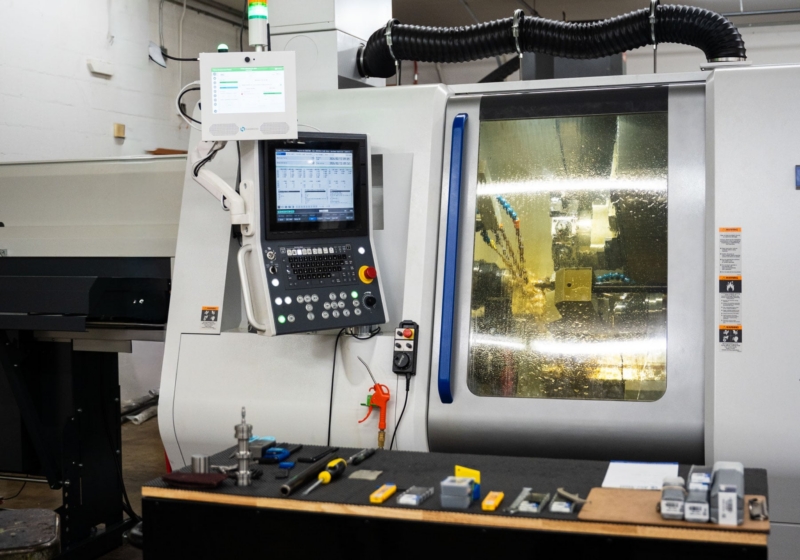
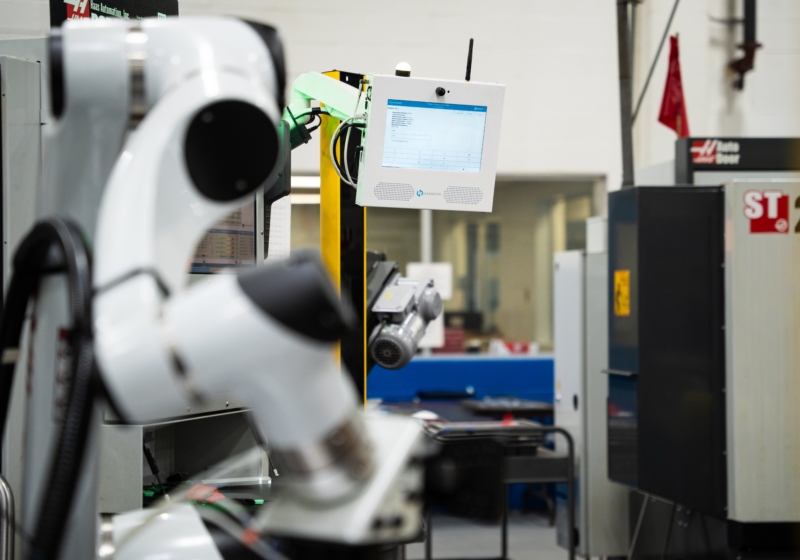
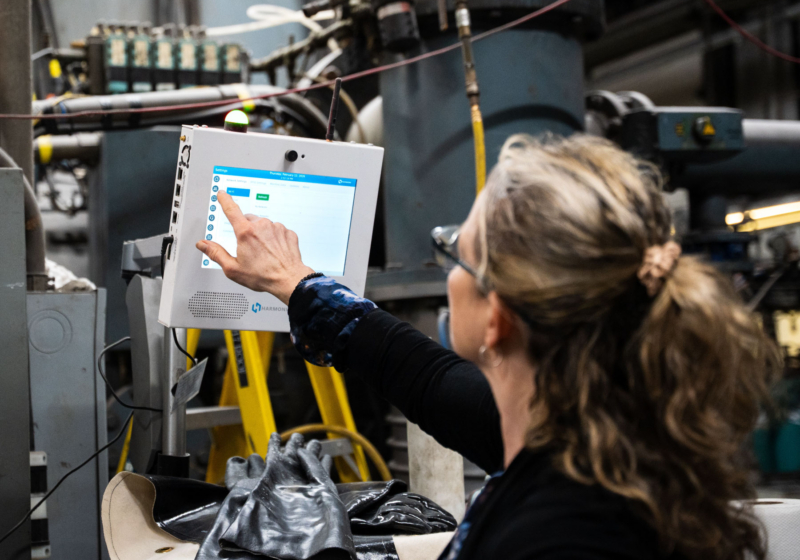
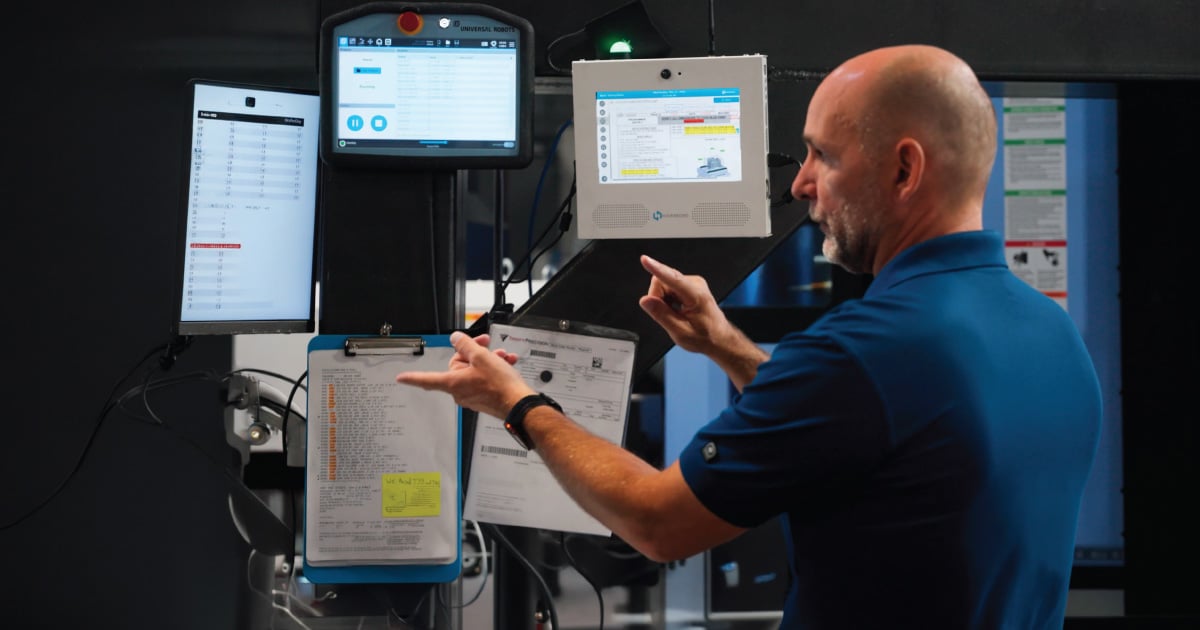
Harmoni’s system includes physical on-machine terminals that operators interact with throughout the day. These terminals serve as the delivery mechanism for the platform’s features and create a mesh network that supports RFID tracking of parts and common tools.
How is factory orchestration different from an MES?
The distinction isn’t about replacing the MES; it’s about filling the gap the MES was never built to address.
An MES operates at the planning and scheduling layer. Factory orchestration operates at the execution layer, at the level of the individual worker and machine, in real time. Here’s how the two compare across the dimensions that matter most:
Layer of operation: An MES sits above the shop floor, managing orders and recording outcomes. Factory orchestration sits on the shop floor, guiding behavior as it happens.
Who it serves: MES systems are primarily designed for planners, supervisors, and quality managers. Factory orchestration is built for the operators themselves: the machinists, assemblers, and technicians whose decisions determine whether a shift goes well or badly.
What it acts on: An MES tracks production data. Factory orchestration acts on that data by automating labor transactions, enforcing process steps, and surfacing anomalies before they become defects or delays.
The ISA-95 framework defines five levels of factory automation. Most MES platforms focus on Level 3. Factory orchestration targets the space between Level 2 (machine control) and Level 3, a layer that has historically been managed by people, clipboards, and tribal knowledge rather than software.
There are approximately 297,000 manufacturers in the US with fewer than 500 employees. Most of them don’t operate automated, lights-out factories. They rely on skilled workers, complex workflows, and institutional knowledge that lives in people’s heads rather than systems.
That last point is particularly risky. When a machinist retires and takes the only working version of a critical program on their personal thumb drive, the manufacturer doesn’t just lose an employee, they potentially lose the ability to make a part entirely.
Factory orchestration is designed to capture and systematize that tribal knowledge before it walks out the door. Combined with real-time labor automation and process control, it gives smaller manufacturers the operational infrastructure to compete with larger, more automated competitors.
Before committing to either an MES or a factory orchestration platform, manufacturers should ask one question: how will this tool change what happens on my shop floor?
If the answer is “it will help us plan and record production better,” an MES may be the right fit. If the answer is “it will change how our workers spend their time, reduce errors at the machine level, and give us real-time visibility into what’s actually happening,” that’s factory orchestration.
The two aren’t mutually exclusive. Harmoni is designed to work within the existing ISA-95 stack, sitting alongside ERP and MES systems rather than replacing them. The goal is to fill the gap those systems leave at the human layer of manufacturing.
There are approximately 297,000 manufacturers in the US with fewer than 500 employees. Most of them don’t operate automated, lights-out factories. They rely on skilled workers, complex workflows, and institutional knowledge that lives in people’s heads rather than systems.
That last point is particularly risky. When a machinist retires and takes the only working version of a critical program on their personal thumb drive, the manufacturer doesn’t just lose an employee, they potentially lose the ability to make a part entirely.
Factory orchestration is designed to capture and systematize that tribal knowledge before it walks out the door. Combined with real-time labor automation and process control, it gives smaller manufacturers the operational infrastructure to compete with larger, more automated competitors.
An MES manages production scheduling, work orders, and post-production data at a planning level. Factory orchestration operates in real time at the worker and machine level, automating labor transactions, enforcing process steps, and delivering operational visibility as work happens, not after.
No. Harmoni’s factory orchestration platform is designed to complement existing MES and ERP systems, not replace them. Factory orchestration fills the gap in the ANSI/ISA-95 stack that sits between machine control (Level 2) and production management (Level 3).
Harmoni organizes its factory orchestration platform around three pillars: labor automation (reducing non-productive time), process control (ensuring the right instructions reach the right worker at the right time), and observability (real-time visibility into shop floor performance).