September 29, 2026
Monitoring Isn’t Enough: Why the Shop Floor Needs Orchestration
Read More

A few minutes spent walking to a shared terminal. Another few minutes searching for the correct program. Time lost waiting for an approval, locating a job, signing into another system, or manually recording production.
Individually, these delays may not seem significant. Most are too small to appear on a production report or trigger a formal investigation.
But they happen repeatedly, across multiple employees, machines, and shifts. By the end of the year, a collection of 5-, 10-, and 15-minute interruptions can consume thousands of hours of productive capacity.
Manufacturers often look for major equipment problems or process failures when they investigate lost productivity. In many factories, however, a significant amount of capacity disappears through ordinary tasks that have become accepted as part of the workday.
This is the 15-minute problem.
Consider a factory with 20 operators. If each operator loses just 15 minutes of productive time during every shift, the factory loses five labor hours per day.
Across 250 working days, that equals:
20 operators × 15 minutes × 250 days = 1,250 hours per year
That is the equivalent of more than 31 full 40-hour workweeks.
If operators lose 30 minutes per shift, the annual impact doubles to 2,500 hours. For a larger facility, or one operating multiple shifts, the number grows even faster.
This calculation only measures labor time. It does not account for the production that could have occurred during those hours, the machines that may have been waiting, or the downstream delays caused when work does not move forward as expected.
The true cost is not simply 15 minutes of labor. It is the value of everything that could not happen during that time.
Most operators do not lose 15 minutes all at once. The time disappears in small increments throughout the day.
An operator may need to:
Each activity may take only a few minutes. That makes the individual delay easy to overlook.
The problem is repetition.
A manual transaction performed once may be inconsequential. The same transaction performed by every operator, for every job, on every shift becomes a significant drain on capacity.
The people completing these tasks are not wasting time. In most cases, they are following the process they were given.
The work may even be necessary. Labor needs to be recorded. Jobs need to be opened and closed. Programs need to be verified. Operators need current instructions. Quality and maintenance issues need to be communicated.
The issue is not whether these steps should happen. The issue is how much human effort they require.
When an operator must leave a machine, find a terminal, sign into a system, locate information, and manually enter data, the factory is using skilled labor to manage administrative friction.
That creates two costs at the same time:
In an environment where manufacturers already struggle to find experienced employees, every avoidable administrative task reduces the capacity of the workforce they have.
Large production problems are usually visible. A machine failure, rejected batch, or missed shipment receives immediate attention.
Small delays are harder to detect because they are distributed across the factory.
No single 5-minute interruption appears serious. The ERP may record when a job starts and stops, but it may not show the steps an operator completed between those transactions. Machine-monitoring software may identify idle time without explaining what the operator was doing or why production stopped.
As a result, these delays often become part of the factory’s normal operating rhythm.
Operators learn the fastest route to the shared terminal. They remember which folders usually contain the correct files. Supervisors answer the same questions repeatedly. Experienced employees develop workarounds that keep production moving.
The factory continues to operate, but it does so with hidden friction built into every shift.
When demand increases, manufacturers often assume they need more machines, more overtime, or more employees.
Sometimes they do. But before making another capital investment, it is worth asking how much capacity is already available inside the current operation.
What would happen if operators could begin work without waiting at a shared terminal?
What if the correct job, program, drawing, and work instructions appeared automatically at the machine?
What if production and labor transactions were recorded without manual data entry?
What if an operator could contact engineering, quality, or maintenance without leaving the workcenter?
What if supervisors could see where work was slowing down without walking the entire floor or assembling information from several systems?
Eliminating these small delays does not make the workday longer. It makes more of the existing workday productive.
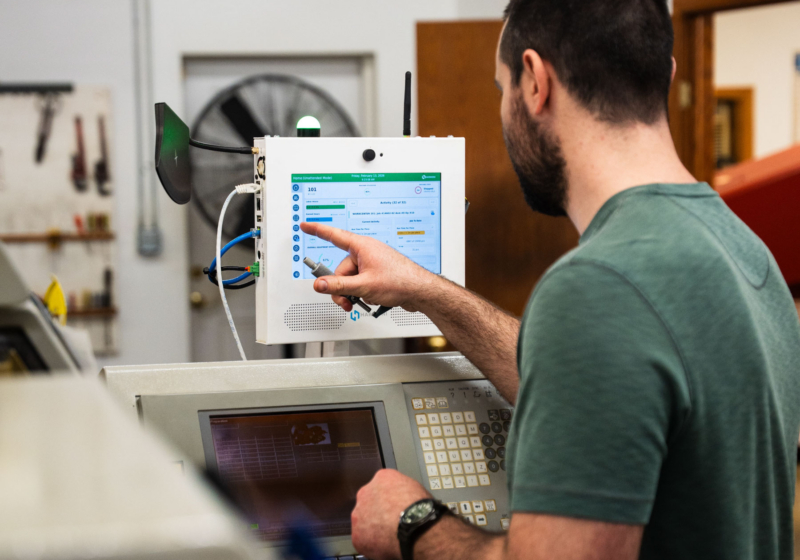
Factory Orchestration connects the people, machines, processes, and systems involved in production so work can move forward with fewer manual steps.
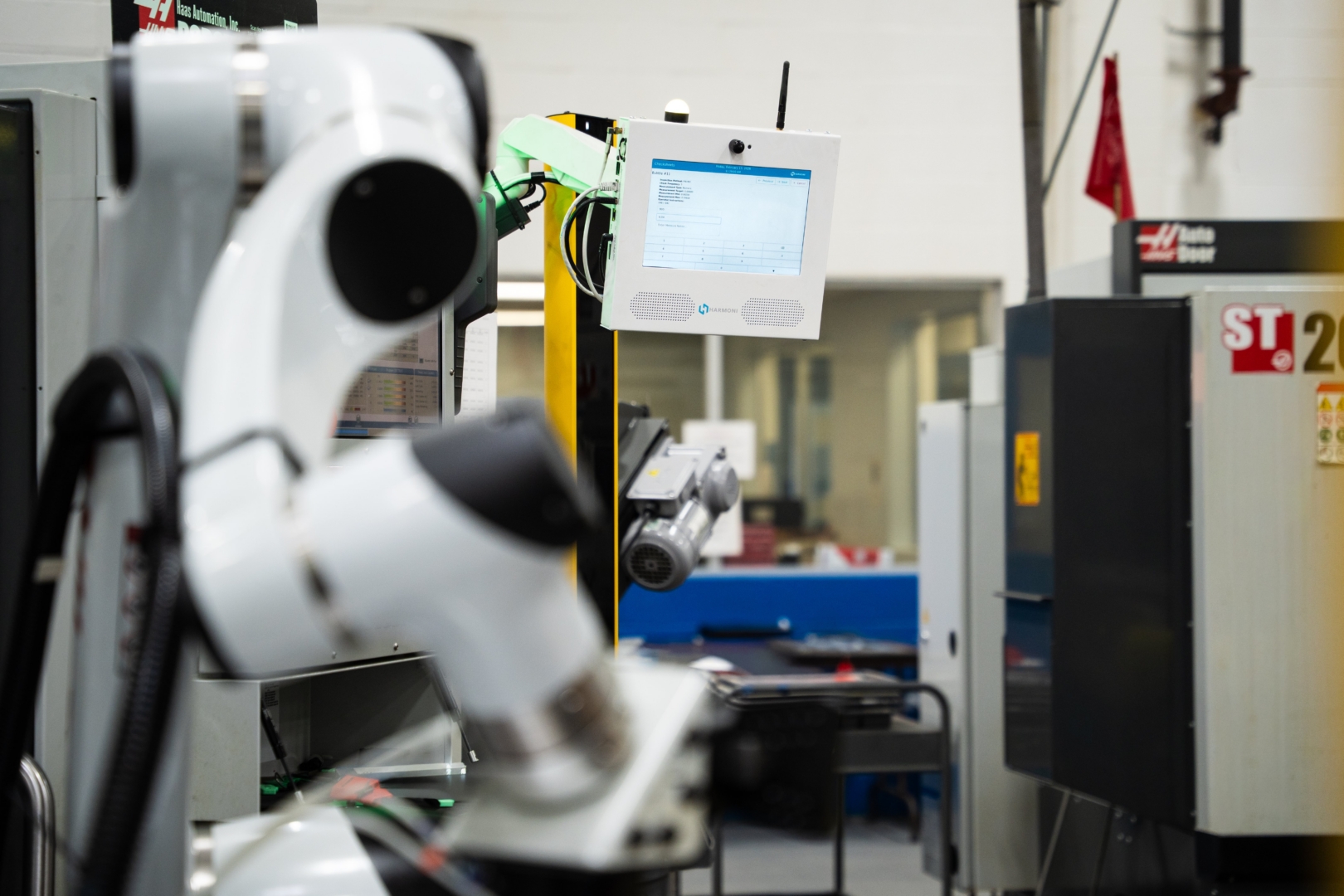
Harmoni brings Automation, Process Control, and Observability together at the workcenter.
Automation reduces repetitive transactions such as clocking in, identifying jobs, recording labor, and entering production information.
Process Control delivers the correct programs, drawings, work instructions, and quality requirements directly to the operator based on the active job and machine.
Observability gives supervisors and managers a real-time view of what is happening, including where jobs are located, which machines are running, where production is falling behind, and where assistance is needed.
Instead of asking operators to bridge the gaps between disconnected systems, Harmoni coordinates the information and activities surrounding the work.
The result is not simply faster data entry. It is more time spent producing.
A manufacturer does not need to eliminate hours of waste from one process to create measurable value.
Recovering 15 minutes per operator per shift can be meaningful. Recovering 15 minutes several times throughout the day can change the economics of an entire operation.
Those minutes can become:
The first step is recognizing that small delays are not small when they happen everywhere.
Factories rarely lose capacity in one dramatic event. More often, it disappears a few minutes at a time.
Factory Orchestration helps manufacturers get those minutes back.