October 20, 2026
How to Track Labor Against Jobs Without Making Operators Hate the System
Read More
Machines generate it. ERPs store it. Operators enter it. Quality systems capture it. Sensors collect it. Dashboards display it.
And yet, walk onto almost any production floor and ask a simple question:
What’s happening right now?
The answer is often surprisingly difficult to get.
A supervisor may need to check a machine-monitoring system, pull up an ERP report, ask an operator, call maintenance, or walk to the production floor to piece together what is actually happening.
The information exists. The problem is that information alone doesn’t run a factory.
What matters is what happens next.
Manufacturing software has historically been built around systems of record:
✔️ERP systems record business transactions.
✔️MES platforms record manufacturing execution.
✔️Machine monitoring systems record equipment activity.
✔️Quality systems record inspection results.
Each serves an important purpose.
But the modern factory needs more than a collection of systems that record what happened.
It needs systems that help coordinate what happens next.
That is where factory orchestration becomes important.
Factory orchestration connects the people, machines, processes, and business systems involved in production so that information can move with the work itself.
Instead of treating every data source as a separate destination, orchestration creates a connected operational layer where information has context.
The result isn’t simply more data.
It’s a factory that can respond faster.
The best manufacturing technology doesn’t necessarily give people more to do.
It removes things they shouldn’t have to do in the first place.
Operators shouldn’t have to spend valuable production time entering the same information into multiple systems.
Supervisors shouldn’t have to hunt through disconnected screens to understand why a job is behind.
Engineers shouldn’t have to wonder whether the operator is working from the latest approved information.
Quality teams shouldn’t have to wait for a report to discover that a process is drifting.
And leadership shouldn’t have to rely on yesterday’s data to make today’s decisions.
The opportunity isn’t simply to digitize those activities.
It’s to orchestrate them.
There is a fundamental difference between a factory that reports problems and one that responds to them.
A report might tell you that a machine was down for three hours yesterday.
A connected operational system can help you understand the event while it is happening.
A report might tell you that a job missed its target.
A connected system can surface that risk while there is still time to intervene.
A quality report might show that a batch failed inspection.
A connected workflow can put the right information in front of the right person before the problem spreads.
That shift—from retrospective reporting to continuous response—is one of the most important changes happening in manufacturing technology today.
And it doesn’t require replacing everything already on the floor.
It requires connecting what you already have and making the information work harder.
The factory of the future won’t necessarily be the one with the most sensors, the most machines, or the most software.
It will be the one that can turn information into action with the least friction.
That means knowing what is happening.
Understanding why it matters.
Determining what should happen next.
And getting that information to the person who can do something about it.
That’s the promise of a truly connected factory.
And that’s where manufacturing software is headed next: from systems that tell you what happened to systems that help you determine what happens next.
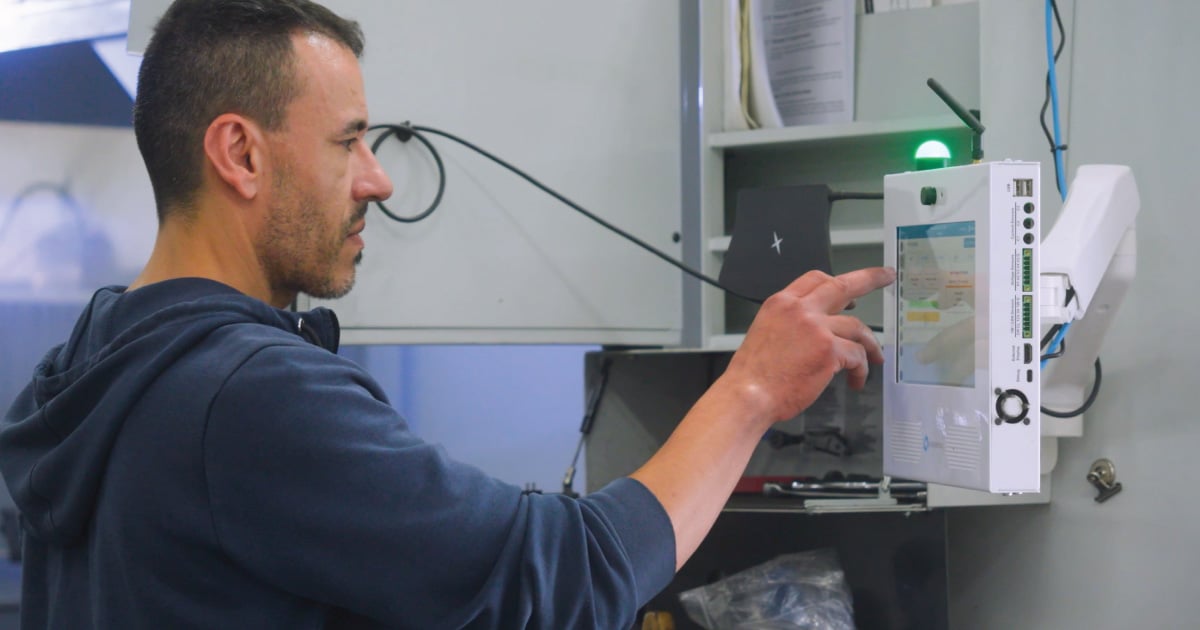
Harmoni’s Factory Orchestration platform connects machines, people, processes, and business systems into a real-time operational layer for the factory—giving manufacturers the context they need to run production with greater clarity, control, and accountability.
The data is already there. It’s time to make it work.
Manufacturing technology has spent decades getting better at collecting information.
We can measure machine utilization down to the second. We can capture labor transactions automatically. We can track job progress, quality results, downtime, materials, and production output.
But collecting more data doesn’t automatically make a factory more responsive.
In many operations, the process still looks something like this:
Data is generated → data is collected → data is reported → someone reviews it → someone decides what to do → someone communicates the decision → someone takes action.
Every step introduces time.
And on a production floor, time matters.
A machine that has been down for five minutes is a different problem than one that has been down for two hours. A quality trend caught on the first affected part is a different problem than the same trend discovered after an entire batch has been completed.
The value of manufacturing data isn’t simply knowing what happened.
It’s using the right information at the right moment to influence what happens next.
The biggest challenge isn’t necessarily that manufacturers lack information.
It’s that the information is often missing context.
A machine may tell you that it is running.
An ERP may tell you which job is scheduled.
A work instruction may tell you how the job should be performed.
A quality system may tell you whether a measurement passed inspection.
But none of those pieces, by themselves, necessarily tells you the complete story.
What job is running on that machine?
Which revision is approved?
Who is operating it?
How long should the cycle take?
Is the machine actually producing at the expected rate?
Has this machine experienced the same issue before?
Is the job already behind schedule?
Is there a quality trend developing?
Context turns data into something useful.
Without it, people are left to connect the dots themselves.
And connecting the dots manually is where much of the hidden inefficiency in manufacturing lives.
When manufacturers try to solve this problem, the instinct is often to add another dashboard.
More visibility sounds like the answer.
But a dashboard can only tell you what the underlying data tells it.
And even a great dashboard still puts the burden on someone to:
That’s a lot of work.
The goal shouldn’t be to give manufacturing leaders more screens to monitor.
The goal should be to reduce the amount of work required to understand and respond to the factory.
That requires a fundamentally different approach to operational software.
Imagine a production environment where information doesn’t simply sit in a database waiting to be queried.
Instead, the system understands the context of what’s happening.
A machine slows down.
The system knows which job is running, the expected cycle time, the current production status, and the impact that delay could have on the schedule.
A process changes.
The system knows which work instruction applies, which revision is approved, and which operator or work center is involved.
A quality measurement begins trending in the wrong direction.
The system has enough context to identify the affected process and surface the issue before it becomes a larger production problem.
A supervisor wants to know which jobs are at risk.
They don’t need to pull five reports together.
The answer is already connected to the operational context.
This is the difference between data visibility and operational intelligence.
There are approximately 297,000 manufacturers in the US with fewer than 500 employees. Most of them don’t operate automated, lights-out factories. They rely on skilled workers, complex workflows, and institutional knowledge that lives in people’s heads rather than systems.
That last point is particularly risky. When a machinist retires and takes the only working version of a critical program on their personal thumb drive, the manufacturer doesn’t just lose an employee, they potentially lose the ability to make a part entirely.
Factory orchestration is designed to capture and systematize that tribal knowledge before it walks out the door. Combined with real-time labor automation and process control, it gives smaller manufacturers the operational infrastructure to compete with larger, more automated competitors.
Manufacturing software has historically been built around systems of record:
✔️ERP systems record business transactions.
✔️MES platforms record manufacturing execution.
✔️Machine monitoring systems record equipment activity.
✔️Quality systems record inspection results.
Each serves an important purpose.
But the modern factory needs more than a collection of systems that record what happened.
It needs systems that help coordinate what happens next.
That is where factory orchestration becomes important.
Factory orchestration connects the people, machines, processes, and business systems involved in production so that information can move with the work itself.
Instead of treating every data source as a separate destination, orchestration creates a connected operational layer where information has context.
The result isn’t simply more data.
It’s a factory that can respond faster.
The best manufacturing technology doesn’t necessarily give people more to do.
It removes things they shouldn’t have to do in the first place.
Operators shouldn’t have to spend valuable production time entering the same information into multiple systems.
Supervisors shouldn’t have to hunt through disconnected screens to understand why a job is behind.
Engineers shouldn’t have to wonder whether the operator is working from the latest approved information.
Quality teams shouldn’t have to wait for a report to discover that a process is drifting.
And leadership shouldn’t have to rely on yesterday’s data to make today’s decisions.
The opportunity isn’t simply to digitize those activities.
It’s to orchestrate them.
There is a fundamental difference between a factory that reports problems and one that responds to them.
A report might tell you that a machine was down for three hours yesterday.
A connected operational system can help you understand the event while it is happening.
A report might tell you that a job missed its target.
A connected system can surface that risk while there is still time to intervene.
A quality report might show that a batch failed inspection.
A connected workflow can put the right information in front of the right person before the problem spreads.
That shift—from retrospective reporting to continuous response—is one of the most important changes happening in manufacturing technology today.
And it doesn’t require replacing everything already on the floor.
It requires connecting what you already have and making the information work harder.
The factory of the future won’t necessarily be the one with the most sensors, the most machines, or the most software.
It will be the one that can turn information into action with the least friction.
That means knowing what is happening.
Understanding why it matters.
Determining what should happen next.
And getting that information to the person who can do something about it.
That’s the promise of a truly connected factory.
And that’s where manufacturing software is headed next: from systems that tell you what happened to systems that help you determine what happens next.
Harmoni’s Factory Orchestration platform connects machines, people, processes, and business systems into a real-time operational layer for the factory—giving manufacturers the context they need to run production with greater clarity, control, and accountability.
The data is already there. It’s time to make it work.