October 14, 2026
How to Prevent the Wrong CNC Program from Reaching a Machine
Read More
Artificial intelligence is rapidly entering manufacturing. Software providers are adding AI assistants, analytics tools, predictive models, and natural language interfaces to their platforms.
But access to AI alone does not make a factory more intelligent. That’s where contextual AI in manufacturing comes into play.
For AI to provide useful answers on the factory floor, it needs more than a collection of reports, documents, and historical data. It needs to understand the operational context behind what is happening.
That means knowing:
Without that context, AI can help someone find information. With it, AI can help someone understand a situation and determine what to do next.
Most manufacturers already have plenty of data.
Production orders live in the ERP. Machine activity is collected through monitoring systems. Work instructions and drawings are stored in document repositories. Quality information lives in another system. Operators and supervisors hold years of knowledge that may not be documented anywhere.
The problem is that these sources rarely provide a complete picture on their own.
A machine-monitoring system may show that a machine is idle, but it may not explain why. The operator could be waiting for material, looking for the correct program, resolving a quality issue, waiting for maintenance, or preparing for the next job.
An ERP may show that a production order is behind schedule, but it may not know what is happening at the machine right now.
A document repository may contain the correct work instructions, but it may not know which revision applies to the job currently running.
AI connected to only one of these sources inherits the limitations of that source. It can retrieve the available information, but it cannot necessarily understand how that information relates to the work being performed.
Operational context connects those pieces.
Consider a supervisor who asks an AI assistant:
Why is this job falling behind?
A generic AI tool cannot answer that question without additional information. Someone would first need to identify the job, gather its production history, check the machine status, review labor activity, compare actual cycle time with the standard, and investigate recent production events.
Context-aware manufacturing AI begins with that information already connected.
It knows which job is being discussed. It understands where the job is located, which machine is running it, who is working on it, what the expected production rate is, and what has happened during the current and previous runs.
Instead of returning a production number without explanation, it can help identify the conditions contributing to the delay.
The same principle applies to questions such as:
The value does not come from the ability to ask a question in natural language. It comes from the operational context behind the answer.
Manufacturers have spent years adding software to solve individual problems. One system tracks machines. Another manages production orders. Another stores engineering documents. Additional tools may support maintenance, quality, scheduling, labor, or reporting.
Adding a separate AI application on top of that fragmented environment does not automatically solve the fragmentation.
If the AI only has access to isolated data, teams may still need to gather information from multiple systems, reconcile conflicting records, and explain the production situation before the AI can provide a useful response.
Manufacturing AI should not become one more disconnected application.
It should operate within a system that already connects people, machines, processes, engineering requirements, and enterprise software. That foundation gives AI the context it needs to understand how work is actually being executed.
Factory Orchestration brings Automation, Process Control, and Observability together in one operating model.
Automation reduces the repetitive administrative work that consumes operators’ time, including labor tracking, production transactions, job identification, and information retrieval.
Process Control ensures the right programs, instructions, drawings, and quality requirements reach the right person at the right machine.
Observability creates a real-time view of production by connecting machine activity, operator input, ERP information, workflow events, and job location.
Together, these capabilities create a live operational model of the factory.
That model is what makes contextual AI possible.
Rather than analyzing disconnected records after production is complete, AI can understand the relationships among the active job, machine, operator, process, requirements, and current production conditions.
HAL, the Harmoni AI Lieutenant, is built on Harmoni’s Factory Orchestration system.
Because Harmoni connects activity across the factory, HAL can understand the operational context behind a question. It does not require the user to assemble that context manually every time.
This makes AI useful to more than analysts and executives.
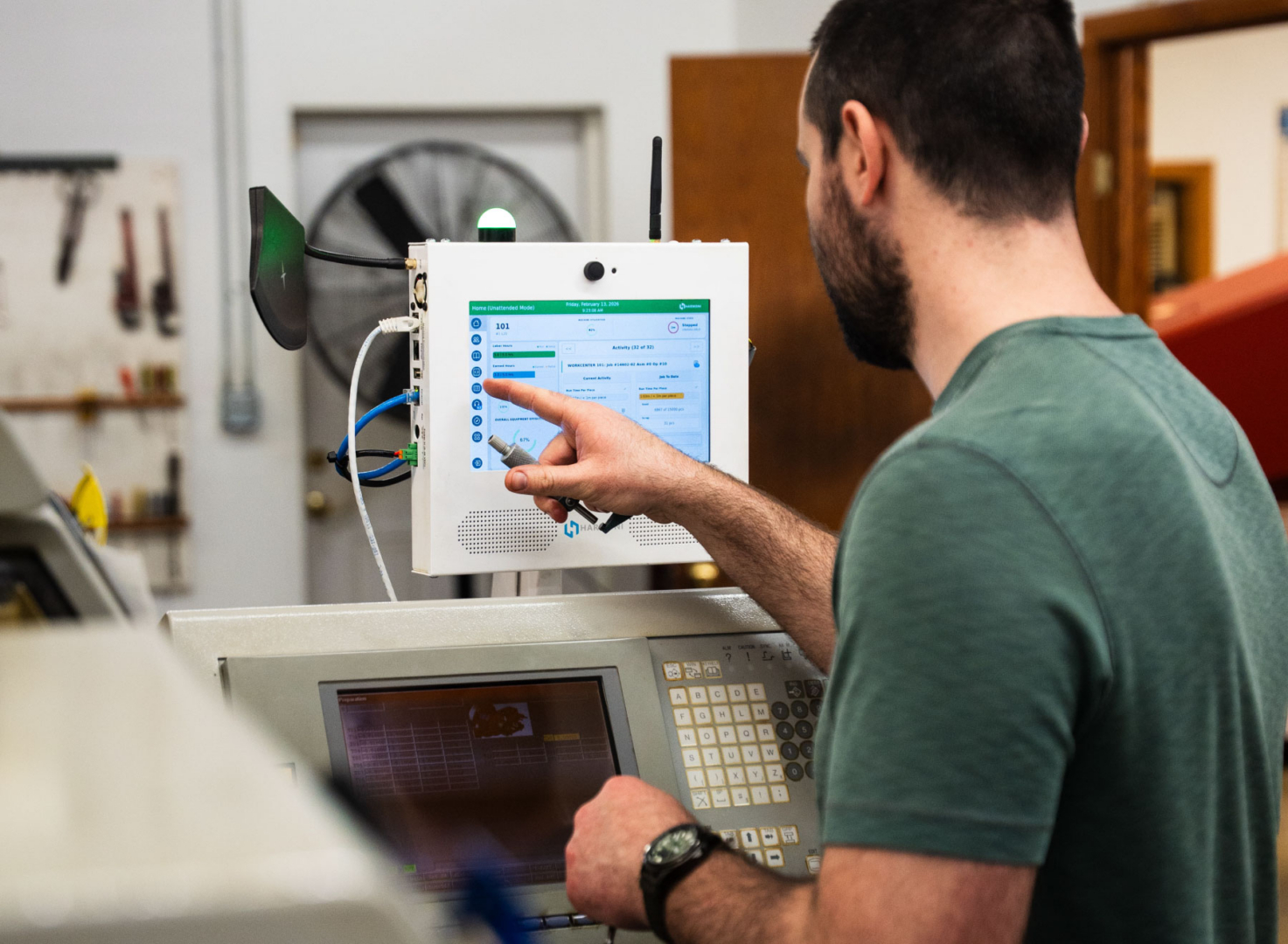
An operator can access relevant information at the point of production. A supervisor can investigate a delay while there is still time to respond. A plant manager can understand where attention is needed across the floor. Leadership can receive answers based on what is happening now, not only what appeared in yesterday’s report.
HAL helps bring intelligence from the executive office to the front lines of production, where decisions are made and work happens.
AI has enormous potential in manufacturing, but its value depends on the environment beneath it.
Manufacturers do not need another tool that simply searches disconnected information or summarizes static reports. They need AI that understands how their factories operate.
That requires context.
When AI knows the job, part, machine, operator, requirements, production history, and current status, it can do more than find data. It can help teams understand problems, identify risks, make decisions, and determine what should happen next.
That is the difference between adding AI to a factory and building a truly intelligent manufacturing operation.
Learn more about HAL, the Harmoni AI Lieutenant.
What is contextual AI in manufacturing?
Contextual AI in manufacturing combines AI with information about active jobs, parts, machines, operators, processes, engineering requirements, and current production conditions.
Why does manufacturing AI need operational context?
Without operational context, AI may retrieve isolated information but cannot reliably explain how that information relates to the work currently being performed.
How does Factory Orchestration support AI?
Factory Orchestration connects automation, process control, and real-time operational visibility, giving AI a live model of how work is being executed across the factory.