Executive Summary
Midway Swiss struggled with manual, paper-based quality checks, lost machine programs, and an over-reliance on tribal knowledge that threatened efficiency. By implementing Harmoni, they digitized their quality assurance processes and centralized critical machine data right at the machine control. This transformation eliminated lost work, empowered operators to problem-solve, and dramatically improved the shop’s operational efficiency.
Introduction
Midway Swiss is a precision machining company that originated as a tool and die shop over 45 years ago. Today, under the leadership of CEO Jayme Rahz and General Manager Tyler Beal, the company runs top-of-the-line equipment, including Citizen Swiss screw machines and five-axis milling machines with robotic integration. Their commitment to high-level automation earned them the prestigious Modern Machine Shop’s Top Shops Award. By employing highly skilled labor and leveraging advanced technology, Midway Swiss consistently pushes the boundaries of manufacturing efficiency.
The Problem
Before Harmoni, Midway Swiss relied on an antiquated machine monitoring system that offered very little actionable insight. It measured spindle uptime, but failed to capture the nuances of the shop floor. “It’s good to have the data, but I need to do something with it,” Jayme explains.
Quality assurance was entirely manual. For years, Jayme would walk the shop floor to collect dirty, oily check sheets. The data from these sheets was simply filed away with job packets, completely inaccessible for real-time decision-making. Nobody could use the information to predict when tools were going to fail or when machine maintenance was required.
Furthermore, the shop relied heavily on “tribal knowledge.” Tyler notes that while experienced machinists are incredibly valuable, tribal knowledge is a double-edged sword. “The second those people start either leaving or retiring, it can kind of go to hell in a handbasket really fast,” he says. Operators kept mental notes, and machine programs were scattered across SD cards and computer drives. In one instance, the team spent two hours just trying to locate the correct program iteration for a highly complicated job, creating unnecessary stress and halting production.
The Solution
Jayme had been searching for a system to digitize QA and make shop floor data usable in real-time. “For years I have been asking for it and everybody’s like, it doesn’t exist,” Jayme recalls. “It was almost like I was crazy for thinking that we needed something like that.”
As soon as she learned about Harmoni, she was hooked. “Once we knew about Harmoni, I really didn’t look at anything else because I already knew that what Harmoni did didn’t exist.”
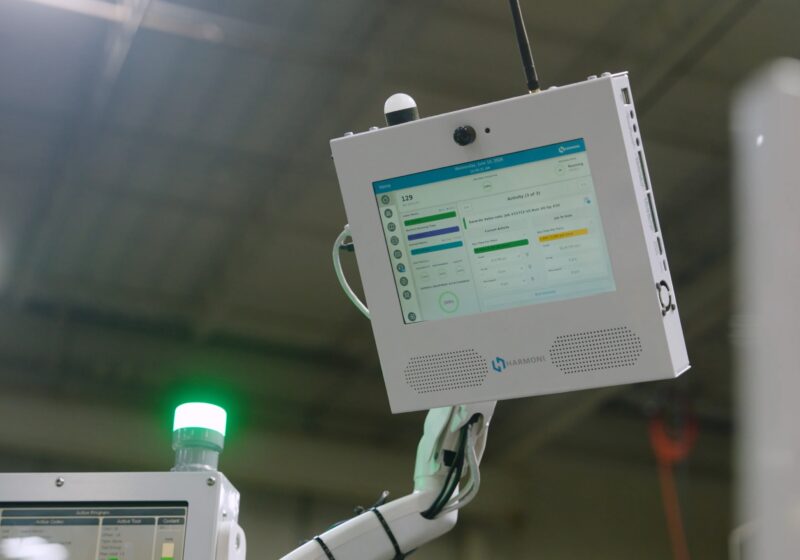
Harmoni provided a centralized, digital dashboard that married quality routing, machine monitoring, and program management into one accessible database. Operators could pull up work instructions and input notes directly at the device mounted on their machines, eliminating the need for handwritten job travelers. Whenever operators encountered specific nuances with a job, they could log the details directly into Harmoni, ensuring that the knowledge was preserved for the next time the job ran.
The Results
The implementation of Harmoni brought immediate, tangible benefits to the Midway Swiss shop floor. Despite initial hesitation from old-school machinists wary of “big brother,” the operators quickly realized the system made their jobs significantly easier. Now, operators are actively requesting Harmoni devices for new machines.
Key outcomes of the implementation include:
- Elimination of Lost Programs: Once a program is proven, it is saved directly into the Harmoni database. “The next time we go set it up, there’s no second guessing,” says Tyler. This saves hours of wasted time and ensures the machines are continuously making money.
- Digitized Quality Assurance: Operators no longer waste time walking to the quality room with paper sheets. Because the data is presented to them clearly, they can track tool wear in real-time and predict necessary offsets before problems occur.
- Improved Management Efficiency: Jayme no longer has to constantly walk the floor to uncover issues or track down the status of customer jobs. “I’ve recouped so much of my day back because I’m not tracking down stuff,” she notes. “I get less phone calls, I get less interruptions. I’m literally here less and I’m with my kids more.”
- Enhanced Employee Satisfaction: By automating tedious data-entry tasks, Midway Swiss’s highly skilled machinists are freed up to focus on problem-solving and improving their craft. “Our ROI is never a number,” Jayme explains. “It’s a feeling in the shop. It’s how we live our lives. It’s the quality of our lives and our employees.”
Conclusion
By embracing Harmoni, Midway Swiss successfully transitioned from a shop reliant on tribal knowledge and manual QA to a highly automated, data-driven operation. As they plan to expand their workforce and add more machines in the coming months, management is confident that the software will scale right alongside them. For Midway Swiss, Harmoni isn’t just a monitoring tool; it’s factory orchestration is a foundational platform that protects their institutional knowledge and drives sustainable growth.